
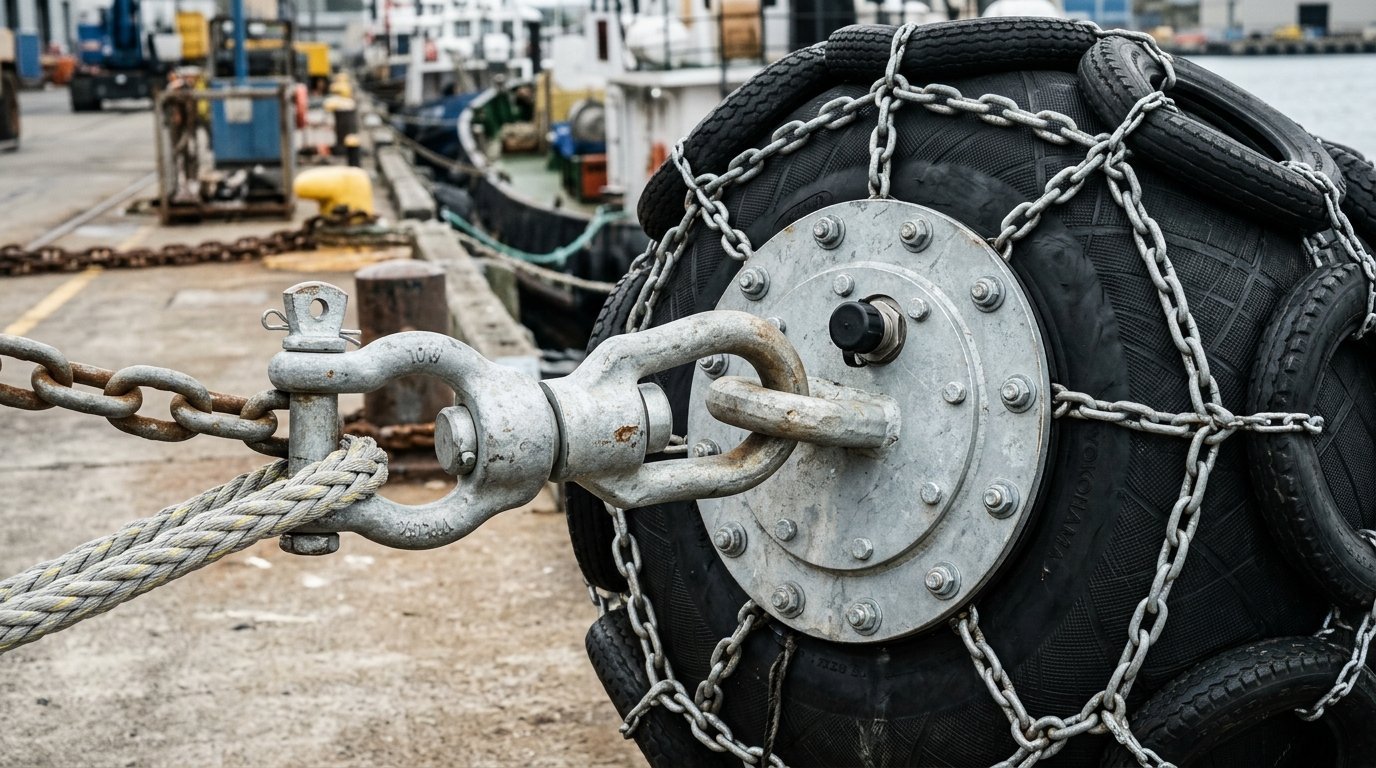
Fender Suspension Hardware
Marine Rigging Gear Supplier for Pneumatic Fender Systems
Swivel joints, shackles, guy chains, and HMPE ropes matched to your fender specifications. Complete suspension packages with mill certificates and working load limit documentation.
JettyGuard supplies marine rigging hardware for pneumatic fender suspension: swivel joints to prevent chain twist, bow and D-shackles for connection, guy chains or HMPE ropes for suspension, master links, lifting slings, and securing hardware. Complete packages include mill certificates and working load limit documentation.
Definition
What Is Marine Rigging Gear for Fender Systems?
The suspension and securing hardware that connects pneumatic fenders to vessels or terminal structures — distinct from the fender body itself.
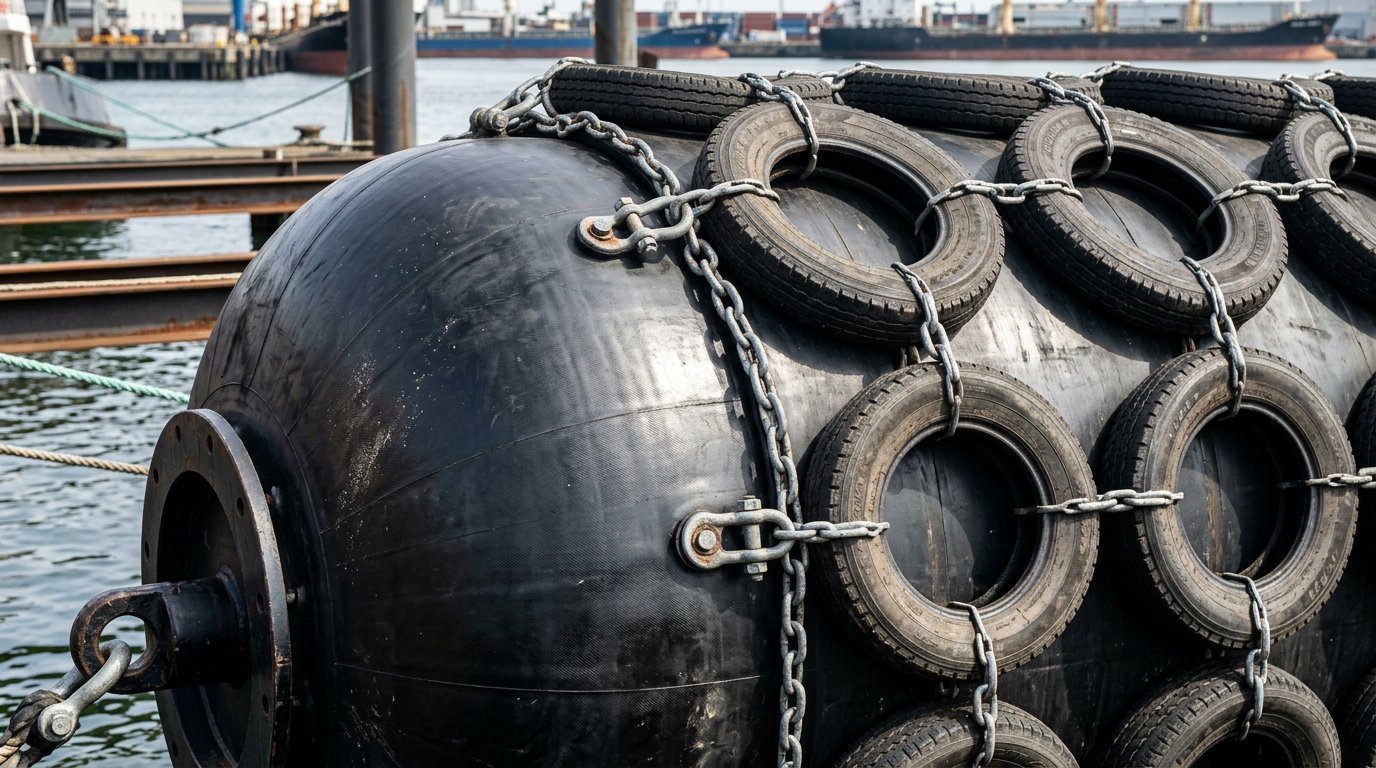
Marine rigging gear is the external suspension and securing hardware that connects pneumatic fenders to vessels or terminal structures. The fender body itself includes the inner rubber tube, reinforcing layers, tire net or chain-and-tire net, end flanges, and safety valve. Rigging gear is the separate hardware package — swivels, shackles, guy chains, guy ropes, master links, and slings — used to hang the fender and secure it in position.
The distinction matters: Tire nets and chain nets are part of the fender body assembly and ship with the fender. Rigging gear refers to external suspension hardware used to hang the fender from the vessel deck or jetty structure. The rigging allows controlled movement during berthing while preventing twist and ensuring safe load distribution.
Package Contents
Complete Rigging Package — What's Included
A full rigging package for pneumatic fenders includes 8 to 10 component types, sized to match fender specifications and deployment conditions.
1 · Swivel Joints
Swivel Joints
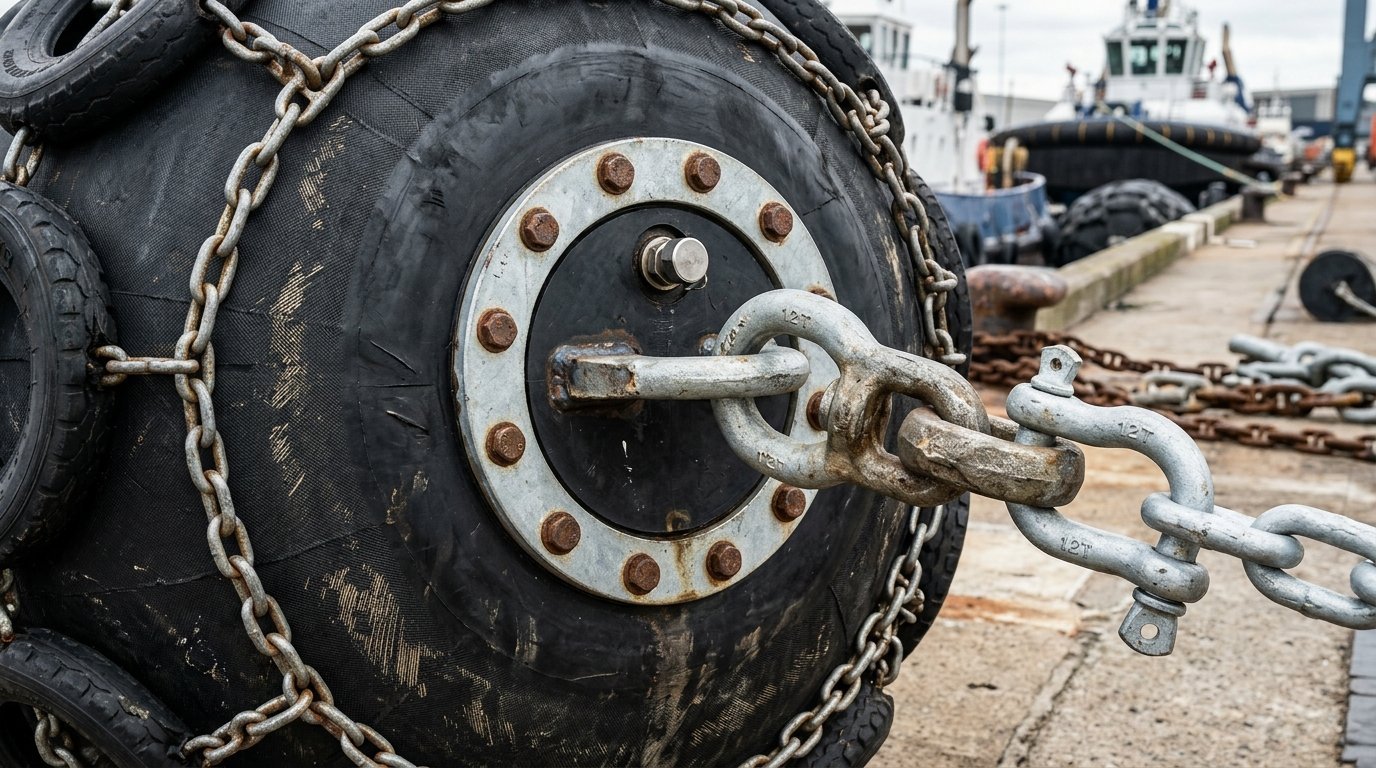
Swivel joints prevent guy chain or guy rope twist during vessel surge, sway, and yaw movements. Typical sizes range from Ø25mm for small fenders to Ø70mm for large FSRU fenders. Material is alloy steel, hot-dip galvanized for corrosion resistance.
Critical for installations where the fender experiences rotational loads — especially FSRU and STS applications.
2 · Shackles
Bow & D-Shackles
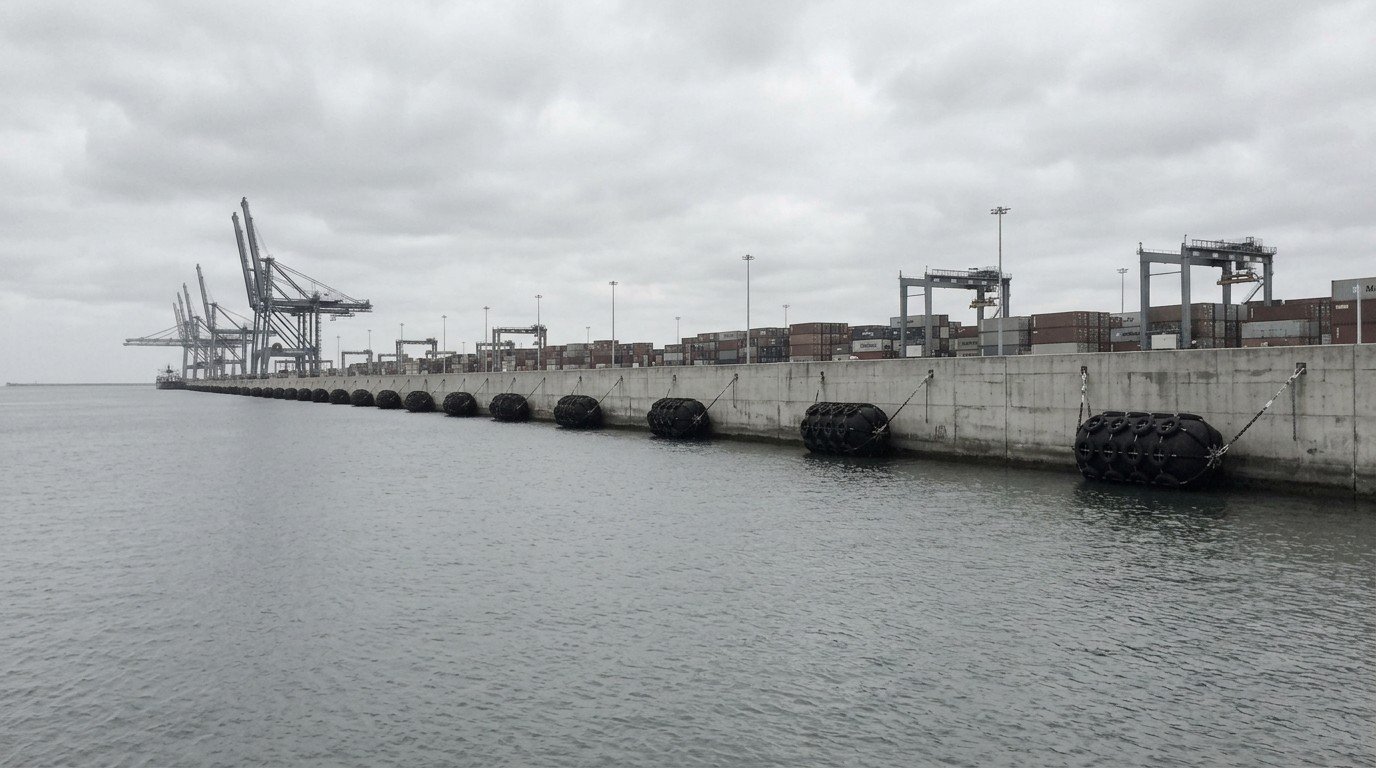
Bow shackles (preferred for multi-directional loads) and D-shackles (for in-line loads where space is limited). Grades G2130, G2150, or equivalent high-strength alloy steel. Sizes 7/8" to 2-3/4" depending on fender size and working load limit.
First shackle connects to the fender end ring (supplied with fender). Second and third shackles connect the swivel to the guy chain or guy rope. Bow shackles are the preferred choice for dynamic applications like FSRU berthing and STS transfer.
3 & 4 · Suspension Members
Guy Chains & Guy Ropes
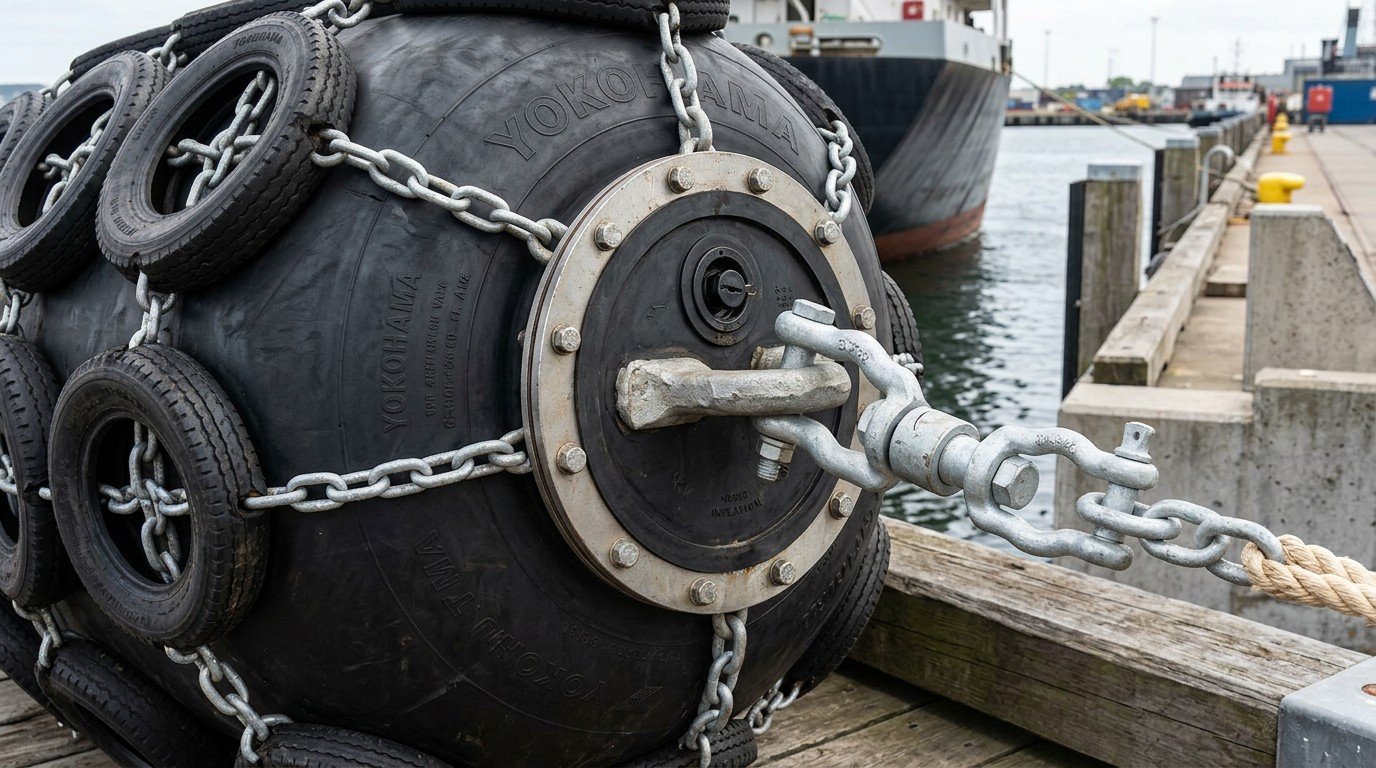
Guy chains: Grade 3 (G30), Grade 4 (G43), or studlink chain, 16mm to 60mm diameter. Preferred for jetty and quay installations where abrasion resistance against concrete or steel is needed (ISO 1704 where chain compliance is specified).
Guy ropes: HMPE, polyester, or wire rope, 20mm to 104mm for large FSRU fenders. HMPE is lightweight, corrosion-free, and easier to handle — preferred for FSRU, STS, and floating terminal applications.
Master Links
Heavy-duty connecting rings serving as primary load-bearing connection points. Sizes match shackle and chain grades. Each link is supplied with individual proof load certificates.
Lifting Slings
Wire rope or synthetic slings for fender lifting, positioning, and deployment. Capacity based on fender weight — from 2,000 kg for small fenders to 15,000 kg or more for large FSRU fenders.
Eye Plates / Pad Eyes
Mounting hardware welded or bolted to ship deck or jetty structure. Load rating must exceed maximum fender reaction force. Structural adequacy is determined by the customer's naval architect or structural engineer.
Safety Accessories
Cotter pins and split pins for shackle securing, mousing wire for additional security, and anti-twist devices (used when swivels are not included).
9 · Documentation Package
Every Component Is Certified
Each rigging component is supplied with mill test certificates (material composition, heat treatment records), working load limit (WLL) certificates, proof load test reports where applicable, and material traceability (heat numbers for steel components).
Third-party inspection is available through Bureau Veritas, DNV, Lloyd's Register, and ABS.
Reference Specifications
Rigging Hardware Specifications for Pneumatic Fenders
Reference specifications by fender size, based on established pneumatic fender rigging practice. Actual rigging is supplied to project specification and confirmed at RFQ.
| Fender Size (D×L mm) | First Shackle | Swivel Dia. | 2nd/3rd Shackle | Guy Chain Grade & Dia. | Guy Rope Dia. (HMPE) | Approx. WLL |
|---|---|---|---|---|---|---|
| 1500×3000 | SB 24 (15/16") | 25mm (1") | SB 24 (15/16") | G3, Ø20mm | 20mm | Per supplier cert |
| 2500×4000 | SB 32 (1-1/4") | 32mm (1-1/4") | SB 32 (1-1/4") | G3, Ø26mm | 30mm | Per supplier cert |
| 2500×5500 | SB 34 (1-5/16") | 38mm (1-1/2") | SB 34 (1-5/16") | G3, Ø32mm | 34mm | Per supplier cert |
| 3300×4500 | SB 36 (1-7/16") | 38mm (1-1/2") | SB 36 (1-7/16") | G3, Ø30mm | 34mm | Per supplier cert |
| 3300×6500 | SB 44 (1-3/4") | 44mm (1-3/4") | SB 44 (1-3/4") | G3, Ø38mm | 42-104mm | Per supplier cert |
| 4500×9000 | Special ring Ø70mm | 70mm (2-3/4") | Special ring | G3, Ø48mm | 54mm | Per supplier cert |
Reference specifications based on industry-established practice. Actual rigging supplied to project specification and confirmed at RFQ stage.
Working load limits (WLL) provided per supplier certificates.
Energos configuration note: The 3300×6500 row shows a range for guy rope diameter (42-104mm). The Energos FSRU project specified 104mm HMPE rope, representing a heavier-duty configuration than standard recommendations. This reflects real-world variance — some projects specify higher safety factors or account for extreme environmental conditions.
JettyGuard supplies rigging hardware to customer-approved specifications; we are not the design authority for suspension systems.
Typical Fender Suspension Assembly
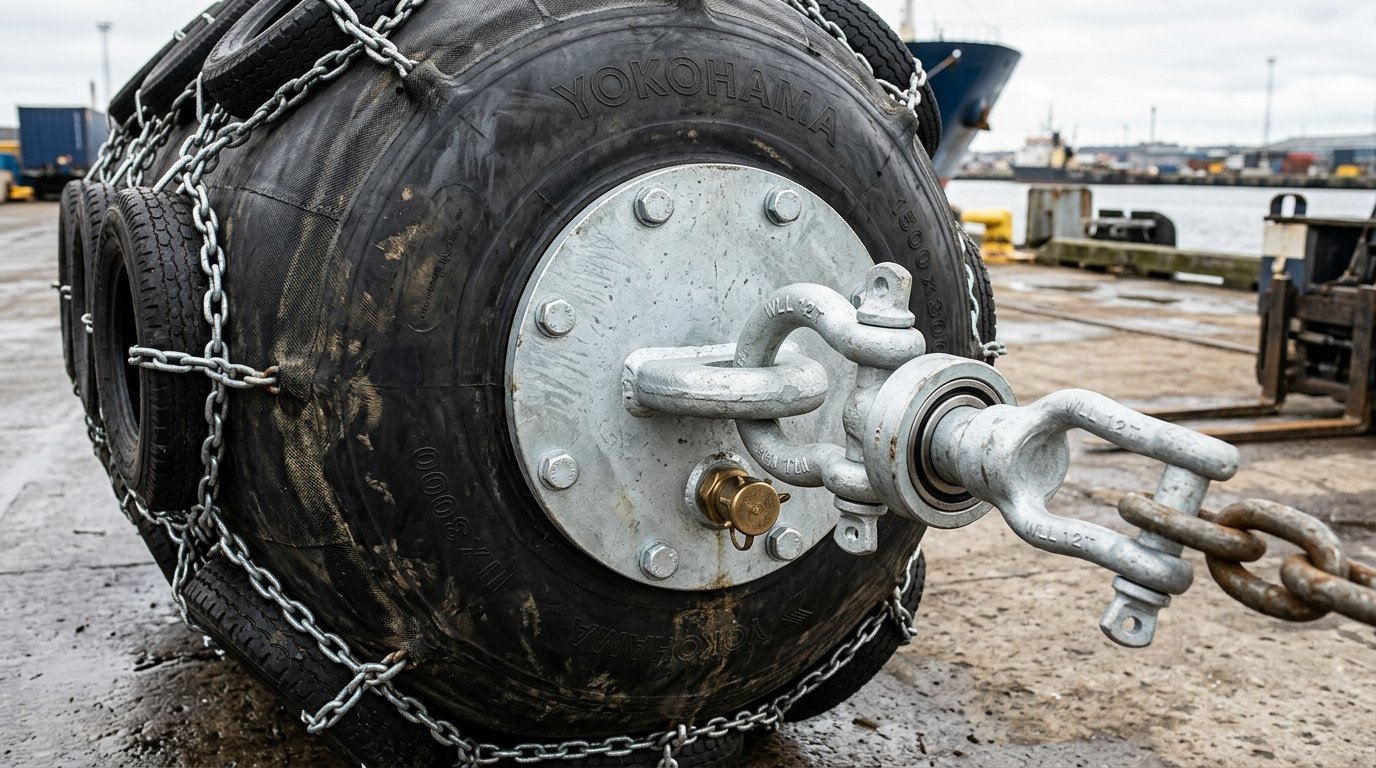
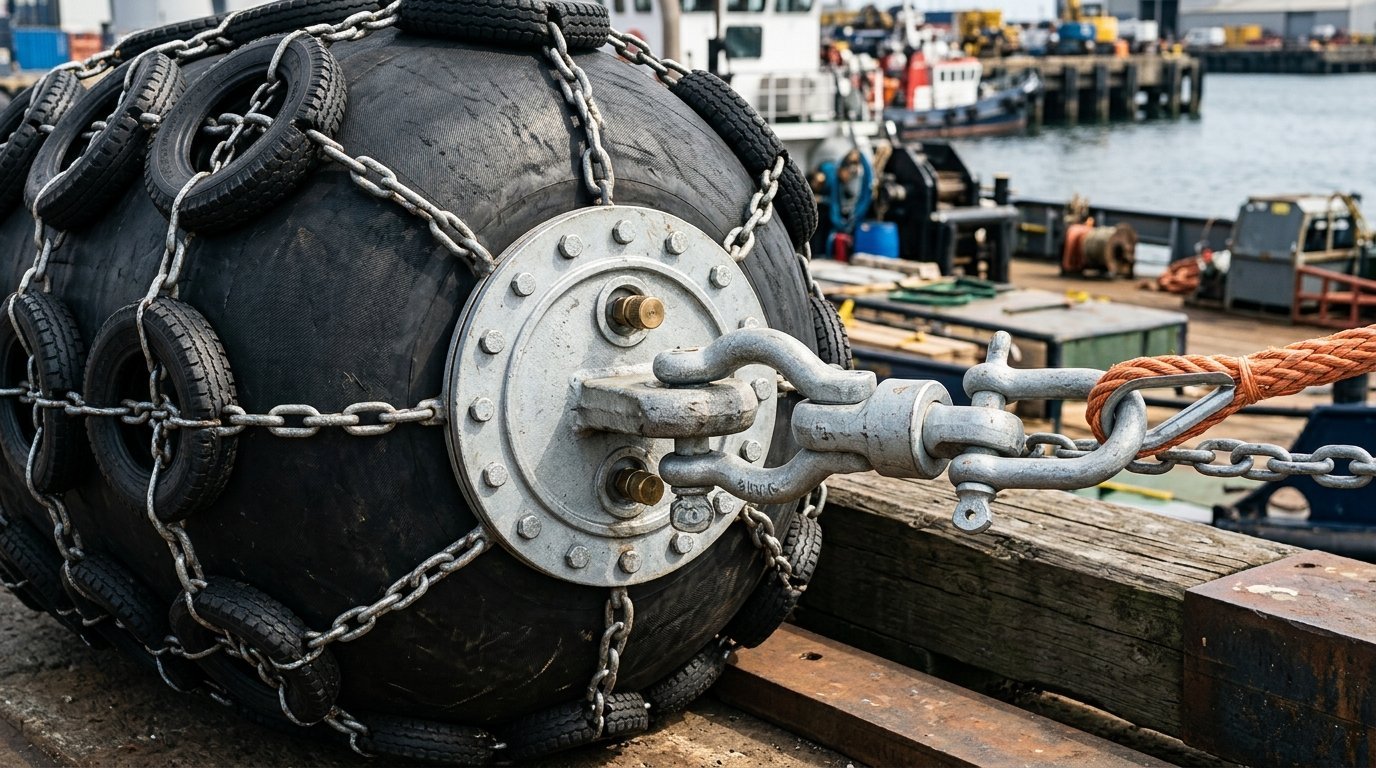
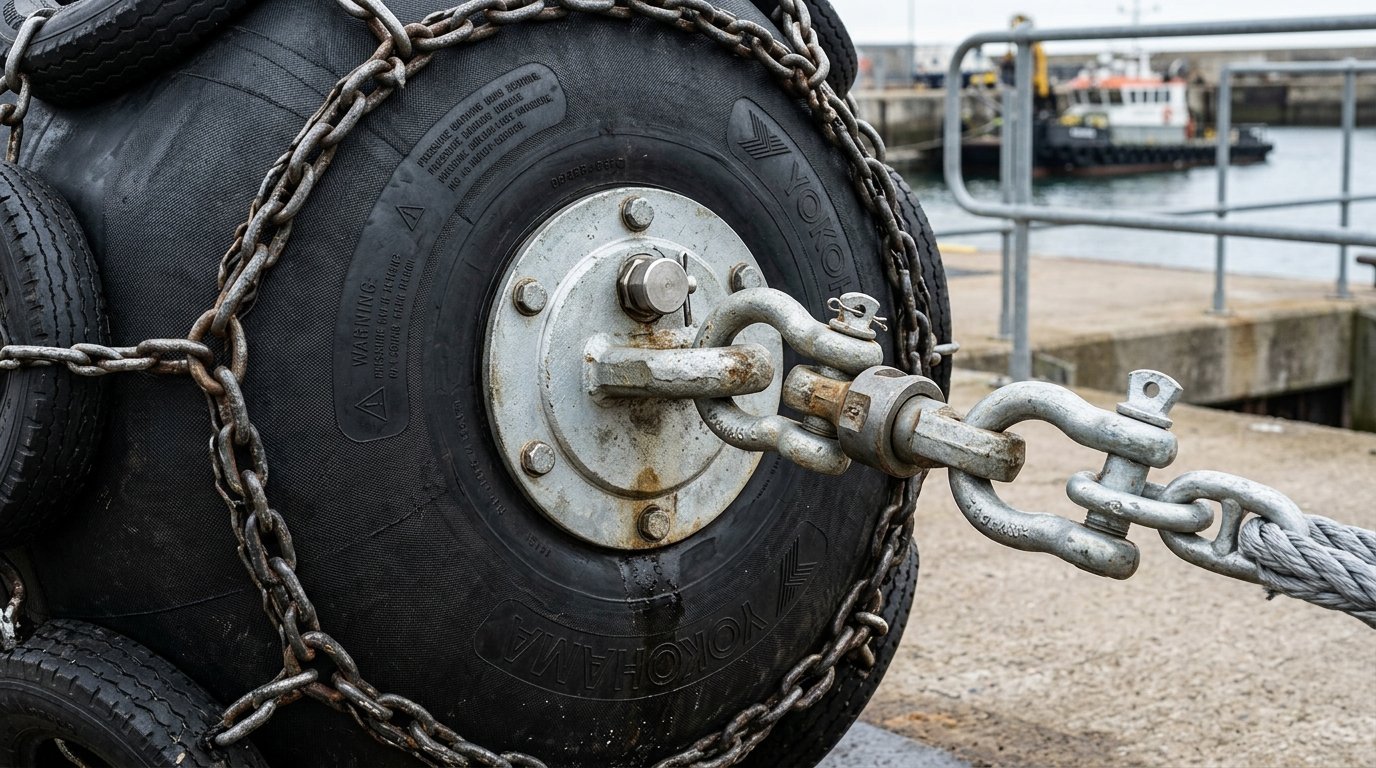
A standard suspension point connects the fender end ring to the vessel or terminal structure through a load path: fender end ring → first shackle → swivel → second shackle → guy rope (or chain) → deck pad eye.
The swivel placement prevents guy rope or chain twist during vessel movement. Bow shackles accommodate multi-directional loads better than D-shackles, making them preferred for dynamic FSRU and STS applications.
Component sizing increases with fender size and application loads. The reference table above provides typical configurations; final sizing is confirmed by your engineering team based on actual berthing loads and vessel displacement.
Deployment Scenarios
Rigging Applications by Fender Deployment
Rigging configuration varies by application. The table below shows typical setups for common deployment scenarios.
| Application | Typical Suspension Method | Guy Chain vs Guy Rope | Shackle Preference | Configuration Notes | Relevant Standards |
|---|---|---|---|---|---|
| FSRU Berthing | Suspended from FSRU deck | Guy rope (HMPE preferred — lighter, corrosion-free) | Bow shackle | V-configuration, 2 lines per fender converging to single deck pad eye | OCIMF MEG4 (rigging guidance) |
| STS Transfer | Hung from tanker deck | Guy rope (HMPE or polyester) | Bow shackle | Fenders deployed vessel-side only; opposite vessel uses mooring lines | OCIMF MEG4, ISO 17357 |
| Fixed Jetty / Quay | Suspended from jetty structure | Guy chain (abrasion resistance against concrete/steel) | Bow or D-shackle | Fixed suspension points; swivels critical to prevent chain fatigue | EN 1677, ISO 1704 |
| Floating Terminal (SPM) | Suspended from terminal deck or buoy | Guy rope (reduced weight) | Bow shackle | Dynamic positioning requires low-mass rigging | DNV 2.7-3 (offshore equipment) |
| Shipyard / Drydock | Temporary suspension or handling slings | Wire rope slings for handling; guy rope for short-term deployment | Bow shackle | Frequent repositioning — quick-release rigging preferred | Local shipyard standards |
Why Configuration Matters
Match the Rigging to the Load Environment
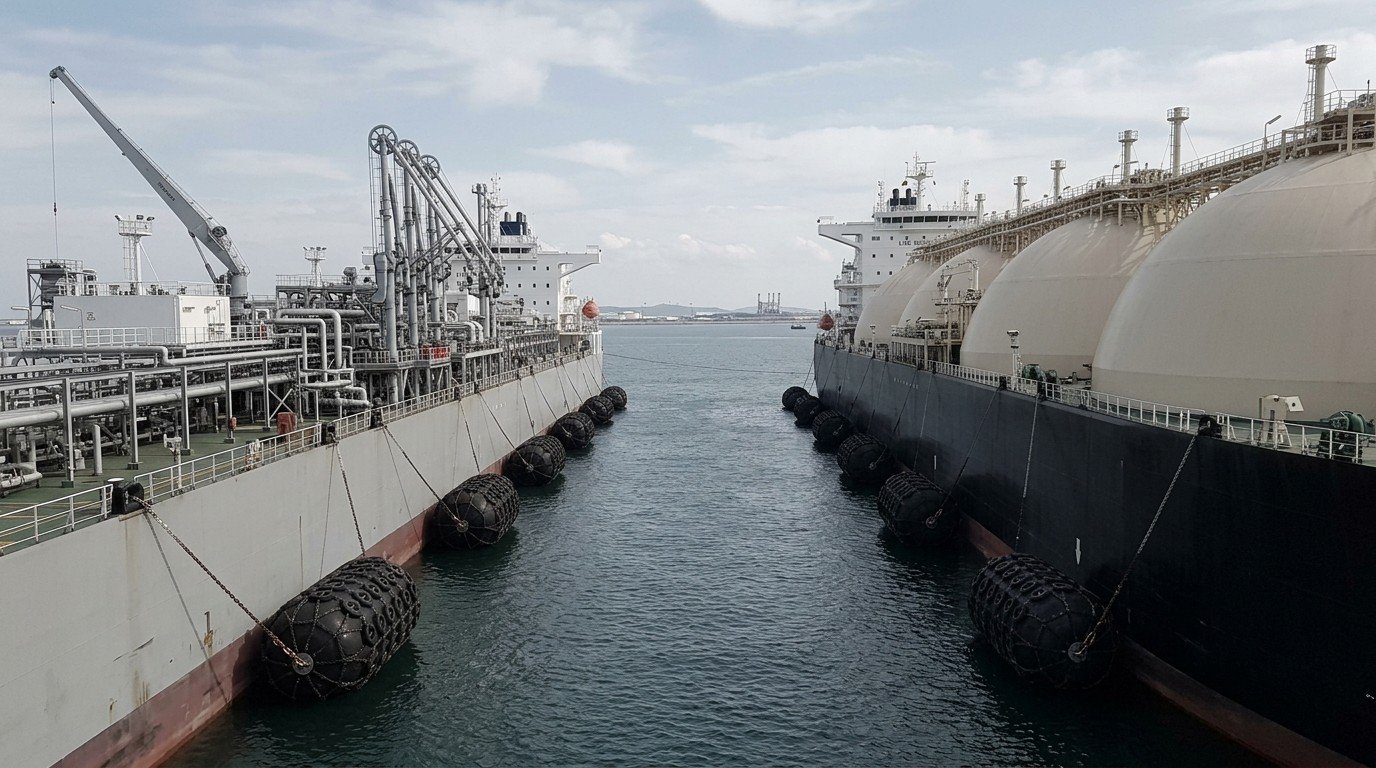
FSRU and floating applications benefit from HMPE rope due to lower weight and corrosion resistance. Fixed jetty installations favor guy chains because they resist abrasion from contact with concrete or steel structures. Bow shackles are preferred for dynamic loads; D-shackles work for in-line loads where space is constrained.
For fender count and positioning guidance, see our SIGTTO-based fender quantity guide →
Compliance
Standards and Certifications
Rigging hardware for marine fender systems is typically specified to conform with the following standards.
Steel Chains
Covers steel chains for lifting applications. Applicable where project specifications require chain grade verification.
Sling Components
Covers components for slings, including shackles, master links, and connecting hardware. Applicable for lifting and suspension components.
Offshore Equipment
Covers offshore containers and portable equipment. Applicable for rigging hardware used in offshore installations under DNV classification.
Mooring Guidelines
Mooring Equipment Guidelines. References minimum grades and practices for rigging hardware used in STS and FSRU berthing operations.
JettyGuard supplies components certified by third-party inspection bodies including Bureau Veritas, DNV, Lloyd's Register, and ABS. Standard documentation includes mill certificates, material traceability (heat numbers), and working load limit (WLL) certificates.
Note: Specific standard applicability depends on project requirements. JettyGuard supplies rigging hardware to project-specified standards and provides documentation as required by the customer or certifying body.
Rigging Package Quote
Send your fender size and deployment scenario
We'll recommend component sizes and supply options matched to your project — with full material traceability and certification.
Buyer Guidance
How to Specify Fender Rigging in an RFQ
When requesting a quotation for fender rigging hardware, provide the following to ensure accurate sizing and compliance.
Buyer Checklist
Six Inputs for an Accurate Quote
- Fender size and quantity (e.g., 4× fenders, 3300×6500mm)
- Deployment scenario (FSRU berthing, STS transfer, fixed jetty, floating terminal)
- Suspension method preference (guy chain or guy rope; if rope, specify material)
- Environmental conditions (corrosion exposure, temperature extremes, abrasion concerns)
- Certification requirements (third-party inspection, material certs, WLL certs, standards)
- Documentation needs (arrangement drawings, load calculations, installation manuals)
What JettyGuard Provides
- Component sizing matched to fender specifications
- Material certificates and traceability (heat numbers)
- Load capacity documentation (WLL per component)
- General arrangement drawings showing rigging configuration
- Proof load test reports (where applicable)
- Third-party inspection coordination (BV, DNV, Lloyd's Register, ABS)
What JettyGuard Does NOT Provide
- Structural design of attachment points (pad eyes, deck reinforcement, backing plates)
- Load path analysis for vessel or terminal structure
- Final approval of suspension geometry (customer's naval architect or structural engineer)
- Certification of the overall suspension system design (design authority remains with customer)
JettyGuard supplies rigging hardware to specification. We are not the design authority for suspension systems. Final rigging design, structural adequacy of attachment points, and approval of load paths remain the responsibility of the customer's engineering team or appointed consultants.
For complete fender system packages, see our pneumatic fenders for FSRU and LNG terminals →
Supply Options
JettyGuard Supply Options
Rigging hardware is supplied in three configurations depending on project scope and existing infrastructure.
| Supply Option | Scope | Typical Lead Time | Documentation | Best For |
|---|---|---|---|---|
| Rigging Hardware Only | Shackles, swivels, guy chains/ropes, master links, slings as per specification | 30-45 days | Mill certs, WLL certs, material traceability | Customer already has fenders; replacing worn or damaged rigging components |
| Complete Fender Package | Pneumatic fenders + integrated tire net + all rigging hardware | 60-90 days (mold-process fenders) | Fender test reports, BV/DNV inspection, ISO 17357 compliance, plus all rigging certs | New installations, full system replacement, single-source procurement |
| Fender + Partial Rigging | Fenders with first shackles (standard); customer specifies additional rigging components | 60-90 days | Customized per scope | Projects with existing rigging infrastructure; selective component replacement |
Single-source advantage: Sourcing fenders and rigging from a single supplier reduces procurement complexity, ensures pre-matched component sizing, and provides unified documentation packages. JettyGuard supplies complete packages with all certifications coordinated through one point of contact.
Project Example
Energos FSRU Rigging Supply
A typical rigging gear supply order for large pneumatic fenders, representing standard practice for FSRU berthing systems.
Project Overview
- Application: FSRU berthing system
- Fender specification: 4× pneumatic fenders, 3300×6500mm
- Fender body included: Inner rubber tube, reinforcing layers, tire net (part of fender body assembly)
Rigging Package (supplied separately)
- HMPE rope: 12-strand, 104mm diameter, 380m total length
- Bow shackles: G2130 grade, 1-3/4" size, hot-dip galvanized
- Swivels: Ø36mm, hot-dip galvanized
HMPE Rope (104mm)
Selected for lightweight characteristics versus equivalent steel chain. Corrosion-free and easier handling for deck crew. The 104mm diameter is a heavy-duty configuration reflecting higher safety factors or extreme conditions specified by the customer's engineering team.
Bow Shackle (G2130, 1-3/4")
Bow shackles handle multi-directional loads better than D-shackles — critical for FSRU applications where the fender experiences loads during surge, sway, and yaw. The 1-3/4" size matches the fender towing ring and swivel pin dimensions.
Swivel (Ø36mm)
Prevents guy rope twist during vessel movements. Critical for FSRU applications with dynamic positioning. Without swivels, guy ropes accumulate twist over time, leading to uneven load distribution and accelerated wear.
Supply Scope
- Complete rigging package supplied with fenders
- Mill certificates for all steel components (shackles, swivels)
- HMPE rope with manufacturer's certificate (MBL, material composition)
- Installation arrangement drawing provided
- All components shipped together, reducing coordination overhead
Outcome
Single-source supply reduced procurement complexity. All rigging components were sized and matched by JettyGuard, eliminating multi-supplier coordination. The customer's engineering team approved the rigging layout; JettyGuard supplied hardware to the approved specification.
Key takeaway: This configuration — HMPE rope, bow shackles, and swivels — is common practice for FSRU and STS applications. JettyGuard supplied hardware to customer-approved specifications; the customer's engineering team retained design authority for the overall suspension system.
For more on FSRU fender systems, see our pneumatic fenders for FSRU guide →
FAQ
Frequently Asked Questions
What rigging hardware is included with a pneumatic fender?
Should I use guy chains or guy ropes for FSRU fenders?
What certifications do you provide for rigging hardware?
Can JettyGuard design the suspension system for my fender installation?
What is the difference between a bow shackle and a D-shackle for fender rigging?
How do I specify rigging hardware in an RFQ?
Request a Quotation
Need Rigging Hardware for Your Fender System?
JettyGuard supplies marine rigging gear matched to pneumatic fender specifications — swivels, shackles, guy chains, HMPE ropes, or a complete fender package with all suspension hardware, with full material traceability and certification.
What to include in your request
Provide your fender size, deployment scenario, and certification requirements. We'll recommend component sizes and supply options based on your project specifications.
Complete the form below and we'll respond with component sizing and a package quotation.
Rigging Hardware
Matched to your fender specification
Send your fender size and deployment scenario for component sizing and a package quote.
Request a Quotation