
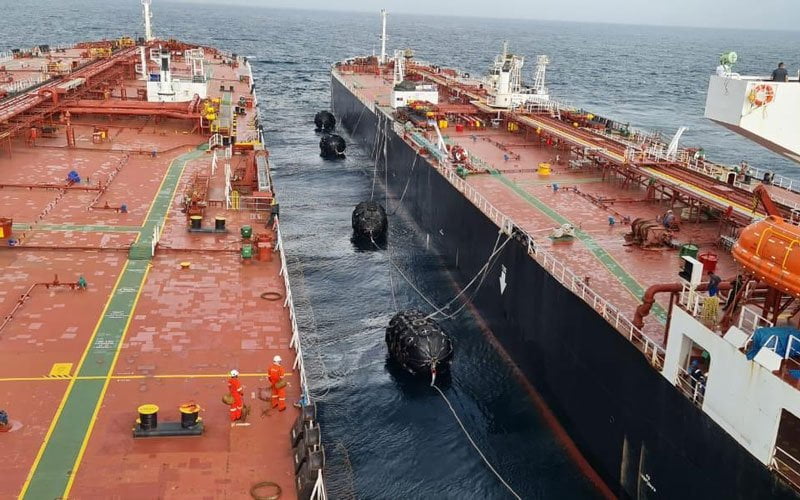
For FSRU berthing, the first question is not always fender size. It is usually the count: how many pneumatic fenders should be arranged along the berthing side before the size calculation starts?
Direct answer: SIGTTO fender requirements do not give one fixed number for every FSRU berth. In practice, use at least two pneumatic fenders per berthing side for stable two-point contact. Most FSRU and LNG carrier side-by-side berthing layouts use three or four fenders per side, with more units added for exposure, larger vessels, or maintenance redundancy.
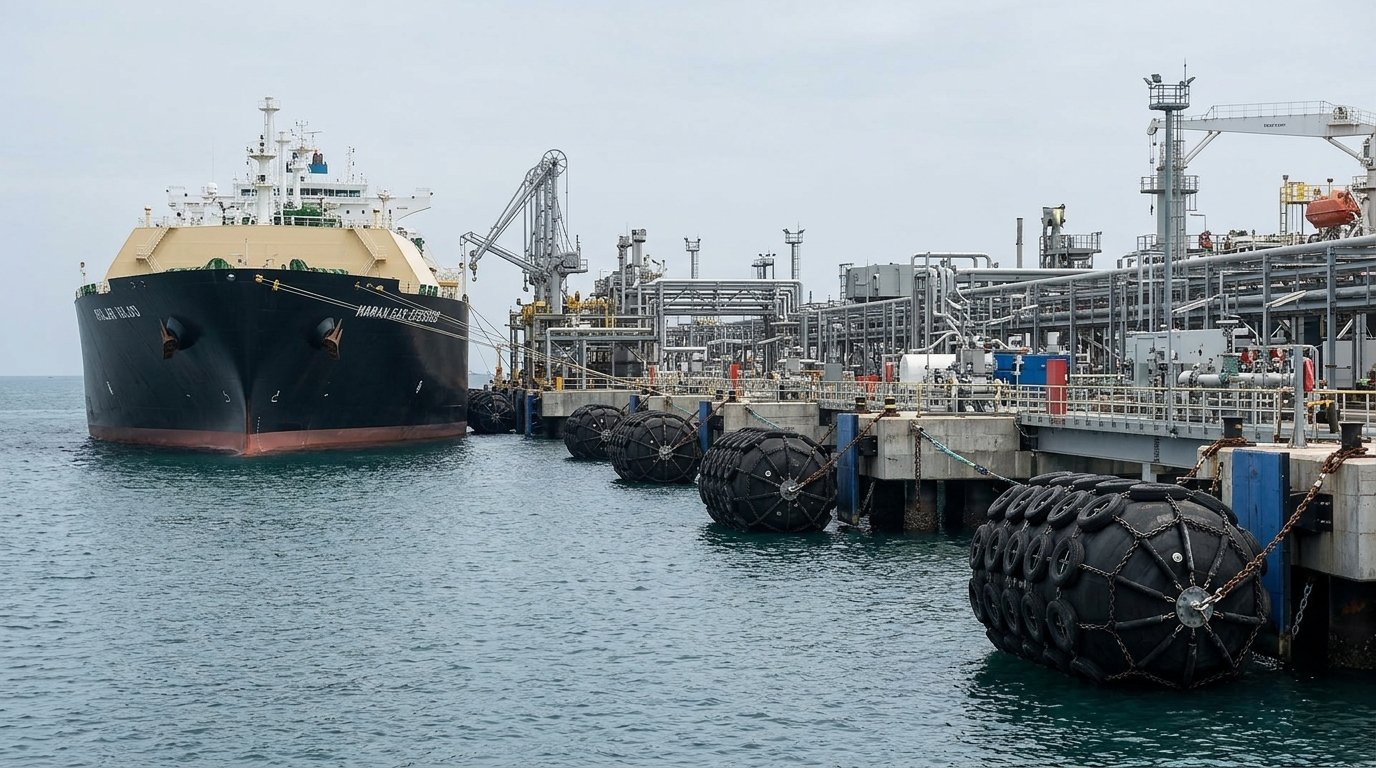
What SIGTTO Actually Means for FSRU Berthing Fenders
SIGTTO guidance for liquefied gas ship-to-ship operations is not a shopping list. It does not say every FSRU needs exactly three, four, or six pneumatic fenders. It gives the operating principles: safe separation, correct fender position, suitable energy absorption, and verified fender condition before the transfer.
The current reference is the Ship to Ship Transfer Guide for Petroleum, Chemicals and Liquefied Gases (2nd edition, 2025), published jointly by ICS, OCIMF, and SIGTTO. It sets how the operation is planned and controlled, not a fixed fender count per berth.
For FSRU berthing fenders, the key point is two-point contact. A single fender can absorb compression at one point, but it cannot control yaw. If the LNG carrier approaches with a small angle, one contact point becomes a hinge. The vessel can rotate around it.
That is why two fenders per side should be treated as the practical minimum. They create two separated contact points within the parallel body zone and help keep the LNG carrier aligned alongside the FSRU.
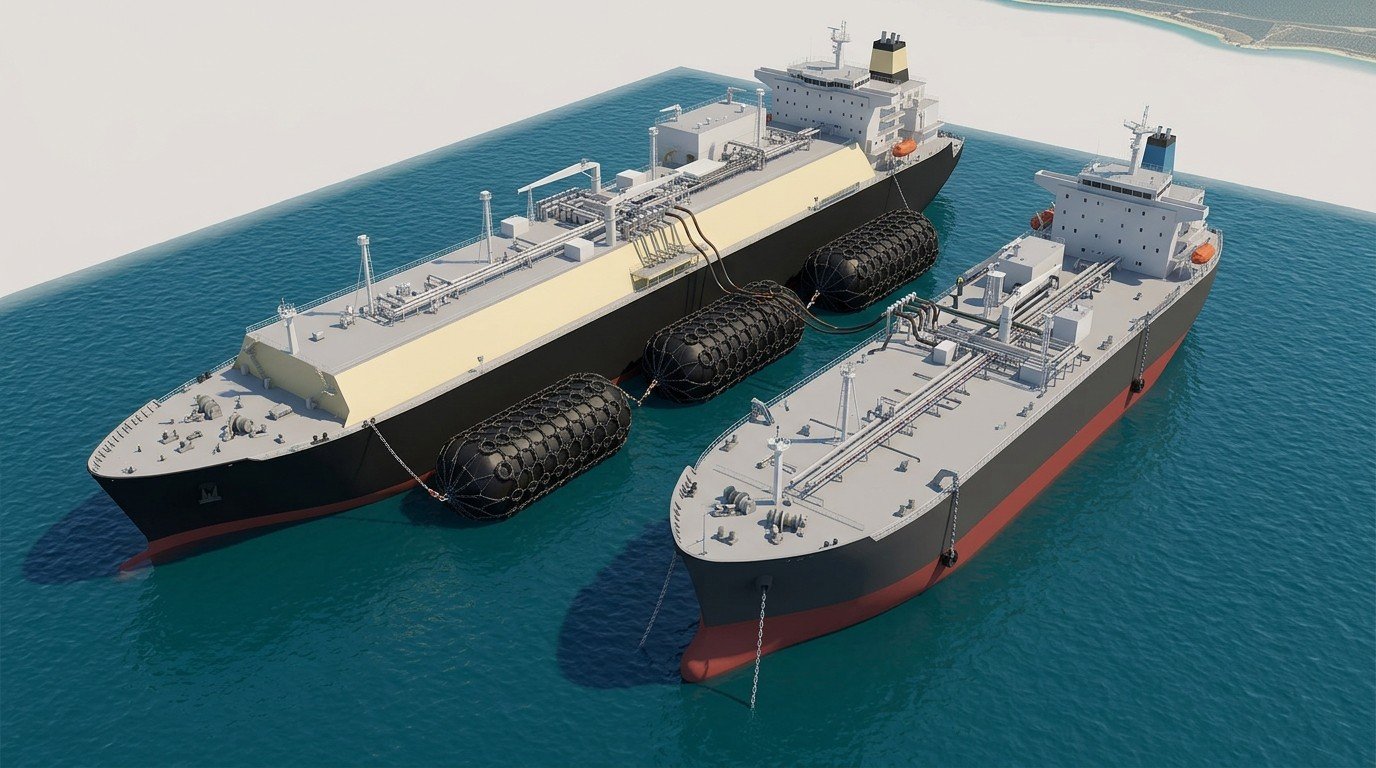
In real projects, I rarely treat two as a comfortable working number for a commercial FSRU berth. Two can be acceptable for a small LNG carrier in sheltered water with low operating frequency. For normal LNG import operation, three or four per side gives a better working margin.
For the product side, the usual starting point is ISO 17357 pneumatic fenders. You can review the standard product range here: pneumatic fender.
Typical Fender Count by FSRU and LNG Carrier Scenario
The count should be selected from the berthing case, not from vessel length only. The same 150,000 m³ LNG carrier can need a different fender arrangement at a protected jetty, a side-by-side FSRU, or an exposed offshore mooring.
| FSRU / LNG Carrier Scenario | Common Starting Count | Main Factors to Check | Practical Comment |
|---|---|---|---|
| Small LNG carrier alongside sheltered FSRU | 2–3 per side | Low displacement, calm water, low approach velocity, infrequent operation | Two is the minimum logic, but three gives better maintenance margin. |
| Standard 125,000–170,000 m³ LNG carrier, normal side-by-side FSRU | 3 per side | Parallel body length, manifold position, expected approach angle, tug control | This is a common starting point for many FSRU berthing layouts. |
| Large LNG carrier or Q-Flex at semi-exposed berth | 3–4 per side | Higher berthing energy, wider motion envelope, wind/current exposure | Often use larger fenders first, then add the fourth unit if spacing or redundancy requires it. |
| Q-Max or exposed offshore FSRU | 4 per side | High displacement, swell, beam wind, current, limited weather window | Four contact points spread load and reduce overloading of the forward fender. |
| High-frequency terminal or strict maintenance continuity | 6–8 per side | N+1 redundancy, inspection window, operation frequency, spare unit philosophy | Some operators use paired fenders at each position so one can be removed without stopping operation. |
I worked with a Southeast Asian terminal buyer who first asked for only two fenders per side because the vessel length looked manageable. After we checked the operation mode, the answer changed. The terminal expected frequent STS operations, limited downtime, and no easy window to remove a fender for inspection.
The final discussion moved from “minimum count” to “working count.” That is a better way to think about FSRU fender quantity.
Why Vessel Length Alone Is Not Enough
Vessel length is useful, but it is not the design basis by itself. Two vessels with similar LOA can have different displacement, hull form, ballast condition, and berthing energy. A length-only rule also ignores how the FSRU is moored and how the LNG carrier approaches.
The parallel body zone matters more than total length. Fenders should sit where the LNG carrier hull side is straight enough for stable contact. If a fender is placed too far forward or aft, the curved hull can create point loading and unstable compression.
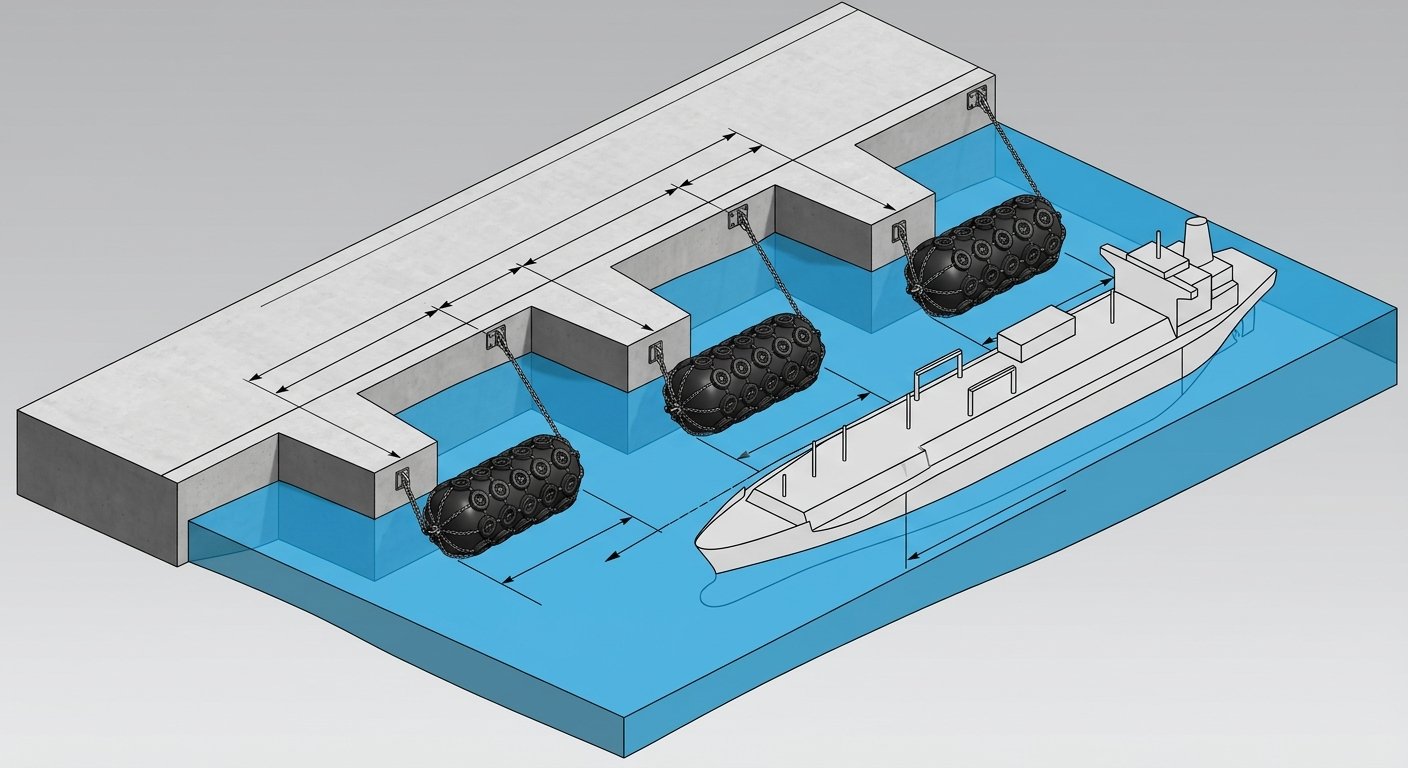
The berthing arrangement also changes the count. A carrier berthing alongside an FSRU in a ship-to-ship layout has different motion from a carrier landing against a fixed jetty face. Tug availability, mooring line sequence, and the angle of approach all affect which fender takes load first.
Environmental condition is another reason. Berthing energy increases with the square of velocity. If the approach velocity changes from 0.15 m/s to 0.20 m/s, the energy increase is not small. It is close to 78%. In that case, a fourth fender may be more useful than trying to stretch three fenders too far apart.
This is why a proper selection should check vessel size, displacement, berth geometry, weather exposure, approach speed, and operation frequency together. The FSRU fender system overview explains how these parts connect in a complete berth arrangement.
How to Place Three or Four Pneumatic Fenders
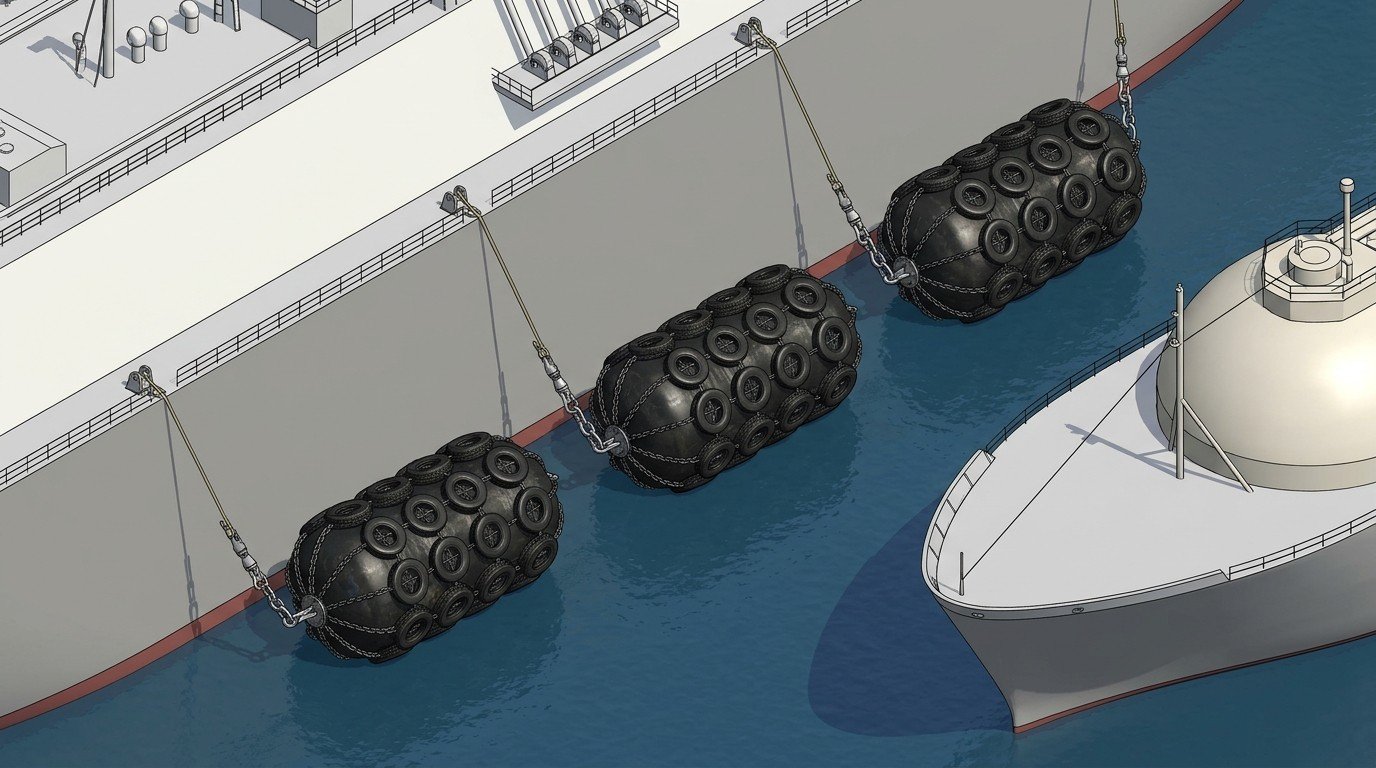
For a standard FSRU side-by-side arrangement, three pneumatic fenders per side is often the first layout to test. The forward, middle, and aft fenders should stay within the LNG carrier parallel body zone. They should not be pushed into the curved bow or stern area only to make the spacing look even.
A practical layout may use slightly tighter spacing forward. During approach, the forward fender often engages first and takes higher early compression. If all fenders are spaced only by equal distance, the layout can look neat on paper but perform poorly during the first contact.
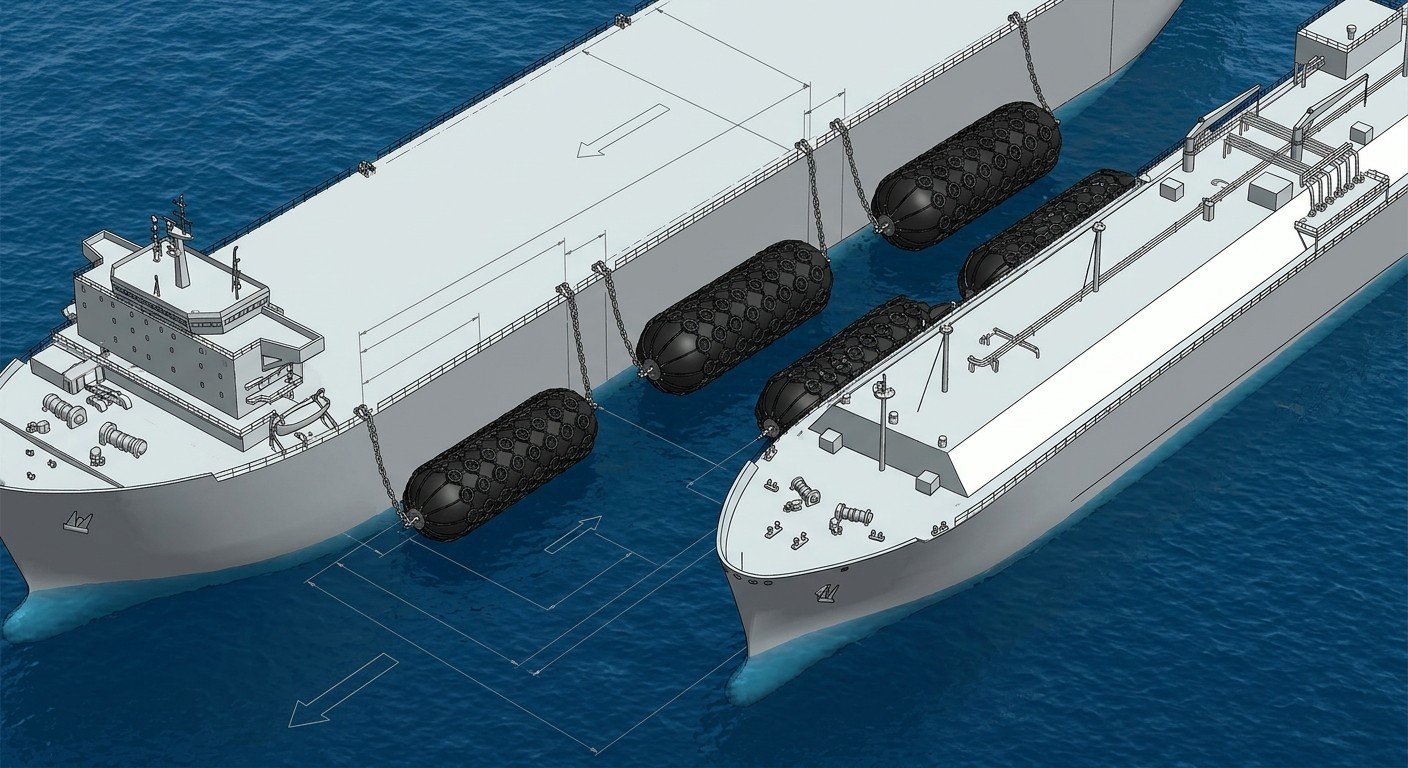
Four fenders per side are usually considered when the vessel class is larger, the berth is more exposed, or the operator wants more even load distribution. Four units also give more flexibility if the final manifold alignment or mooring pattern shifts the preferred contact zone.
For sizing, the count and size should be checked together. A layout with three 3,300 × 6,500 mm fenders may not be equivalent to four smaller units. Fender energy, reaction force, net type, initial pressure, and allowable hull pressure all need to be checked. Our LNG terminal pneumatic fender selection guide gives the next step after count selection.
When Six or Eight Fenders Make Sense
Some FSRU projects use paired fenders at each working position. That means six fenders per side for three positions, or eight per side for four positions. This is not because SIGTTO asks every berth to double the quantity. It is usually an operation decision.
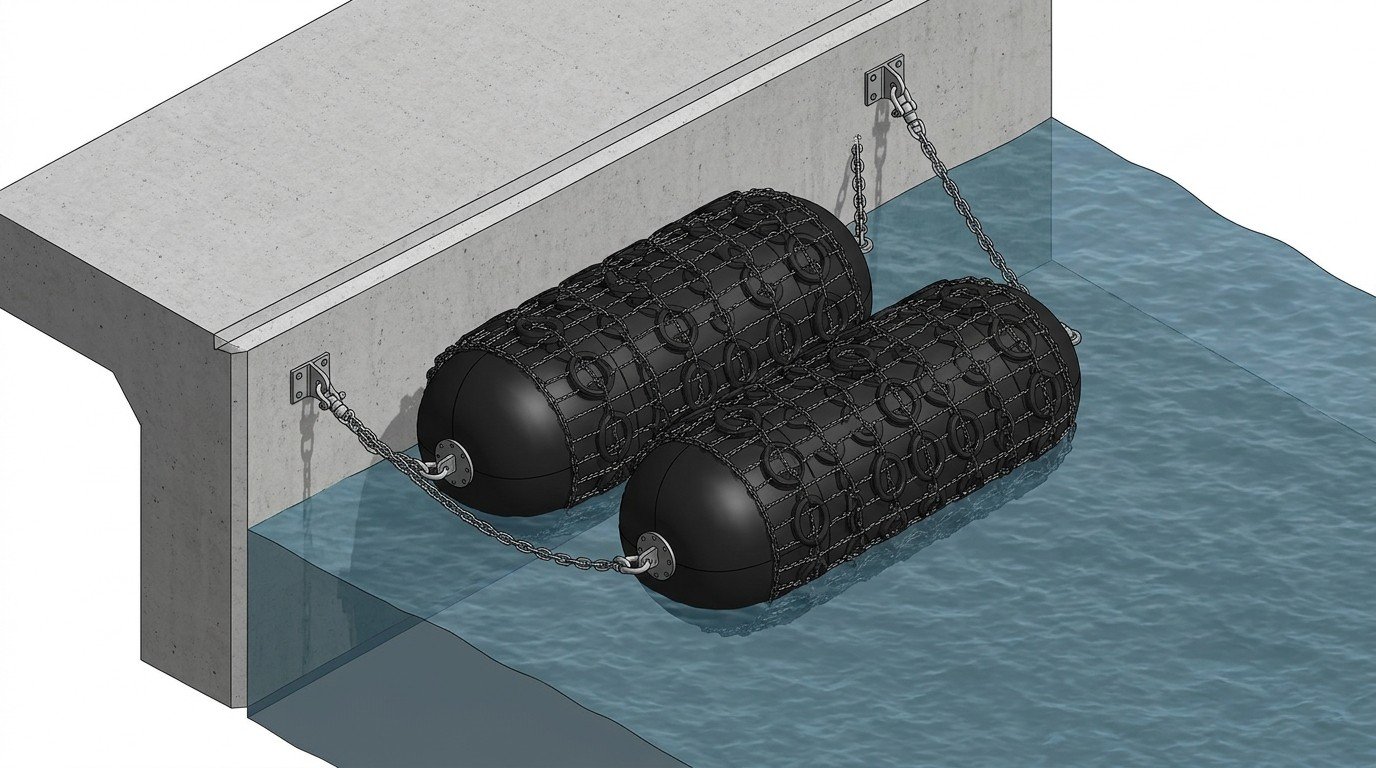
Pneumatic fenders need pressure checks, valve inspection, net inspection, and hardware review. If the terminal has a busy LNG schedule, removing one fender can become a problem. With paired fenders, one unit can be inspected while the other remains at that position.
I would not recommend doubling the count by default. It increases fender cost, chain/net hardware, lifting work, and deck handling. But if the terminal has high operation frequency or a strict no-shutdown requirement, redundancy can be justified.
Each fender position also needs proper slings, shackles, chains, and handling arrangements. If the rigging is not planned with the fender count, the berth may have enough rubber but not enough safe support hardware. For complete rigging hardware specifications, including shackle sizes, swivel dimensions, and guy chain grades by fender size, see our rigging gear guide.
Practical Starting Point for a New FSRU Project
For an early-stage FSRU discussion, I would start with three questions.
First, what is the largest LNG carrier expected to berth? Use the design vessel, not only the first cargo vessel. Future cargo flexibility often changes the fender requirement.
Second, what is the operating condition? A sheltered harbor, a nearshore berth, and an exposed offshore FSRU should not use the same starting count.
Third, what is the operation mode? A low-frequency project can work around inspection windows. A high-frequency import terminal may need redundancy from day one.
For many projects, the first commercial estimate can start with three pneumatic fenders per side for standard LNG carriers, four per side for larger or exposed cases, and paired fenders only when the operation philosophy requires it. Then the final count should be confirmed by berthing energy calculation and layout review.
FAQ
What is the minimum fender count for FSRU berthing?
Use at least two pneumatic fenders per berthing side. Two contact points are needed to control yaw and keep the LNG carrier stable alongside the FSRU. For normal commercial operation, three or four per side is more common.
Do SIGTTO fender requirements specify an exact number?
No. SIGTTO guidance sets the operational principles for safe liquefied gas STS transfer. It does not give one universal fender count for all FSRU berths. The count depends on vessel size, berth geometry, environment, and operation mode.
Can I use fewer fenders if I choose a larger size?
Only within limits. A larger fender can absorb more energy, but it cannot replace the need for stable contact points. One oversized fender still cannot control yaw. Count and size should be checked together.
What is the normal count for a standard LNG carrier alongside an FSRU?
Three pneumatic fenders per side is a common starting point for a sheltered or moderate side-by-side FSRU layout. Four per side is often used for larger carriers, exposed sites, or wider operating margins.
If you are preparing an FSRU or LNG terminal fender package, we can review the expected vessel class, berthing arrangement, and operation mode before sizing the fenders. Start from the pneumatic fender product page or send the project details through our FSRU package page: pneumatic fenders for FSRU and LNG terminal projects.