
Most buyers ask us the same thing before a berth project: foam or rubber? Both absorb berthing energy, but they behave very differently in service, cost, and maintenance.
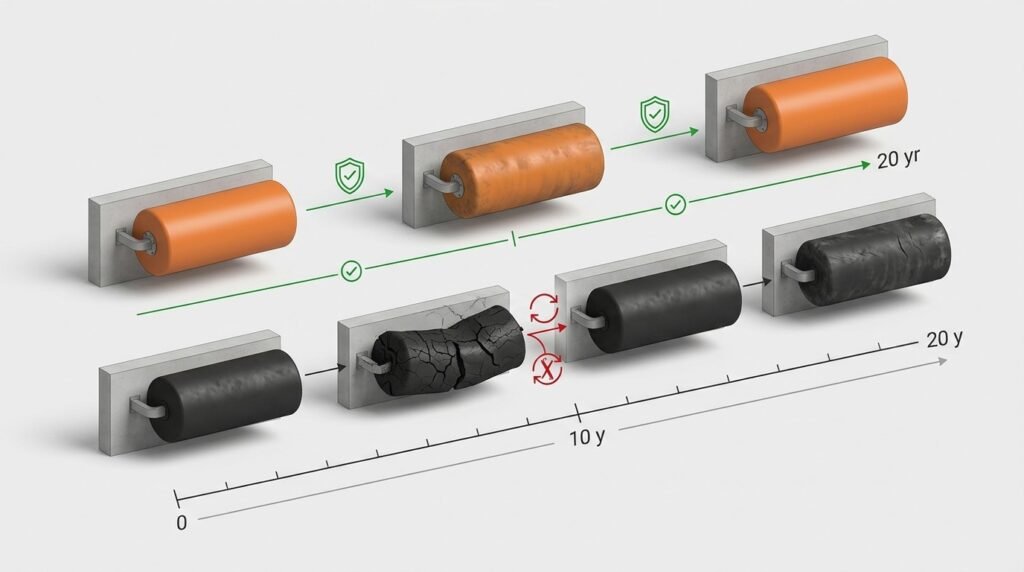
In a foam filled fender vs rubber fender decision, foam wins on low reaction force, near-zero maintenance, and a 20-plus year service life. Rubber suits high-tonnage permanent berths with fixed structures. The right choice comes down to berthing frequency, mounting type, and lifecycle cost.
What Are Foam Filled Fenders?
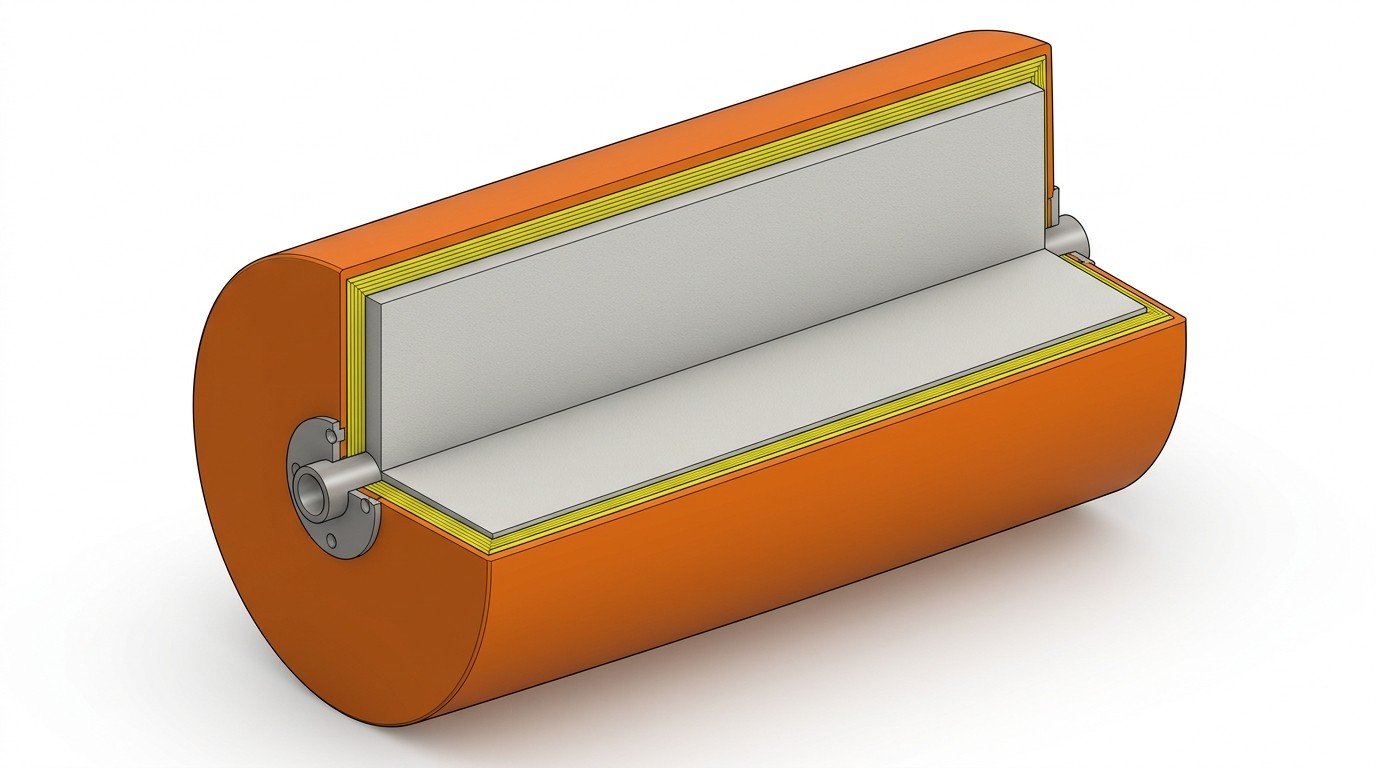
A foam filled fender is a non-pressurized unit built around a 100% closed-cell foam core. The core is wrapped in a nylon-filament-reinforced polyurethane and polyurea skin, with embedded end fittings for chain mounting.
There is no air inside. The foam itself absorbs the impact, so the fender cannot burst or deflate. Even with a punctured skin, it keeps floating and keeps working.
JettyGuard manufactures foam filled fenders through in-house forming, reinforcement layering, polyurea spraying, and fitting assembly. You can read the full range on our foam filled fenders page.
What Are Rubber Fenders?
A rubber fender is a solid elastomer unit. It is fixed to a quay wall or bolted to a steel panel and bollard system. The rubber deforms under load to absorb berthing energy.
Rubber fenders carry high energy density in a compact shape. That makes them a common pick for fixed, high-tonnage berths. The trade-off is high self-weight and a structure that must stay intact to function.
JettyGuard manufactures the steel panel systems and integrates the complete fender system. Rubber elements are produced by our strategic partner under JettyGuard’s quality control, to our design. See our rubber fenders page for the full system.
Foam Filled Fender vs Rubber Fender: Side-by-Side Comparison
Here is how the two types compare across the axes that decide a real project.
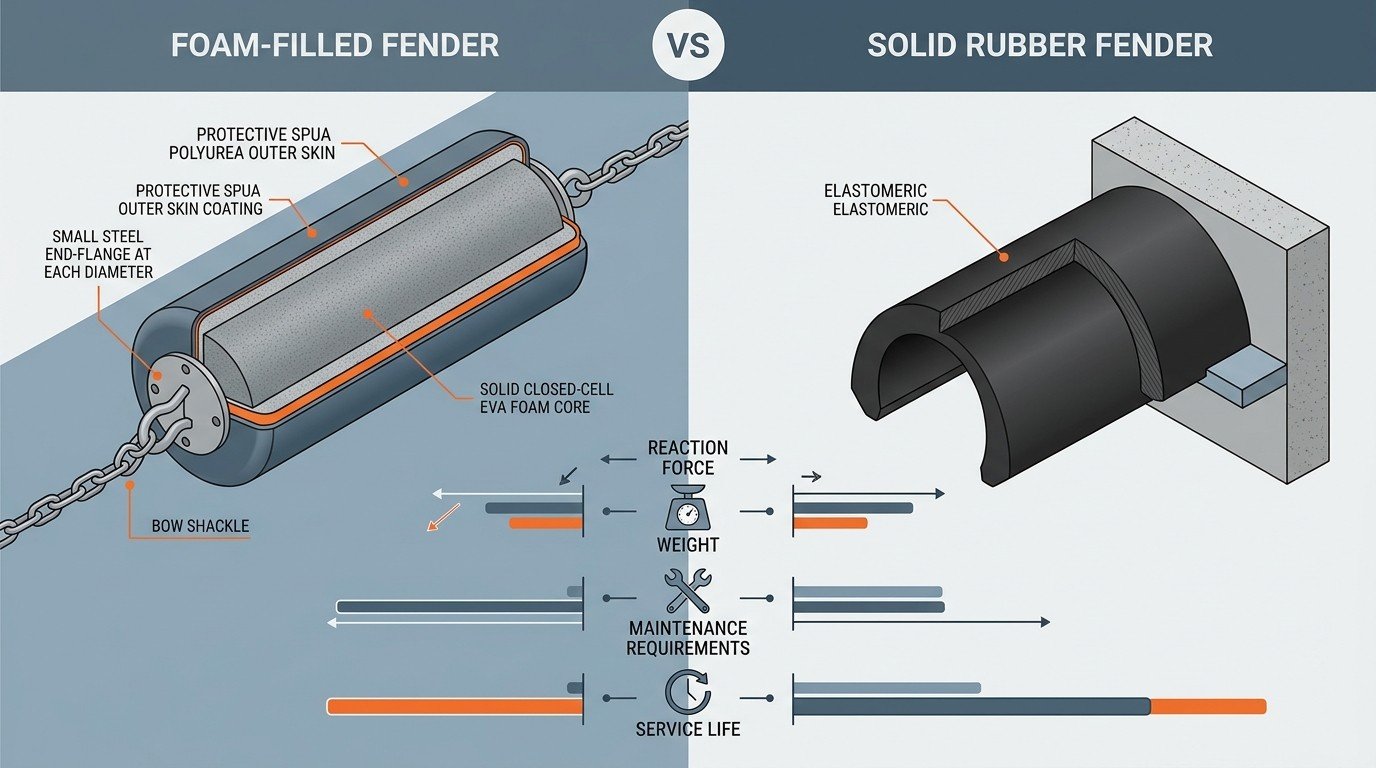
| Factor | Foam Filled Fender | Rubber Fender System |
|---|---|---|
| Internal pressure | None (closed-cell foam core) | None (solid elastomer) |
| Reaction force at equal energy | Lower | Higher |
| Self-weight | Light, floats | Heavy (e.g. large cell units near 18,500 kg) |
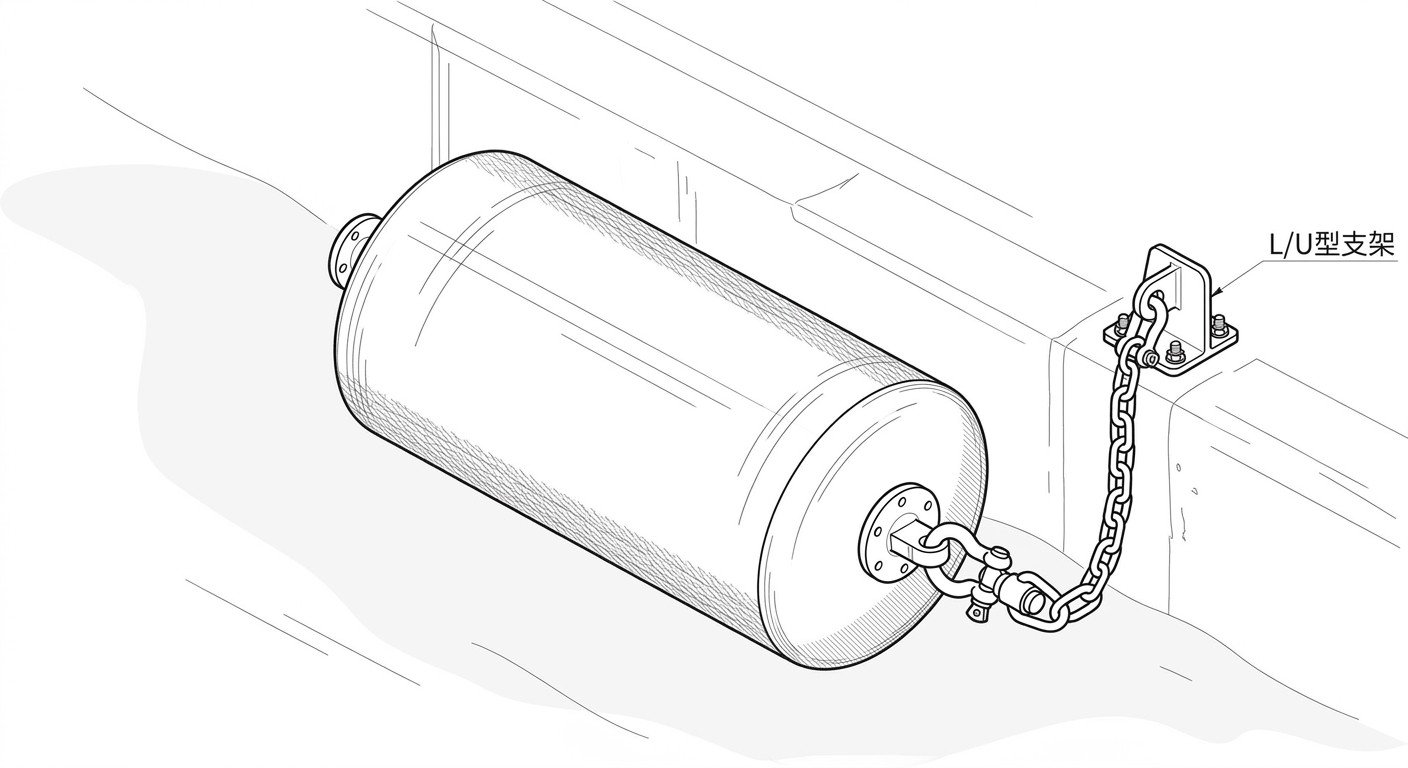
| Mounting | Chain-suspended, floating | Fixed to quay wall / steel panel + bollards |
| Damage tolerance | Keeps working when punctured | Whole system out of service if damaged |
| Service life | 10 to 25 years | Around 10 years on medium-high frequency berths |
| Maintenance | Near zero | Periodic inspection, panel and bolt upkeep |
| Best fit | Floating, exposed, low-freeboard, temporary | Fixed high-tonnage permanent berths |
The short version: foam is forgiving and low-maintenance, rubber is compact and rigid. The next sections back each row with numbers and field experience.
Reaction Force and Energy Absorption
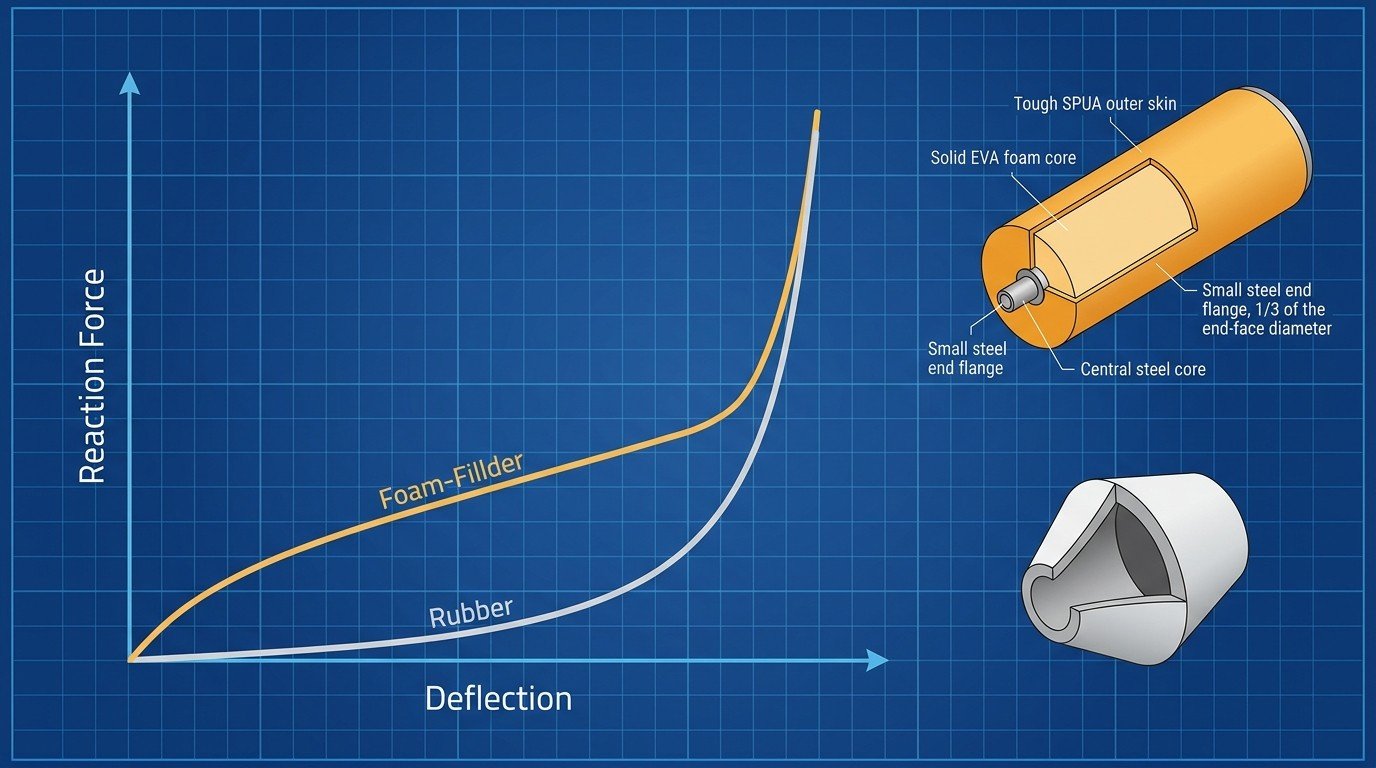
At the same energy absorption, a foam filled fender puts a lower reaction force back into the hull and the structure. I’ve seen this decide projects where an older hull or a light structure could not take a high point load.
Our JFF foam series gives real figures, tolerance ±10%:
- JFF 1500×3000: 596 kN / 244 kNm
- JFF 2500×5500: 1516 kN / 1022 kNm
- JFF 4500×9000: 4726 kN / 4779 kNm
For a rubber benchmark, a Super Cone SCN 900 absorbs about 275 kNm at 585 kN reaction. Rubber packs high energy in a small unit, but the reaction climbs steeply near full deflection. For full foam figures, see our JFF series specifications.
Maintenance, Lifespan, and Total Cost of Ownership
This is where the gap is widest, and it is the point I raise most with buyers.
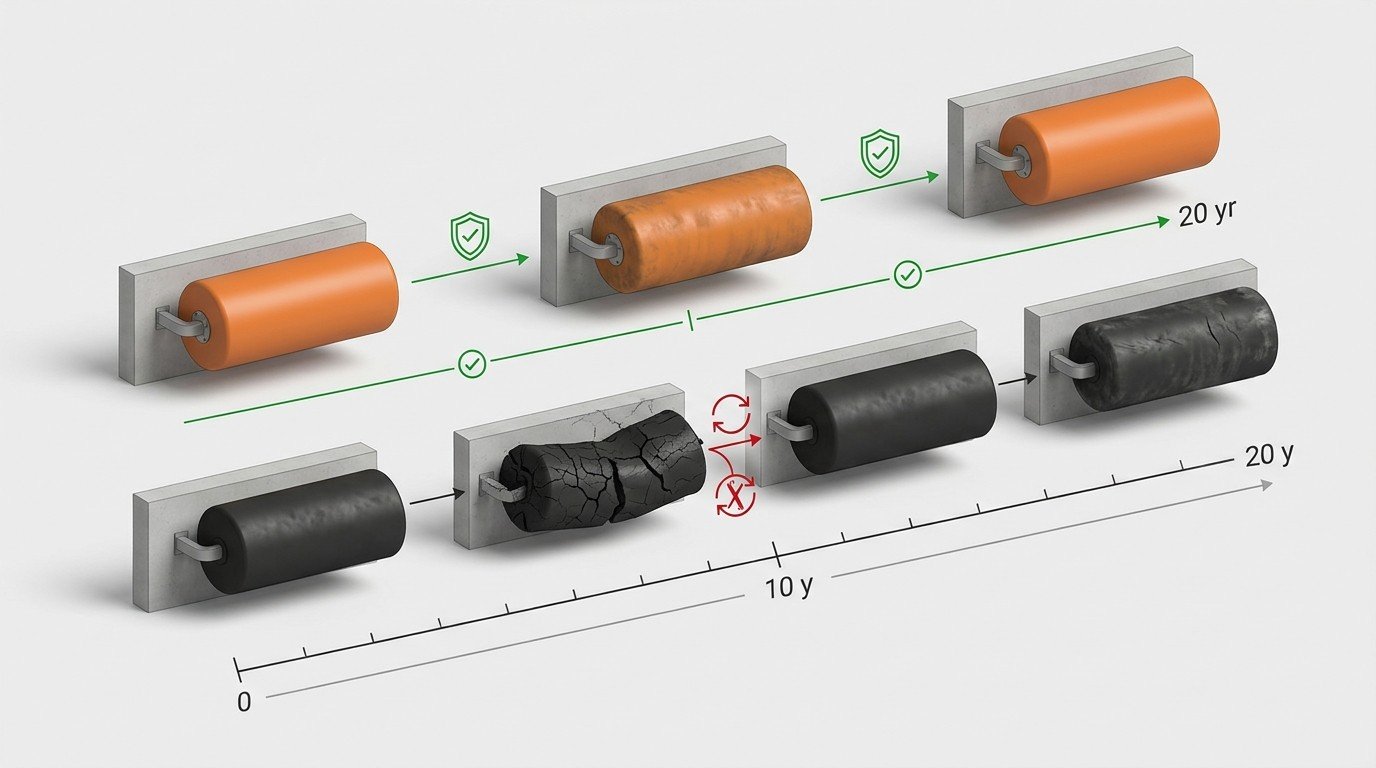
In my experience, a foam filled fender is almost maintenance-free. With a good-quality EVA foam core, the polyurea spray done right, and the reinforcement layer done right, it lasts more than 20 years. No re-inflation, no valve replacement, no pressure checks.
Rubber ages. A rubber fender has a rough built-in life of around 10-15 years. I’ve rarely seen rubber last 15 to 20 years on a berth with medium-to-high berthing frequency. Cases of 20-year rubber exist, but they are a small share, and they sit on light-duty berths most of time.
Foam also has very few accessories. If the body is damaged, replacement is easy. A punctured or split foam fender keeps working and can stay in service during the replacement window, so the berth keeps operating safely.
A damaged rubber unit is the opposite. The whole system goes out of service, and replacement is a cumbersome process. Over 15 to 20 years, that difference in downtime and upkeep is what drives foam’s lower total cost of ownership on most floating and temporary applications.
When to Choose Foam Filled Fenders vs Rubber Fenders
Match the type to the berth, not the other way around.
Choose foam filled fenders when:
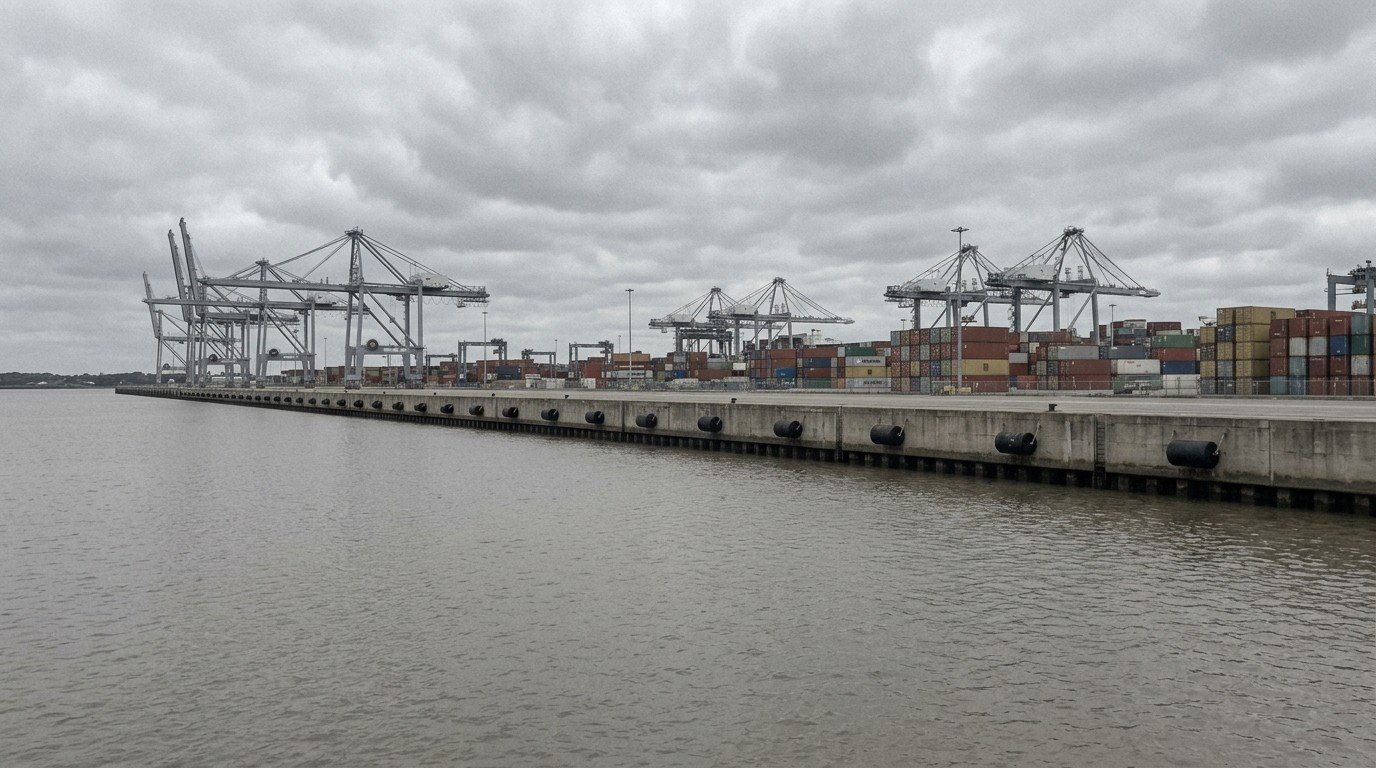
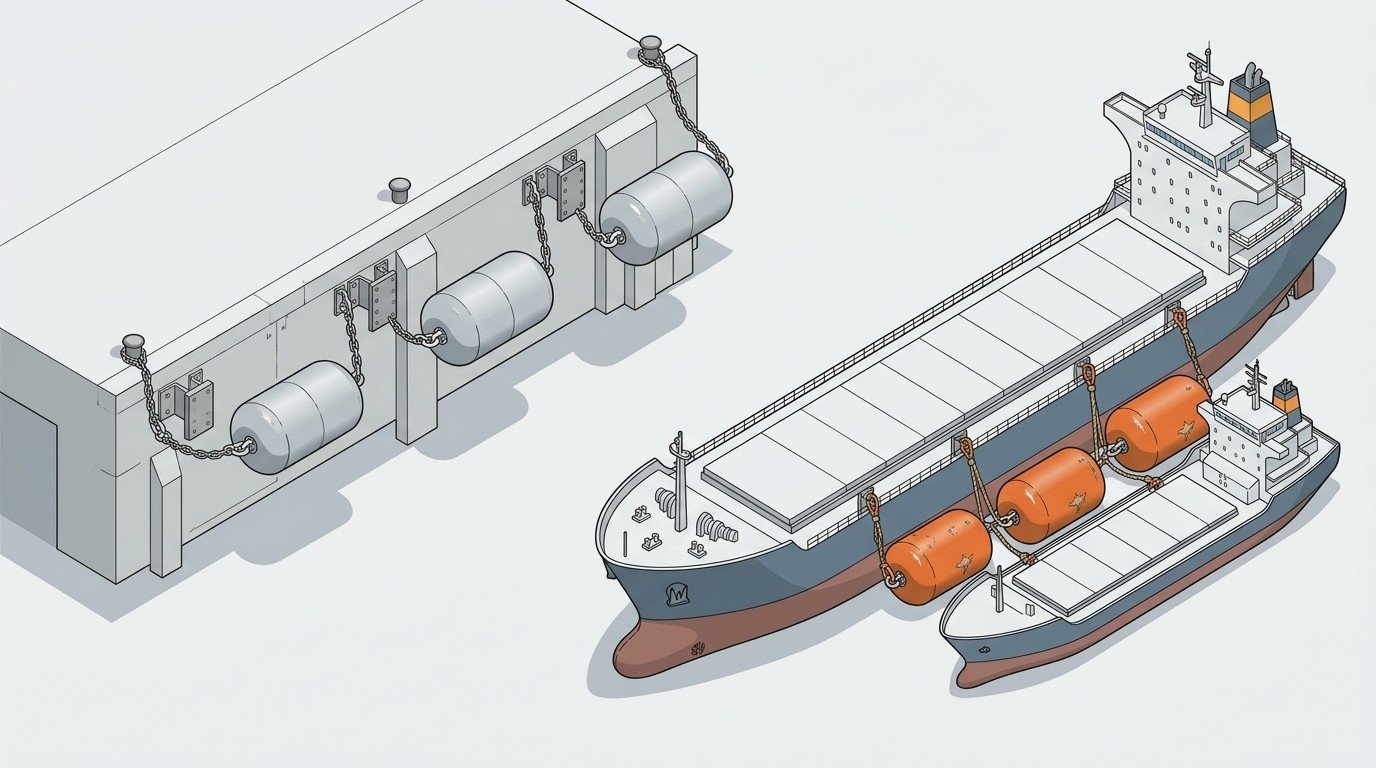
- The berth is floating, exposed, or has large tidal or freeboard change.
- The structure or hull cannot take high reaction force.
- Maintenance access is limited (remote, unmanned, or offshore berths).
- Uptime matters and you cannot afford a full system to go offline.
- The application is LNG or STS work, where a non-pressurized body is safer.
Choose rubber fenders when:
- The berth is fixed, permanent, and built for high tonnage.
- Space is tight and you need high energy in a compact unit.
- There is a solid quay wall or panel structure to bolt to.
- Berthing frequency is low enough that aging is not the limiting factor.
Standards and Compliance
Both types sit inside their own design frameworks. Getting the standard right protects you in an RFQ.
Foam filled fenders in US federal work follow UFGS 35 59 13.17 (2021), which covers the foam core, elastomer skin, and acceptance testing. Foam is not pneumatic, so it does not fall under ISO 17357. That standard is for air-filled units.
Rubber fender selection and berthing energy design follow PIANC WG211:2024 and BS 6349-4. JettyGuard’s manufacturing facility is certified to ISO 9001, and we size every project to the applicable berthing-energy method.

Frequently Asked Questions
Which lasts longer, foam filled fenders or rubber fenders?
Foam filled fenders last longer in most cases, 10 to 25 years versus around 10 years for rubber on medium-high frequency berths. Rubber ages over time. A quality foam core with correct polyurea spray and reinforcement can pass 20 years.
Are foam filled fenders more expensive than rubber fenders?
Rubber can have a lower upfront cost in small sizes. But foam’s longer life and near-zero maintenance usually give it a lower total cost of ownership over 15 to 20 years, especially on floating or temporary berths.
Can foam filled fenders be used for permanent berths?
Yes, foam works on permanent berths, and it is often the better pick where reaction force must stay low or maintenance access is limited. Rubber is still the common choice for fixed, high-tonnage berths with solid quay structures.
What happens if a foam filled fender is punctured?
It keeps working. The closed-cell foam core is not pressurized, so the unit cannot burst or deflate. A punctured fender stays buoyant and stays in service, which lets you keep the berth running until a planned replacement.
Send us your vessel size, berthing energy, fender size, quantity, and operating environment. We’ll recommend the right type and size for your berth. Contact us for fender selection.