
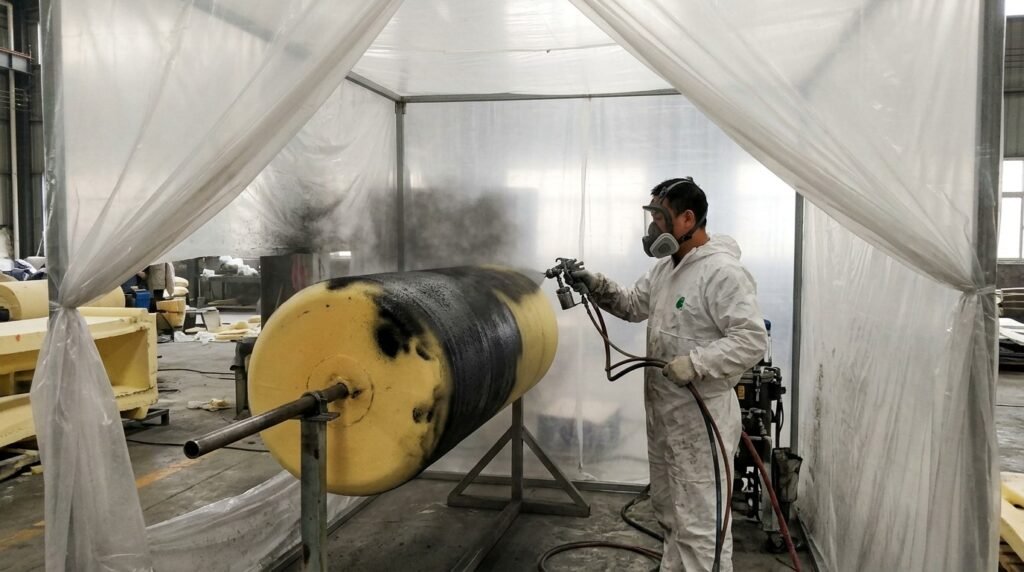
Buyers ask me about EVA foam density and reaction force curves. Almost nobody asks about the skin. That is a mistake. On a foam filled fender, the coating decides how many years you keep using it before you cut it open and look inside.
SPUA coating (Spray PolyUrea Application) is a fast-curing, two-component elastomeric skin sprayed over the EVA foam core of a foam filled fender. Typical applied thickness sits between 5 mm and 20 mm depending on duty. A well-specified SPUA coating gives 8 to 15 years of service in most marine environments.
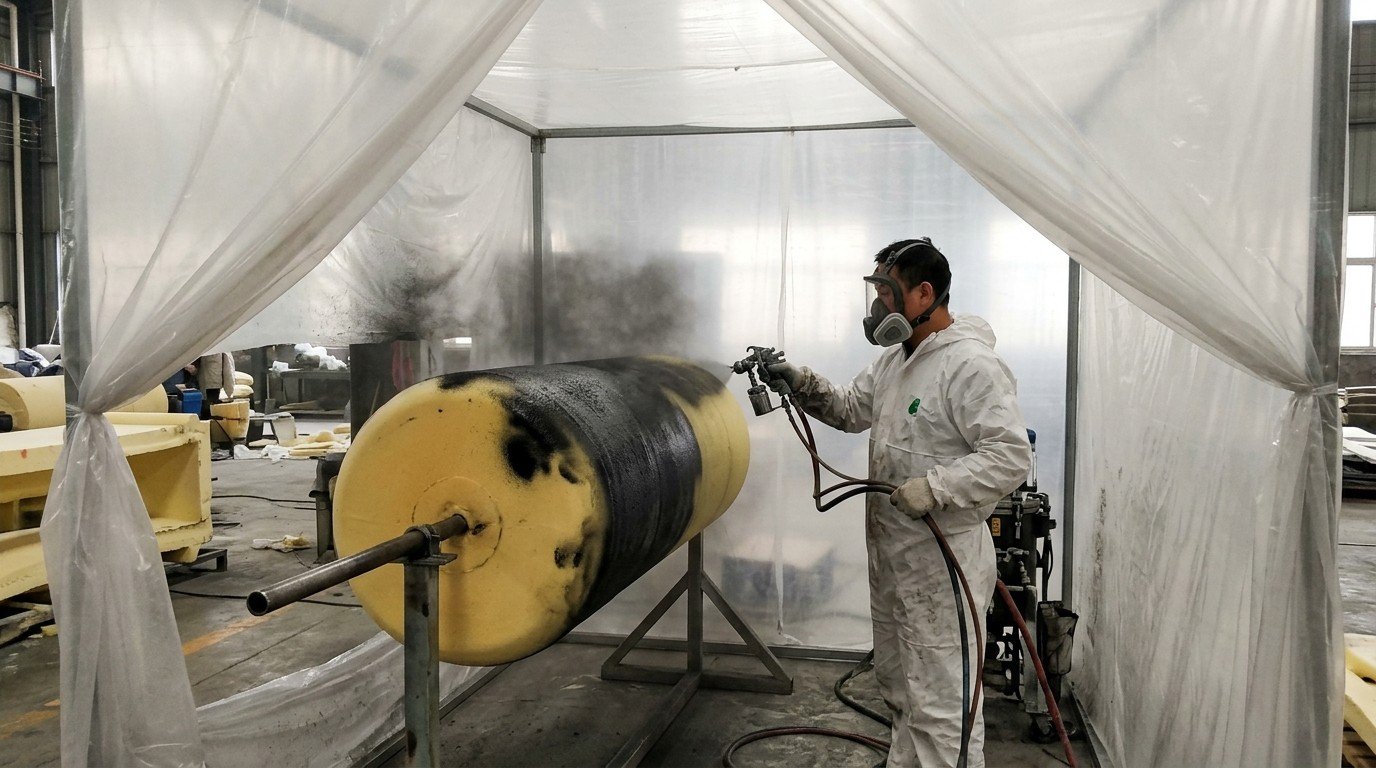
The skin is the part that meets the hull, the chain, the quay wall, and the sun. The closed-cell EVA core sits behind it and absorbs energy; our EVA foam core guide explains the material and rebound trade-off. If the coating fails first, the foam fender stops working as a unit. That is why coating selection matters as much as foam density on a foam filled fender product range.
What Is SPUA Coating on a Foam Filled Fender
PIANC WG211 §10.11.2 describes the foam fender outer skin as a “Polyurethane (Solvent Free) Outer Layer Elastomer or Similar Material.” JettyGuard’s own catalog has long described the skin as a polyurethane epidermis. SPUA polyurea sits in the “or similar material” branch of that family — same plural-component spray principle, faster cure, easier field repair.
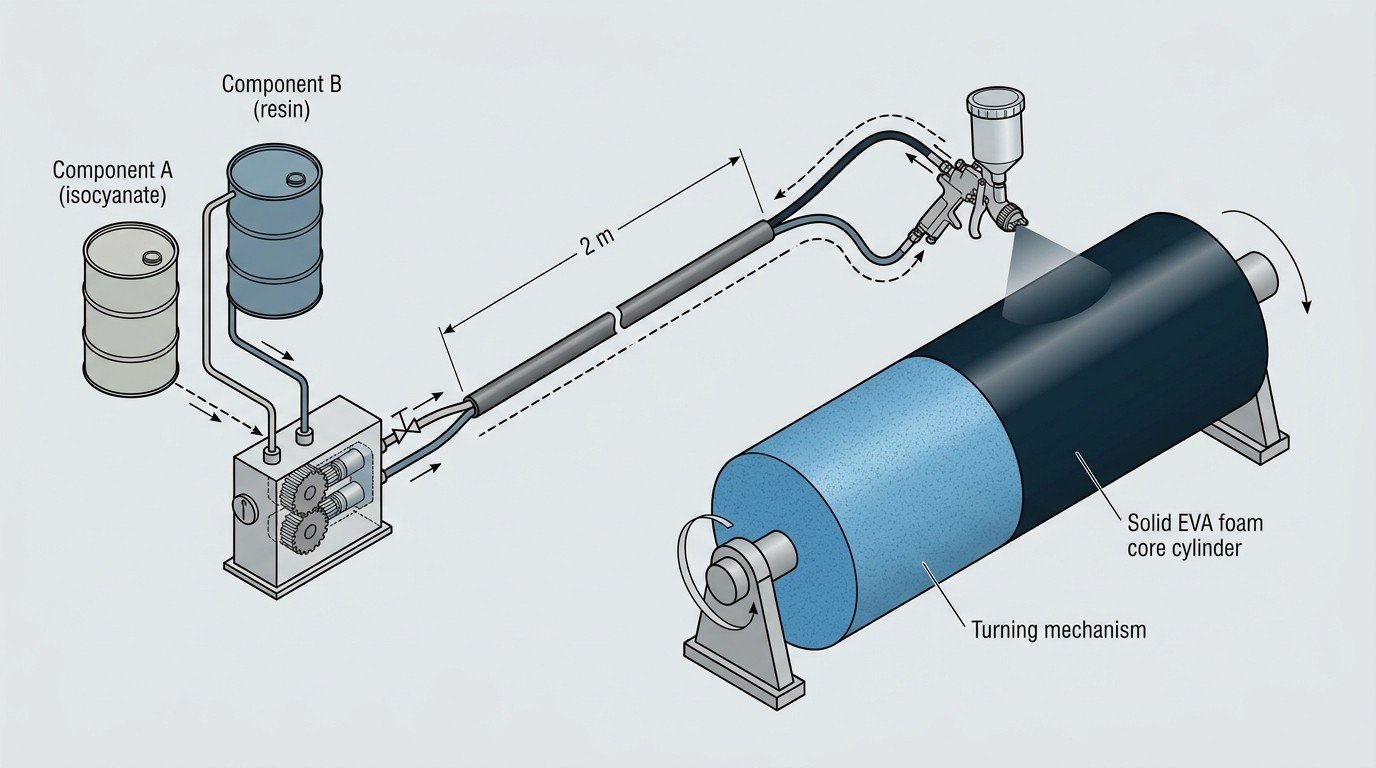
SPUA stands for Spray PolyUrea Application. It is a two-component system: one side isocyanate, the other side a resin blend. The two streams meet at the spray nozzle, react in seconds, and cure into an elastomeric layer on the foam core.
The chemistry is fast. Gel time is under 10 seconds. Full mechanical strength comes within 24 hours. That speed is what makes a thick, seamless skin possible. Slower coatings cannot be built up in one pass without sagging or trapped solvent.
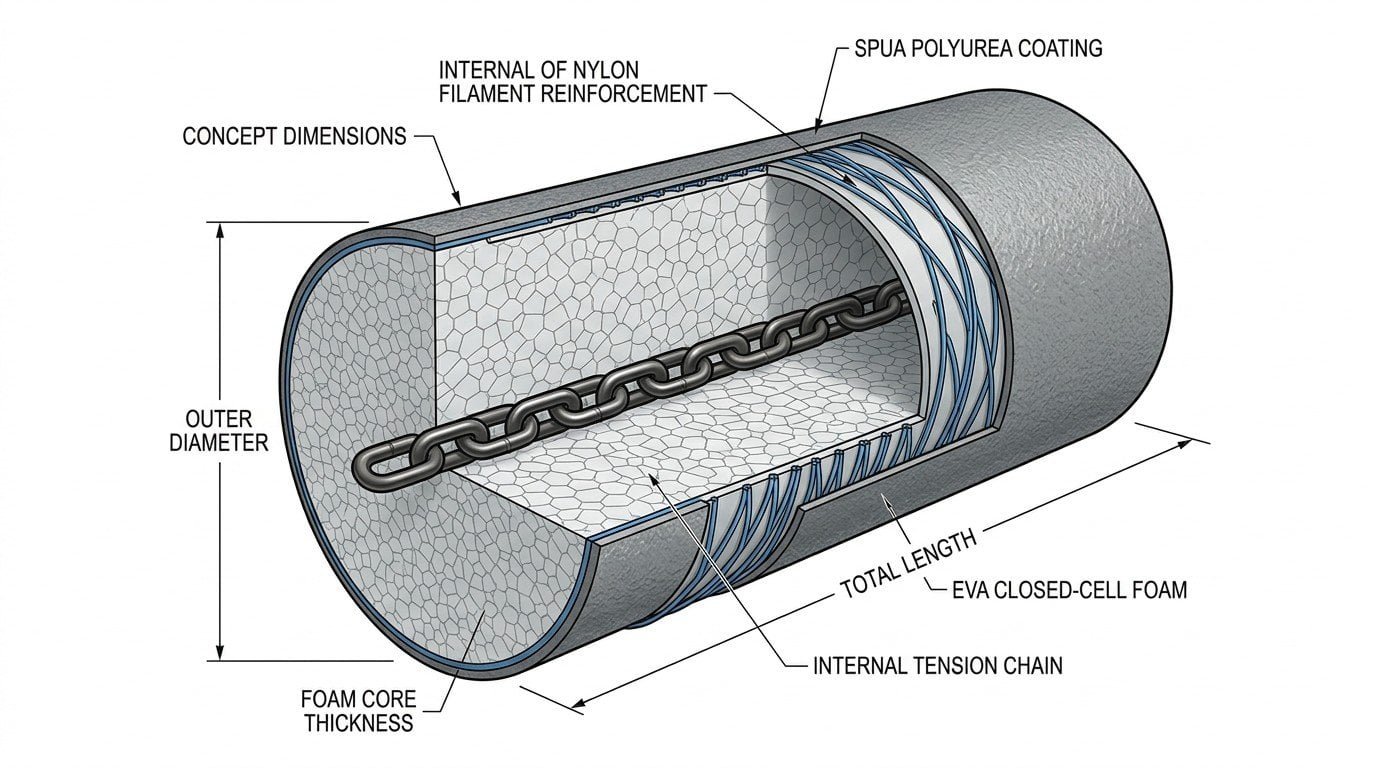
On a foam filled fender, we spray the polyurea over the EVA closed-cell core. Between the core and the outer polyurea, there is normally a filament reinforcement layer — a wound nylon cord network that carries tensile load when the fender is lifted, towed, or compressed at the chain net.
Applied thickness depends on duty. JettyGuard builds polyurea skins at 5 mm, 8 mm, 10 mm, 15 mm, and 20 mm. A 5 mm skin suits sheltered inland berths. A 20 mm skin is what we spec for exposed offshore platforms and STS lightering buoys.
Physical and Chemical Properties That Matter at the Berth
A polyurea fender skin works because it behaves like a tough elastomer, not like a paint film. The numbers below are typical ranges for marine-grade SPUA. Exact values shift with formulation, so confirm with the supplier on critical projects.
| Property | Typical Range | What It Means in Service |
|---|---|---|
| Tensile strength | 18–25 MPa | Resists tearing when the fender twists under shear load |
| Elongation at break | 300–500% | Skin stretches with foam compression instead of cracking |
| Shore D hardness | 45–60 | Hard enough to resist abrasion, soft enough to flex (Shore D scale; the UFGS 35 59 13.17 polyurethane skin is specified on the Shore A scale at 80–95 — the two scales are not directly comparable) |
| Abrasion resistance (NBS, ASTM D 1630) | ≥ 100 (PIANC 211 minimum); marine-grade SPUA typically exceeds | Low wear under repeated hull contact |
| Tear resistance (Die C) | 70–120 kN/m | Resists rip propagation from a cut or puncture edge |
| Cure time (full service) | 24 hours | Coating reaches full mechanical strength quickly |
Elongation matters most on a working fender. When a vessel berths, the foam core compresses, and the skin has to stretch with it. A skin that only stretches 100% will crack at the equator and at the flange transition before the foam ever fatigues. A skin at 300% to 500% rides the compression cycle for years.
Tensile and tear values decide what happens after the first cut. A small mooring chain nick will not propagate across a high-tear polyurea skin. On a low-grade skin, the same nick becomes a long split within one storm season.
Abrasion, UV, and Seawater Corrosion Resistance
The three things that age a foam fender skin are abrasion, UV, and seawater chemistry. SPUA polyurea handles all three, but not equally well at every thickness.
Abrasion at hull and chain contact zones
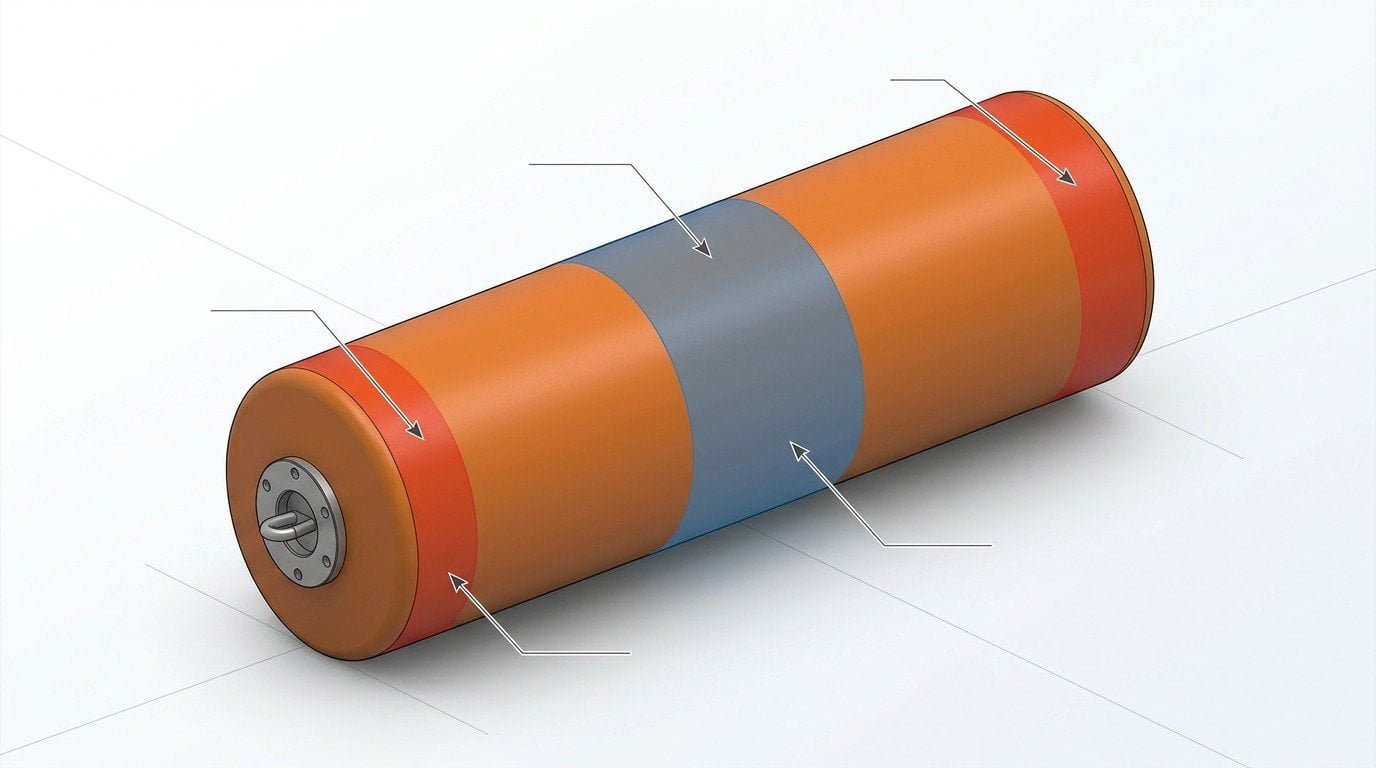
Most of the wear shows up in two zones. The first is the equator belt, where the hull plate sits against the fender during berthing. The second is the chain rub zone, where the chain net cuts into the skin under tide and wave motion. A polyurea skin at 8 to 10 mm holds up well at the equator. At chain contact, I push customers toward 15 mm or thicker.
UV exposure and color retention
Aromatic polyurea chalks under UV. The surface fades and turns grey-brown over time. The chalking is cosmetic in most cases — the mechanical properties stay intact for years underneath. For terminals that care about appearance, we apply an aliphatic polyurea topcoat over the aromatic base layer. The topcoat holds color better but adds cost.
Seawater and hydrocarbon resistance
Polyurea is hydrolytically stable. Chloride exposure does not break down the polymer chain at ambient seawater temperatures. At oil and chemical terminals, the skin also resists hydrocarbon contact. Small fuel or diesel splashes do not soften or swell the surface. Sustained immersion in heavy aromatic solvents is a different story, but that is not a normal marine fender duty.
Coating Thickness vs Service Life
Coating thickness on a foam filled fender is specified in millimeters, not microns. That is the first signal you are dealing with a marine product, not a building coating. A 200-micron industrial polyurea liner has nothing in common with a 10 mm fender skin.
The ranges below are indicative, based on JettyGuard project records; they are not standard-derived numbers and should be read alongside an inspection regime.
| Coating Thickness | Sheltered Berth | Open Quay / Coastal | Offshore / STS / SBM |
|---|---|---|---|
| 5 mm | 10–12 years | 6–8 years | Not recommended |
| 8 mm | 12–15 years | 10–12 years | 8–10 years |
| 10 mm | 15+ years | 12–15 years | 10–12 years |
| 15 mm | 15+ years | 15+ years | 12–15 years |
| 20 mm | 15+ years | 15+ years | 15+ years |
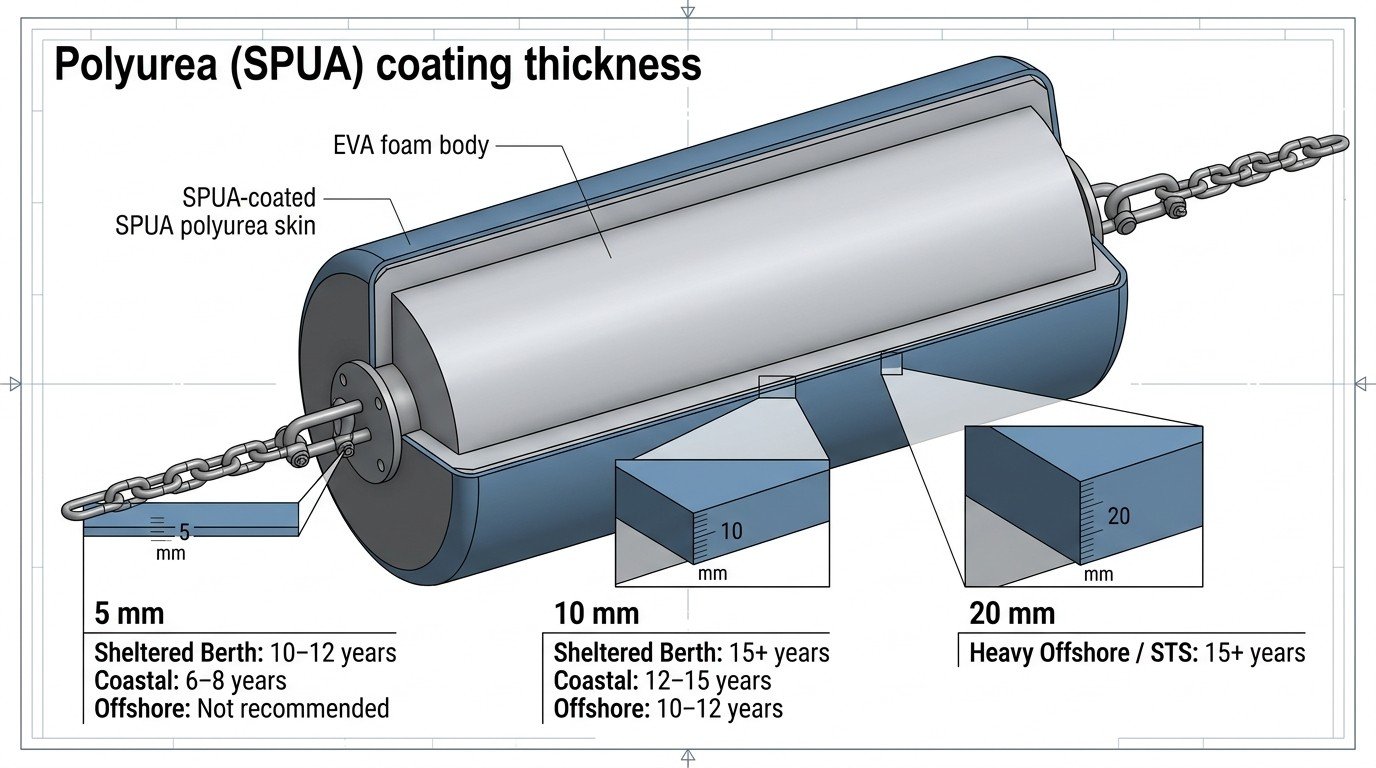
Service life numbers assume reasonable maintenance and no major impact event. A fender hit hard enough to crush the core or tear the chain net will need work regardless of skin thickness.
I have seen buyers spec 5 mm skins for offshore platforms to save cost. That decision usually shows up as a service call within 18 months. The right place to use a 5 mm skin is an inland quay or a yacht berth, where the duty is light and the inspection cycle is forgiving. For how to choose a foam filled fender for your application, the coating thickness has to match the duty, not the budget.
SPUA Polyurea vs PU vs Rubber Outer Skin
PIANC WG211 §10.11.2 covers two plural-component spray families — polyurethane (PU) and similar elastomers including polyurea (SPUA) — alongside vulcanized rubber as the third common outer skin. The real difference is not the material family, but cure time, field repairability, and cost.
| Property | SPUA Polyurea | Polyurethane (PU) | Rubber Outer Skin |
|---|---|---|---|
| Application method | Plural-component spray, mixed at nozzle | Plural-component spray, mixed at nozzle (PIANC WG211 §10.11.2) | Vulcanized panel bonded over foam |
| Cure time (full service) | 24 hours | Minutes at gel; hours to days for full mechanical strength | Vulcanized in factory mold |
| Typical applied thickness | 5–20 mm | 3–8 mm | 10–25 mm |
| Tensile strength | 18–25 MPa | ≥ 13.8 MPa (PIANC 211 Table 10-8 minimum) | 15–20 MPa |
| Abrasion resistance | NBS ≥ 100 (ASTM D 1630, PIANC 211 minimum); marine-grade SPUA typically exceeds | NBS ≥ 100 (ASTM D 1630, PIANC 211 minimum) | Vulcanized formulation, excellent abrasion resistance |
| UV / color retention | Chalks (aromatic); stable with aliphatic topcoat | Yellows under UV | Excellent |
| Field repairability | Patch spray on site | Trowel patch on site | Vulcanized patch — factory work |
| Typical service life | 8–15 years | 5–8 years | 10–15 years |
| Cost (relative) | Medium-high | Medium | High |
| Best use case | Most marine applications, offshore exposed | Light-duty, sheltered berths | High-abrasion ports, vulcanized standard required |
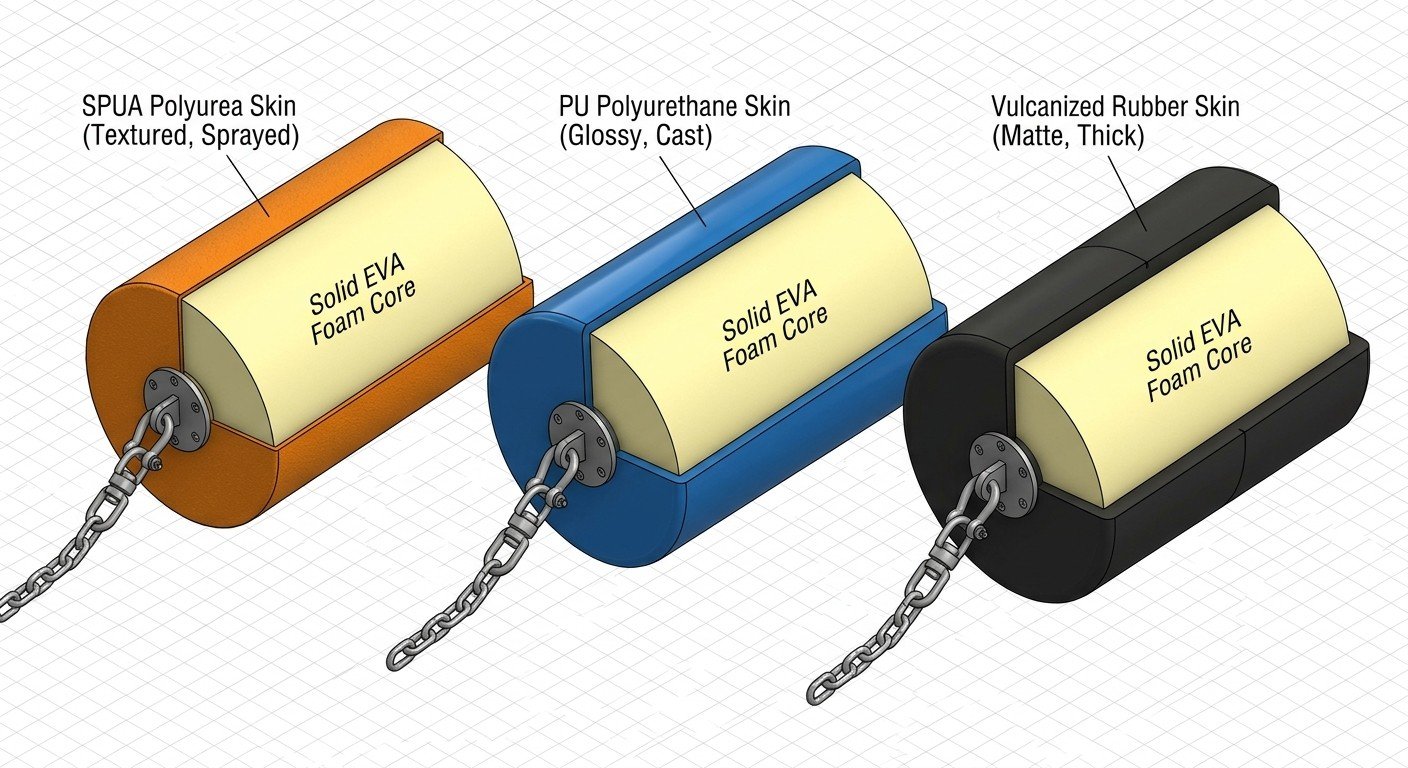
A rubber outer skin is the traditional answer and still works well. The issue is repair. Once a vulcanized rubber skin is cut, the fender goes back to a factory or it lives with the patch on site. Within the same plural-component spray family covered by PIANC §10.11.2, SPUA polyurea wins on field repair speed, which is what most port operators care about after the first incident.
For terminals running ship-to-ship transfer with pneumatic units alongside foam units, see pneumatic vs foam filled fender comparison — the skin comparison there is structured around STS duty.
Field Repair After Coating Wear or Damage
One of the reasons SPUA polyurea works on a foam filled fender is that you can patch it without sending the fender back to a factory. Not every kind of damage is field-repairable, and being honest about that limit matters.
Field-repairable:
– Surface abrasion below 2 mm depth
– Small punctures with no foam exposure
– Edge wear on the head plate area
– Chain rub grooves up to 5 mm deep
Factory recoat required:
– Cuts exposing the EVA foam core
– Delamination patches larger than 200 mm across
– Tearing along the flange seam
– Damage to the filament reinforcement layer
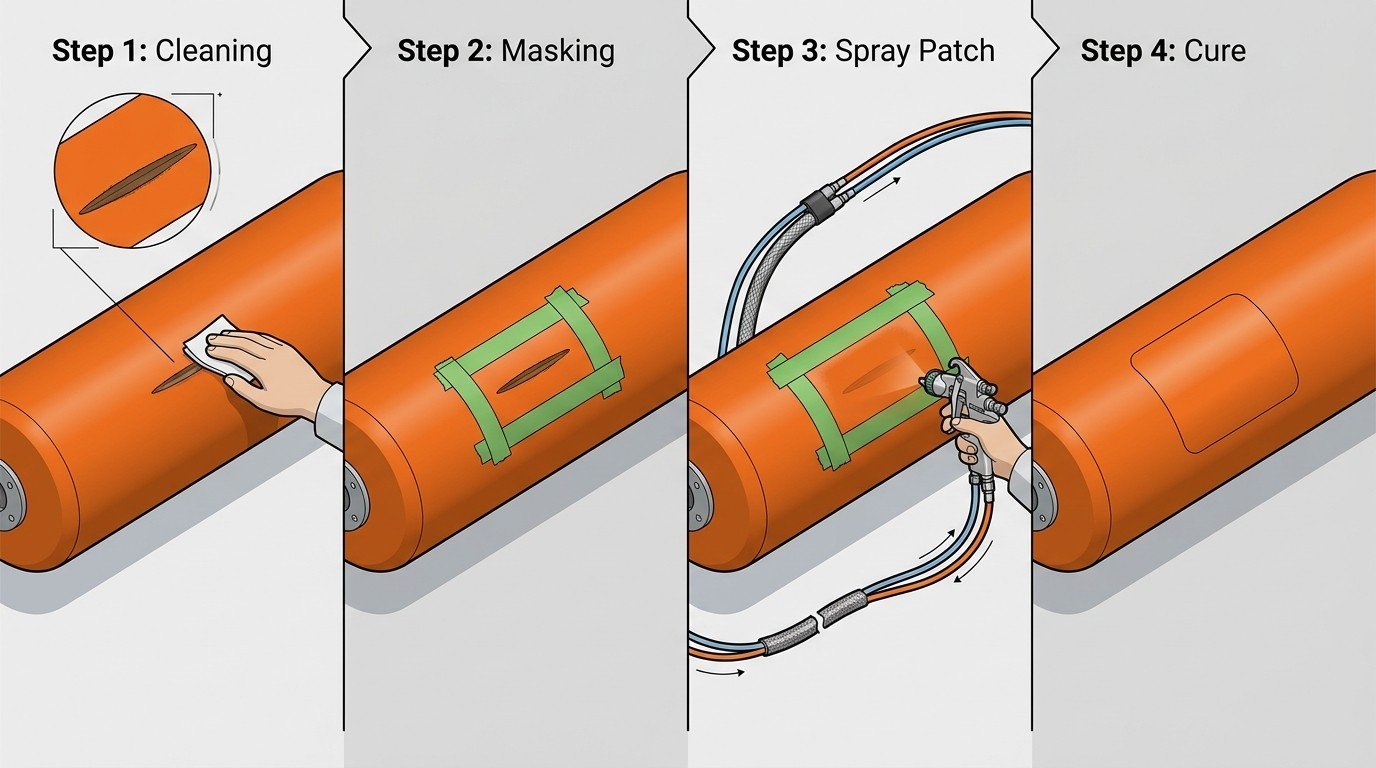
Field repair sequence:
- Clean the damaged area with fresh water and a stiff brush. Remove salt, oil, and loose coating fragments.
- Sand the patch zone with 60 to 80 grit until the surface is dull. Extend the sanded area 50 mm past the visible damage on every side.
- Wipe with isopropyl alcohol and let the surface flash-dry for 5 minutes.
- Mask the patch boundary with high-temperature tape.
- Spray the polyurea patch in 2 to 3 passes, building thickness to match the surrounding skin.
- Let the patch cure for at least 4 hours before mechanical contact. Full service strength returns within 24 hours.
- Remove the masking tape while the patch is still warm to get a clean edge.
A trained two-person crew can finish a 300 mm patch in under 2 hours. The fender returns to service the same day for non-impact duty, or the next day for heavy berthing.
Maintenance Frequency and Inspection Intervals
Inspection is what keeps the 15-year service number honest. A polyurea skin is forgiving, but it is not maintenance-free.
Recommended inspection schedule:
- Quarterly visual check: walk the fender, look for chalking, cracks, exposed reinforcement filament, and chain rub depth. Photograph any new damage.
- Annual detailed inspection: measure coating thickness at the equator, the head plate transition, and the chain attachment area. Compare to the previous year.
- Post-incident inspection: after any unusual berthing impact or storm event, inspect within 7 days.
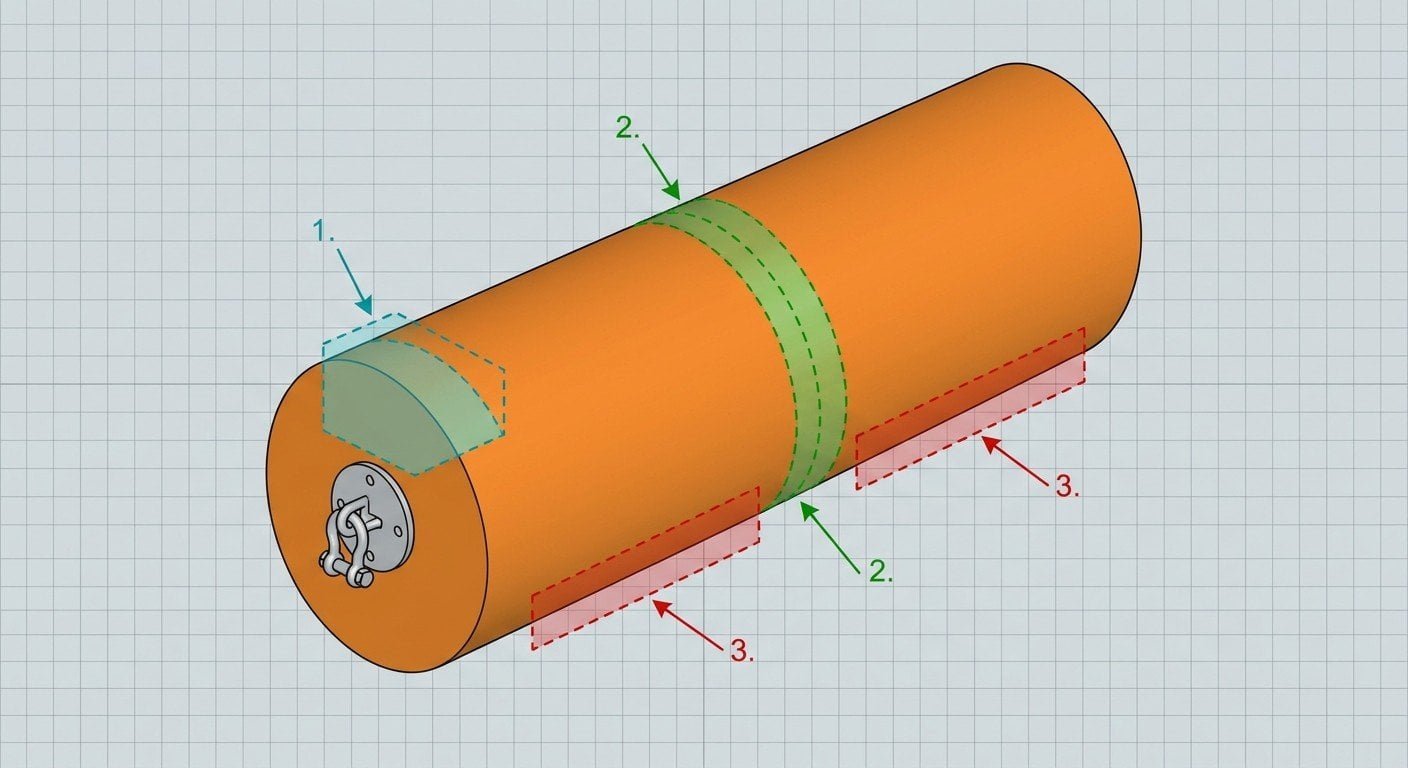
A foam filled fender is solid. There is no internal pressure to lose, so a small skin nick does not deflate the fender. But that same solid build means the flange end cannot redistribute stress the way a pneumatic fender does, where reinforcement cords route around the flange ring and share load with the rubber body. On a foam unit, the flange end carries concentrated stress directly into the skin and the reinforcement layer.
What this means in practice: I tell operators to inspect the flange-end skin more carefully than the equator. The middle body rarely punctures, because we use conservative thickness in design and production. When real damage shows up in service, it is more often at the flange end where coating, reinforcement, and steel meet. JettyGuard runs a dedicated flange-end reinforcement process for this reason — extra wraps, extra skin thickness, and controlled cure at the transition. That process reduces flange-end tearing risk and gives our foam fenders stronger structural stability than many alternatives on the market.
For port operators managing a fender fleet, see port contractor fender supply for a procurement framework that pairs inspection cycles with replacement planning.
Frequently Asked Questions
What does SPUA stand for in foam fender coatings?
SPUA stands for Spray PolyUrea Application. It is a two-component plural-spray coating that cures in seconds at the nozzle. On a foam filled fender, the SPUA polyurea skin forms the outer protective layer over the EVA foam core and the filament reinforcement.
How thick is the polyurea coating on a foam filled fender?
Marine SPUA polyurea coatings range from 5 mm to 20 mm. A 5 mm skin suits sheltered inland berths. 8 to 10 mm is the common spec for open quay duty. Offshore platforms, STS lightering, and SBM buoys normally use 15 mm to 20 mm. Match thickness to duty, not to budget.
How long does a polyurea-coated foam fender last?
Service life is 8 to 15 years in most marine environments. A 10 mm coating on an open quay delivers around 12 to 15 years. A 5 mm coating in the same duty drops to 6 to 8 years. Inspection regime and a single major impact event also shift the number.
Can a damaged polyurea fender coating be repaired in the field?
Yes, for surface abrasion under 2 mm, small punctures, and chain rub grooves up to 5 mm. Deep cuts exposing the foam core, delamination over 200 mm, or damage to the reinforcement layer need factory recoat. A trained crew finishes a 300 mm patch in under 2 hours, with the fender back in service within 24 hours.
Is polyurea coating better than rubber skin on a foam fender?
It depends on duty and repair access. Rubber outer skin holds color and resists abrasion well, but a damaged rubber skin needs vulcanized factory repair. SPUA polyurea matches rubber on abrasion and beats it on field repair. For most port operators, the field-repair advantage decides the choice.
What is the difference between polyurea and polyurethane (PU) on marine fenders?
Both modern marine polyurea and polyurethane are applied as plural-component spray under PIANC WG211 §10.11.2. Polyurea reaches full mechanical strength within 24 hours, while marine PU may need additional days depending on formulation. Polyurea also handles humidity and slight surface moisture during application better than PU. On tensile and tear strength, marine-grade SPUA typically sits above the PIANC 211 minimum (≥ 13.8 MPa tensile, ≥ 32.4 kN/m tear). PU still works for light-duty sheltered berths.
Specifying a foam filled fender for a new project? Send us your vessel size, berthing energy, fender dimensions, and exposure environment. We will come back with a coating thickness recommendation and a service life range you can defend to procurement.