
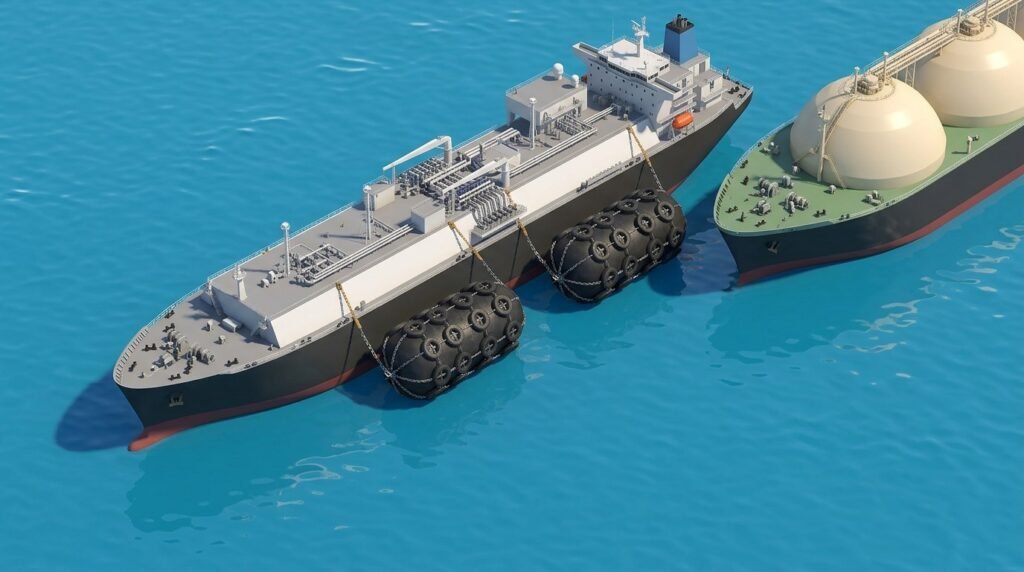
LNG terminal owners and EPC engineers now have one practical issue to check: many fender specifications still refer to WG33, but PIANC has moved on. A specification can look familiar and still miss the current design basis for seagoing vessel berthing.
PIANC MarCom 211 is the 2024 PIANC fender guideline (March 2024, code MarCom WG 211) that completely supersedes WG33. It covers the design, manufacturing, and testing of fender systems for seagoing vessels under controlled, tug- or thruster-assisted berthing — including LNG terminals, FSRUs, and in-port or nearshore STS transfers. It is not a certification scheme.
For buyers, the main question is simple: does the tender still use an old WG33 shortcut, or does it ask for a full WG 211 design basis with ISO 17357-1 test reporting where pneumatic fenders are specified?

What Is PIANC MarCom WG 211?
PIANC MarCom WG 211 is the working-group report titled Guidelines for the Design, Manufacturing and Testing of Fender Systems (PIANC Report N° 211, March 2024, ISBN 978-2-87223-036-5). PIANC is the World Association for Waterborne Transport Infrastructure. For fender specifications, WG 211 is now the document buyers will see in new terminal tenders.
WG 211 began as an update of WG33 (2002), but the report itself (§1.1) calls it “essentially a new guideline.” It completely supersedes WG33 and all fender design and berthing guidance in other PIANC MarCom reports that referred to WG33. Do not treat it as a simple title change.
PIANC set a two-year transition period so fender suppliers can reorganise catalogues and complete the type approval testing the new guideline requires. That period ends 1 May 2026. Designers can use WG 211 now, but buyers should check what is being specified for deliveries before that date.
Buyers should treat WG 211 as the umbrella design reference for new LNG terminal, FSRU, and ship-to-ship transfer fender specifications going forward. For pneumatic options under this design basis, see our pneumatic fender product range.
Scope: What WG 211 Covers — and What It Does Not
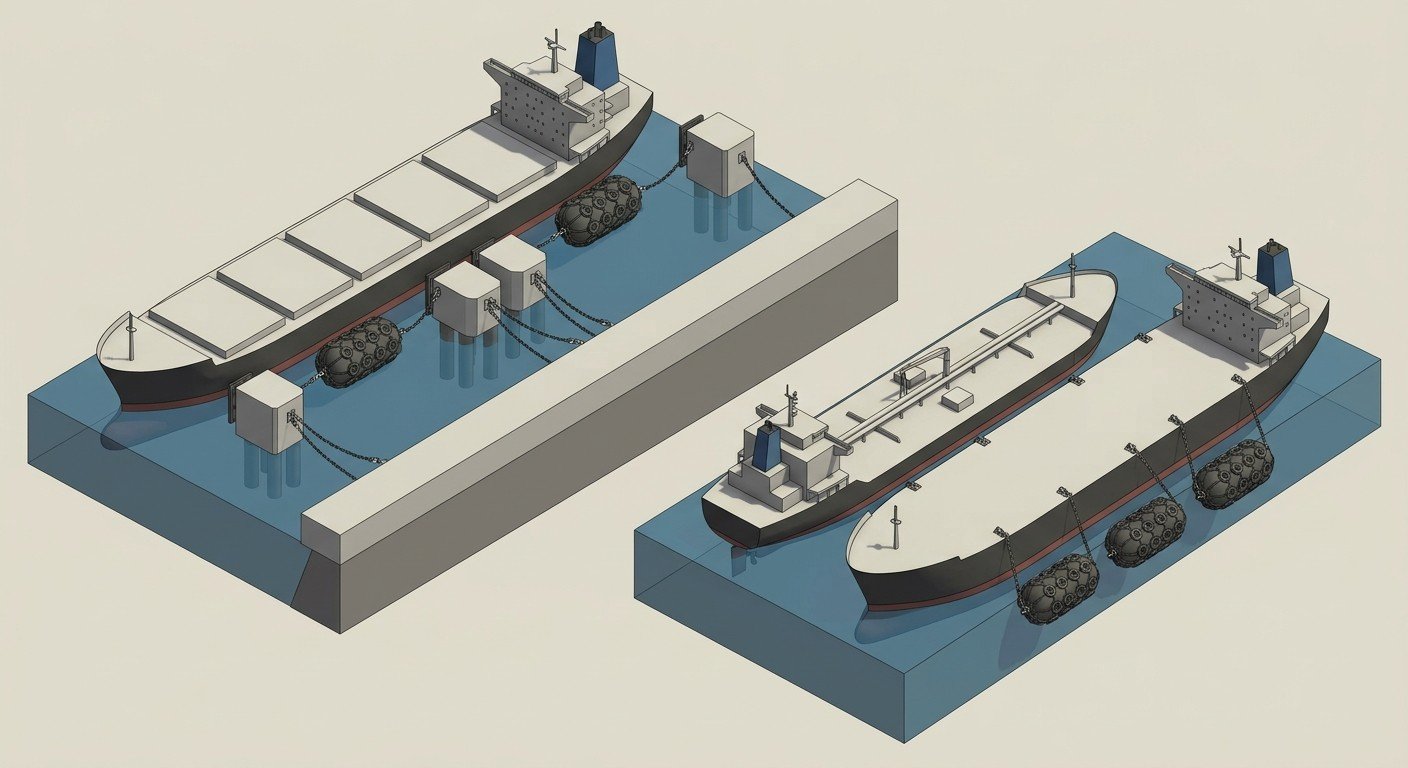
PIANC MarCom WG 211 covers fender systems for seagoing vessels under controlled berthing — meaning maneuvers assisted by tugs or vessel thrusters. The scope spans design basis, berthing energy, fender selection, response under moored conditions, components, manufacturing, testing, inspection and maintenance, sustainability, and specification writing.
The following are out of scope and need separate references:
- Collision protection structures
- Lock-chamber fender design
- Inland vessel and barge fender design
For LNG carriers and FSRUs operating under pilotage with tug assistance, WG 211 is the applicable design guideline. For non-controlled impact loading or barge operations on inland waterways, buyers need to consult other PIANC reports or industry standards.
The guideline applies whether the project is a new greenfield jetty, a brownfield retrofit, or a floating receiving terminal.
How WG 211 Changes LNG Terminal Fender Design vs WG33
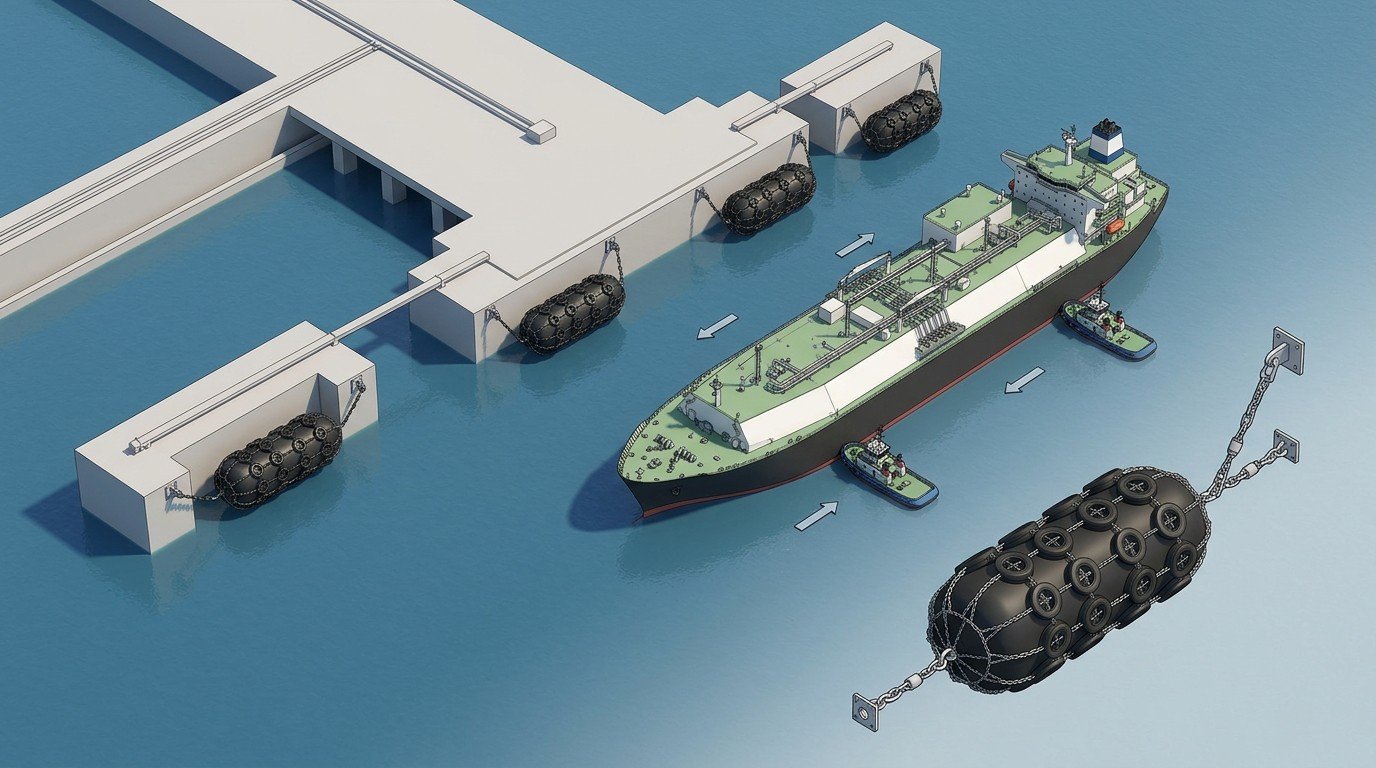
WG 211 changes the way buyers should read an LNG fender specification. PIANC’s own communication points to a better representation of the physical berthing process. An old WG33 specification should not be reused without recalculating the berthing energy, fender response, and structure interaction.
The main procurement checks are below.
| Aspect | WG33 (legacy) | WG 211 (2024) |
|---|---|---|
| Status | Superseded | Supersedes WG33 and WG33-based guidance in other MarCom reports (§1.1) |
| Design data source | Generic tables widely used | Site-specific data strongly recommended; PIANC fallback velocities (Table 5-3) only when no site data exists |
| Berthing velocities | Generally lower assumptions | Higher; fallback values in Table 5-3 |
| Berthing angles | Higher | Lower; fallback values in Table 5-5 |
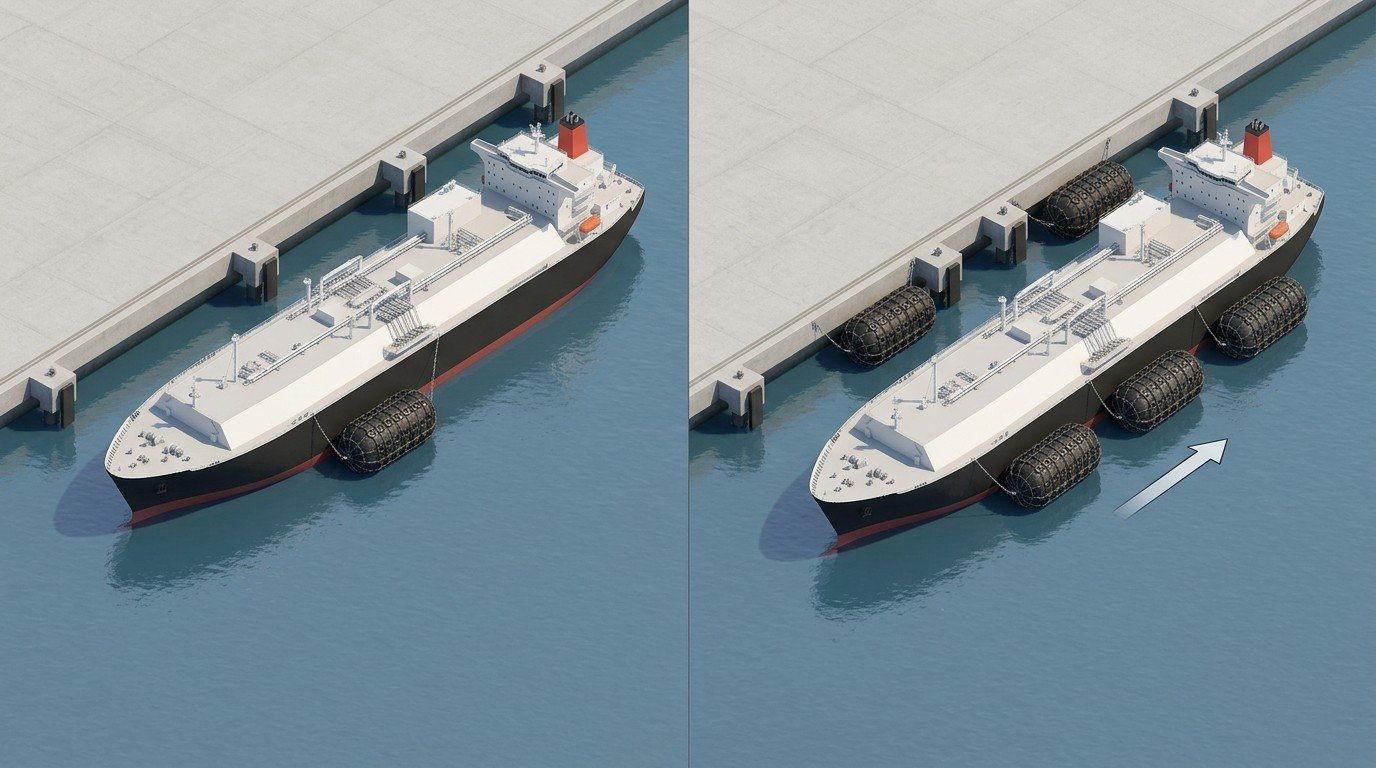
| Fender contact assumption | Predominantly single-fender contact | Single- and multi-fender contact treated separately (partial energy factors, Table 5-8 / 5-9) |
| Berth configuration factor (Cc) | Applied separately | Removed — its effect is already captured in the recorded berthing velocities |
| Safety hierarchy | Less explicit | Puts more safety in the rubber than in the supporting structure |
| Design return period | — | Fender designed to the same 50-year return period as the supporting structure (§4.4) |
| Specification reuse | — | Old WG33 specs cannot be relabelled; full update required |
| Catalogue transition | — | Supplier transition period ends 1 May 2026 |
The site-specific data emphasis is the most operationally significant change for LNG terminal owners. Buyers commissioning a new specification should expect a metocean and berthing study, not a generic WG33 lookup. The report is explicit that when site-specific data is used, fenders come out slightly smaller than under WG33 — and that ignoring local knowledge tends to over-design them.
WG 211 gives fallback berthing velocities in Table 5-3 only for cases with no site data. LNG carriers are not listed as a separate class; the report instructs designers to use the equivalent vessel size, while noting most gas carrier owners hold their own berthing datasets. For the large-vessel classes an LNG carrier maps to, the table’s characteristic perpendicular velocities run 0.100 m/s (favourable conditions) to 0.250 m/s (unfavourable), with a recommended floor of 0.10 m/s for new berths. Table 5-5 gives the matching berthing angles — a characteristic angle as low as 2° for parallel, tug- and thruster-assisted approaches. Treat both as conditional fallbacks, not LNG design values: the project engineer sets the governing inputs.
The energy calculation feeding fender sizing follows from that input — see our notes on LNG carrier berthing energy calculation for the input parameters typically required.
PIANC WG 211 vs ISO 17357 vs OCIMF / SIGTTO References
WG 211 is the umbrella design guideline for fender systems. It points down to product standards and across to operational guidance. Buyers should keep the layers separate: one document does not replace the others.
| Reference | What It Governs | Relationship to WG 211 |
|---|---|---|
| PIANC MarCom WG 211 (2024) | Whole-system fender design, manufacturing, testing, I&M, specification writing for seagoing vessels under controlled berthing | The umbrella design guideline |
| ISO 17357-1 | Pneumatic fender product standard (testing, performance reporting as guaranteed value) | WG 211 refers to ISO 17357-1 for pneumatic fender material and performance testing (§6.7.2, §9.7, §10.9) |
| OCIMF MEG4 | Mooring equipment and offshore fendering reference for STS/LNG project practice | Complements WG 211 where mooring and offshore transfer practice must be checked |
| OCIMF / SIGTTO general LNG guidance | Operational practice for LNG and LNGC | Sits alongside WG 211; WG 211 is the engineering / fender-system guideline |
A procurement specification for an LNG terminal typically cites WG 211 for the fender-system design basis and the ISO 17357 pneumatic fender standard for pneumatic product testing and performance reporting. OCIMF MEG4 enters when the project also needs mooring or offshore STS practice checked.
WG 211 does not replace ISO 17357 or OCIMF documents. It points to them.
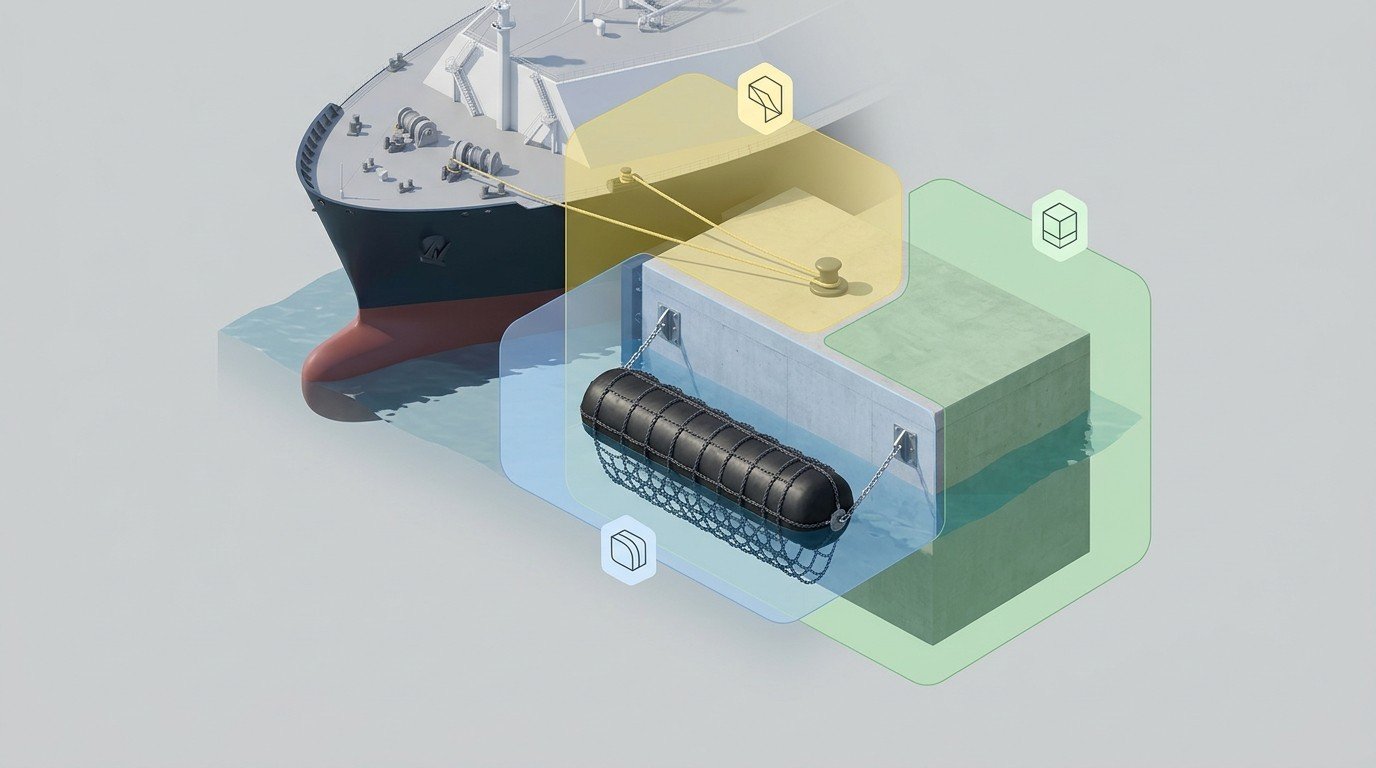
LNG Terminal & FSRU Fender Design Considerations Under WG 211
A buyer checklist for specifying fenders on LNG terminal and FSRU projects under WG 211 should cover the factors below. The table summarises what the guideline emphasises in plain terms; the governing numbers are site-derived inputs the project consultant provides.
| Design Factor | What WG 211 Emphasises (in plain terms) | Implication for Fender Selection |
|---|---|---|
| Site-specific environmental data (wind, current, wave) | Use real site measurements; fall back to PIANC velocities only if no site data exists | Avoid one-size-fits-all sizing; commission a metocean / berthing study |
| Berthing velocity | Updated, generally higher than WG33 assumptions | Re-check energy absorption capacity of legacy specs |
| Berthing angle | Lower angles than WG33 | Influences contact geometry and reaction force distribution |
| Single vs multi-fender contact | Treated as separate cases with their own partial energy factors (Table 5-8 single contact, Table 5-9 multiple contact) | Changes the design energy per unit; confirm which case the consultant applied |
| Safety hierarchy | Allow rubber to fail before supporting structure | Pneumatic or foam-filled units may be preferred where protecting the supporting structure is the priority |
| Whole-system approach | Includes I&M, sustainability, specification writing | Procurement scope expands beyond bare fender unit |
| Pneumatic fender performance | Reported as “guaranteed value” under ISO 17357-1 testing | Demand documented test reports against ISO 17357-1, not “PIANC certified” claims |
For procurement teams, the practical change is the depth of input data the design engineer needs.
A standard pneumatic fender enquiry under WG 211 typically asks for vessel particulars at light and laden draft, design berthing velocity, design berthing angle, approach configuration, jetty stiffness, and the chosen energy coefficients. Suppliers should not be expected to size a fender from vessel class alone.
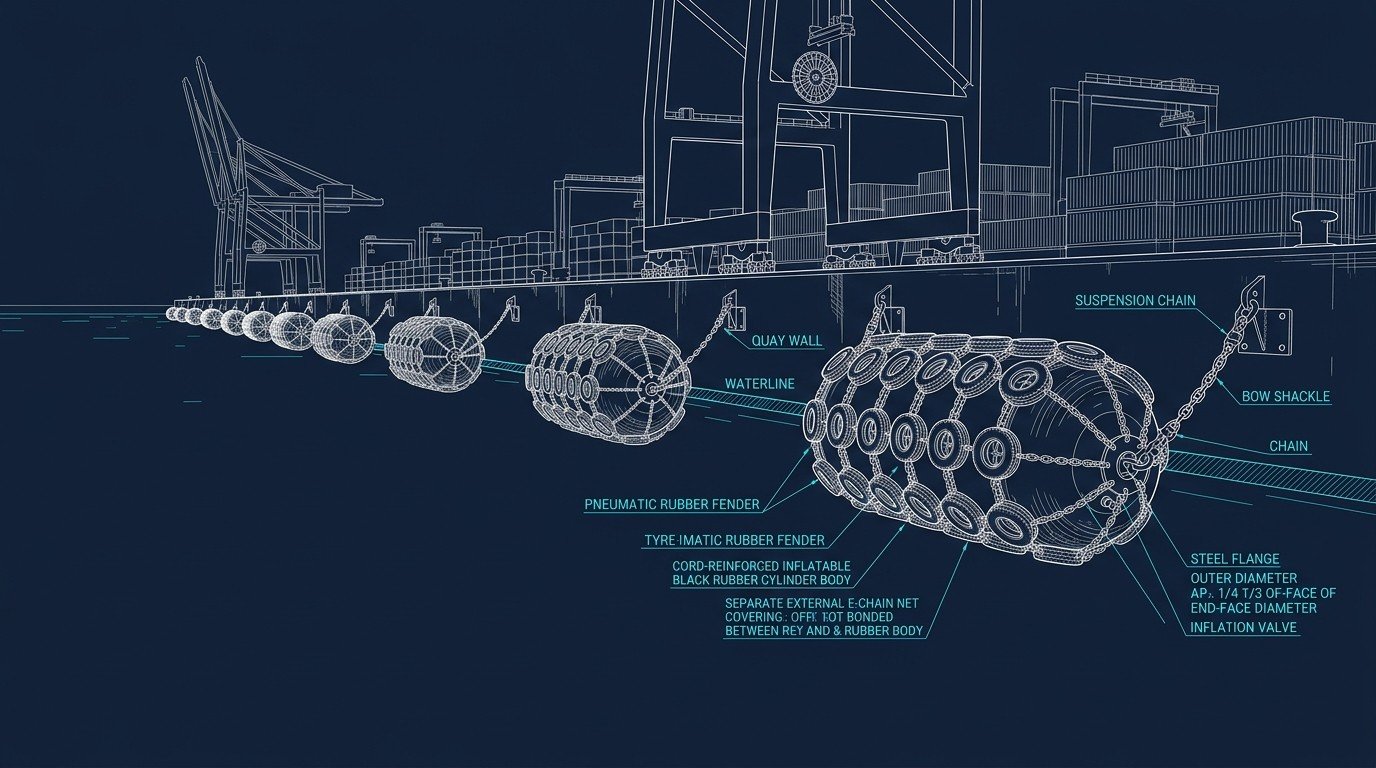
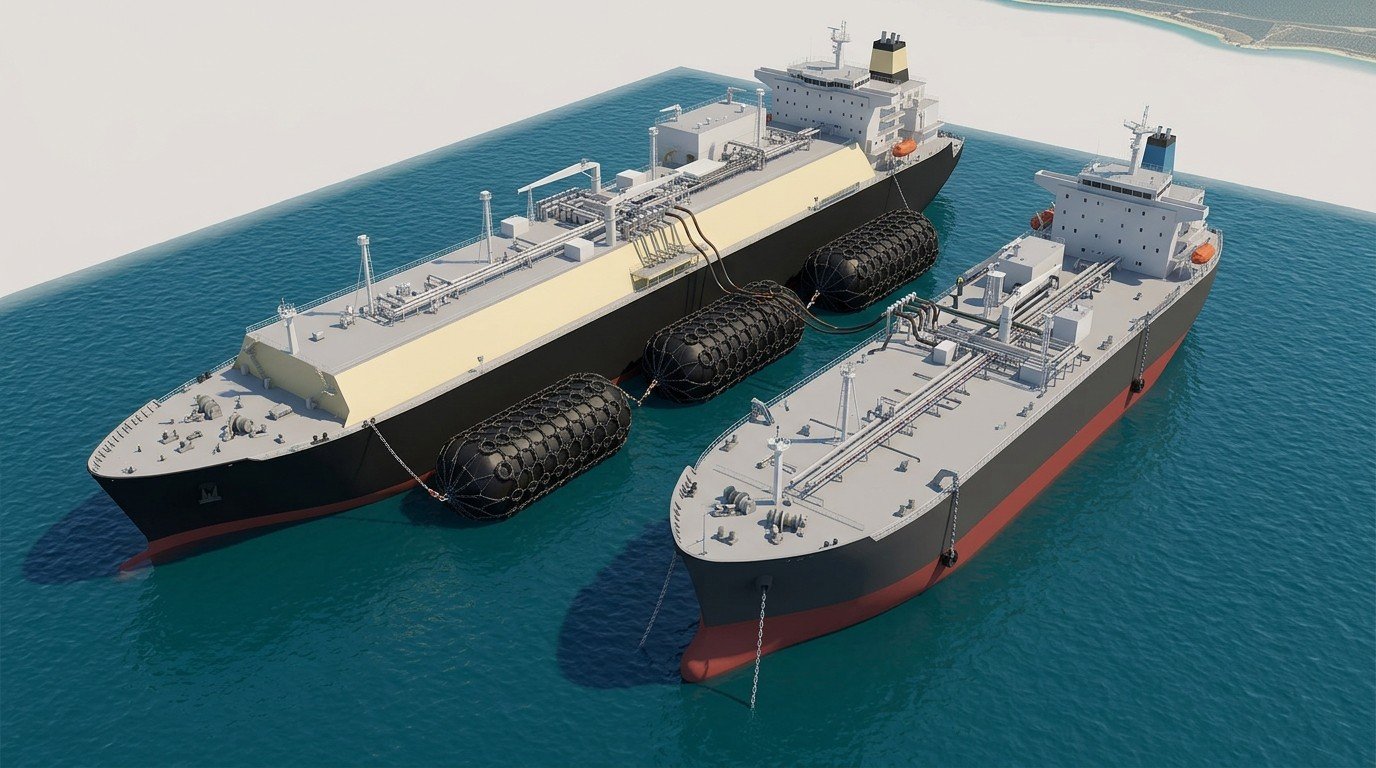
STS, Nearshore Transfer, and FSRU Fendering
WG 211 gives guidance for in-port or nearshore STS applications and FSRU-related fendering cases that sit outside normal vessel-to-dock berthing. Offshore STS practice still needs OCIMF MEG4, the OCIMF STS guidance, IMO guidance, and any class requirements that apply to the transfer.
For LNG projects, the practical point is this: do not treat an FSRU or nearshore STS case as a normal jetty fender line. The fenders, stand-off distance, relative approach velocity, and mooring arrangement all need to be checked together.
For STS, the governing input is the closing velocity — the relative approach speed of the two vessels, which the report flags as the single most important factor because berthing energy scales with its square. Table 5-13 gives characteristic closing velocities by deadweight and sea state, sized off the smaller vessel. For vessels above 100,000 t these run 0.150 m/s in calm conditions to 0.250 m/s in rough seas; smaller vessels and higher sea states reach up to 0.500 m/s. The report cautions these are starting points only — and that STS in moderate or rough sea states is often not considered safe at all.
For procurement, this changes the reference stack. An FSRU project specification under WG 211 cites the guideline for the fender-system design basis, ISO 17357-1 for pneumatic product testing, and OCIMF MEG4 for the broader mooring envelope.
Yokohama-type pneumatic fenders remain the dominant solution for these applications. Foam-filled fenders also appear where buoyancy at low tide or reduced maintenance is the priority.
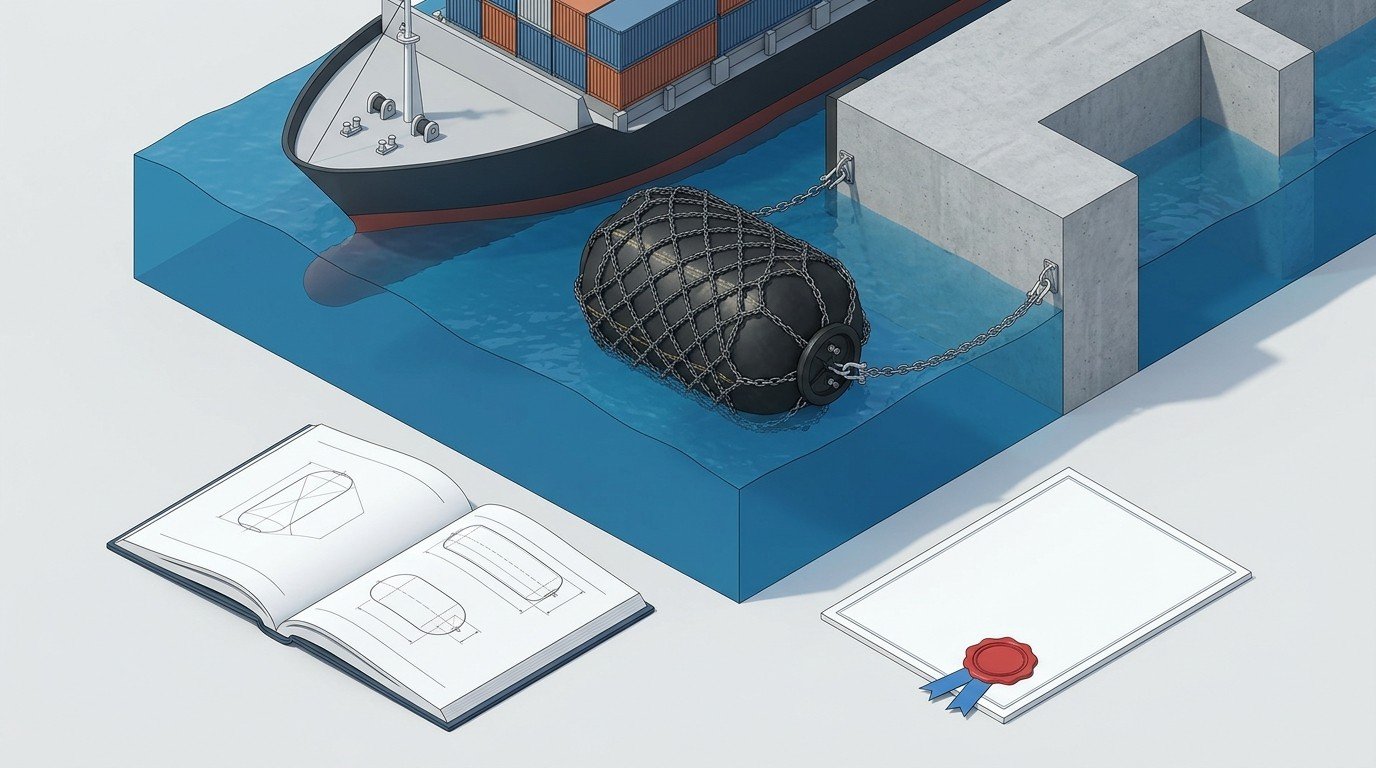
“PIANC Certified Fender” — Why That Phrase Is Misleading
PIANC publishes guidelines. It does not test, audit, or certify fender products. The report states plainly that “conformity is not obligatory” and that PIANC “disclaims all responsibility in the event that this report should be presented as an official standard.” No supplier can produce a fender that is “PIANC certified,” because PIANC operates no certification scheme — type approval testing rests with a third party.
What a supplier can legitimately claim is that a fender is designed and tested in line with WG 211 and that pneumatic units are tested to ISO 17357-1 with documented type test and routine test reports. Buyers should request the actual test reports — not marketing language referring to PIANC compliance.
This distinction matters during technical bid evaluation. A claim of “PIANC certified” on a datasheet is a flag for tighter QA review.
Frequently Asked Questions
Does PIANC MarCom 211 specify a fender size for LNG carriers?
No. WG 211 is a design guideline. Fender size results from site-specific berthing energy calculations performed by the project engineer, not from a PIANC lookup table. The guideline sets out the design method, not a sizing chart. LNG carriers are not even listed as a separate class in the fallback velocity table — the report tells designers to use the equivalent vessel size and notes most gas carrier owners hold their own berthing data.
Is PIANC MarCom 211 the same as ISO 17357?
No. PIANC 211 is a fender-system design guideline covering the whole project lifecycle. ISO 17357-1 is a product standard for pneumatic fenders, governing testing and performance reporting. WG 211 refers to ISO 17357-1 for pneumatic fender testing.
Does PIANC 211 apply to ship-to-ship (STS) transfers?
Partially. WG 211 includes in-port and nearshore STS cases, including FSRU-related fendering. Offshore STS practice still needs OCIMF MEG4, the OCIMF STS guidance, IMO guidance, and any class requirements that apply. Treat the documents as complementary, not interchangeable.
Is there such a thing as a “PIANC certified fender”?
No. PIANC is not a certifying body. A fender can be designed and tested in line with WG 211, and a pneumatic fender can be tested to ISO 17357-1. The phrase “PIANC certified” has no technical meaning — the report explicitly states conformity is not obligatory.
Can we keep our existing WG33-based fender specification?
No. WG 211 completely supersedes WG33. Specifications need a full update — new berthing energy calculations, updated velocity and angle assumptions, and single- versus multi-fender contact considerations. The supplier catalogue transition window ends 1 May 2026.
If you are updating an LNG terminal, FSRU, or nearshore STS fender specification under PIANC MarCom 211, send us the vessel size, design berthing velocity, berthing angle, and berth arrangement. We can help check the pneumatic fender size against the WG 211 design basis and ISO 17357-1 test reporting.
Sources
- PIANC. Guidelines for the Design, Manufacturing and Testing of Fender Systems (MarCom Working Group Report N° 211, March 2024, ISBN 978-2-87223-036-5). Official publication page
- ISO 17357 pneumatic fender standard — internal reference page
For the system-level design framework behind these standards, see our guide to the LNG terminal fender system.