
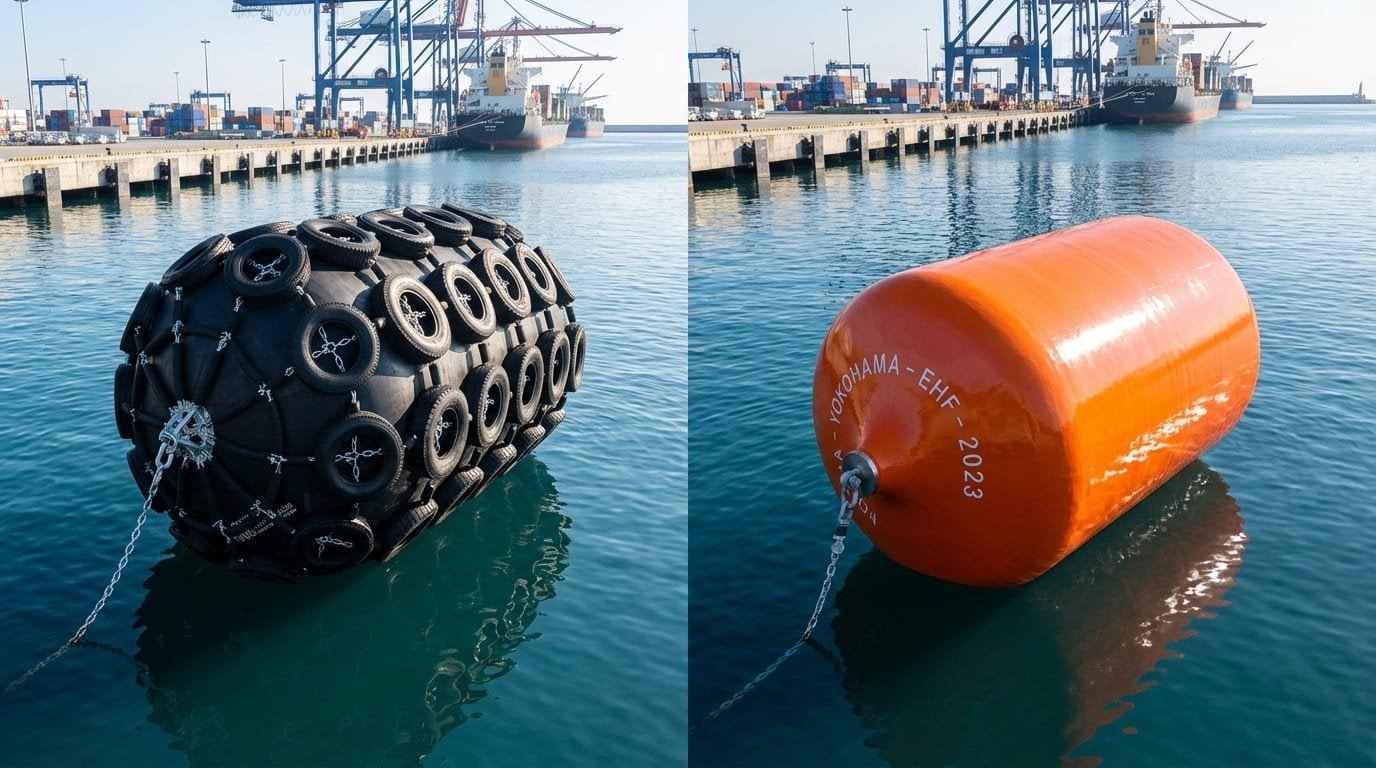
Comparison Guide · LNG / STS / FSRU
Pneumatic Fender vs Foam Fender: Which Is Right for LNG Terminals and STS Transfer?
A standards-based comparison for terminal engineers, STS operators, EPC contractors, and procurement teams evaluating compliance, hull pressure, certification, maintenance, and operating fit.
When comparing a pneumatic fender vs foam fender for LNG terminals and STS transfer, pneumatic fenders are the standard choice. They comply with ISO 17357-1:2014, align with OCIMF and SIGTTO guidance, and deliver low hull pressure — around 130-160 kPa at 60% deflection for Pneumatic 50 fenders, within the PIANC gas-carrier limit. Foam fenders are better suited to remote offshore moorings and secondary positions where maintenance-free service life matters most.
Quick Verdict
Choose pneumatic fenders for LNG terminals, FSRU berths, and ship-to-ship transfer where standards compliance, class certification, and adjustable performance matter. Choose foam fenders for remote, low-maintenance, non-critical, or secondary positions.
Definitions
What Are Pneumatic and Foam Fenders?
Both are floating marine fenders, but they solve impact protection in different ways and fit different operating conditions.
A pneumatic fender, also called a Yokohama-type fender, is an air-filled rubber cylinder. When a vessel comes alongside, the fender compresses and absorbs berthing energy through internal air pressure. It is manufactured and tested to ISO 17357-1:2014, with performance governed by initial internal pressure (IIP), typically 50-80 kPa. JettyGuard pneumatic fender specifications are widely used for LNG terminals, FSRU berthing, and ship-to-ship operations.
A foam-filled fender uses a closed-cell EVA foam core with a polyurea or polyurethane skin. The foam core provides buoyancy and energy absorption without internal air pressure. Because the fender cannot deflate, it remains usable after surface damage and needs no pressure monitoring. That makes it a good fit for remote offshore moorings, SPM buoys, and berths with limited maintenance access.
Both types float independently and can be deployed without quay-wall mounting. In practice, the pneumatic fender vs foam fender decision depends on application, standards requirements, and maintenance access — which the comparison table below breaks down point by point.
Decision Table
Quick Comparison — Pneumatic vs Foam Fender at a Glance
All performance values below use the 3300x6500mm size, a common LNG/STS comparison point, at 60% deflection for pneumatic fenders and rated deflection for foam-filled fenders.
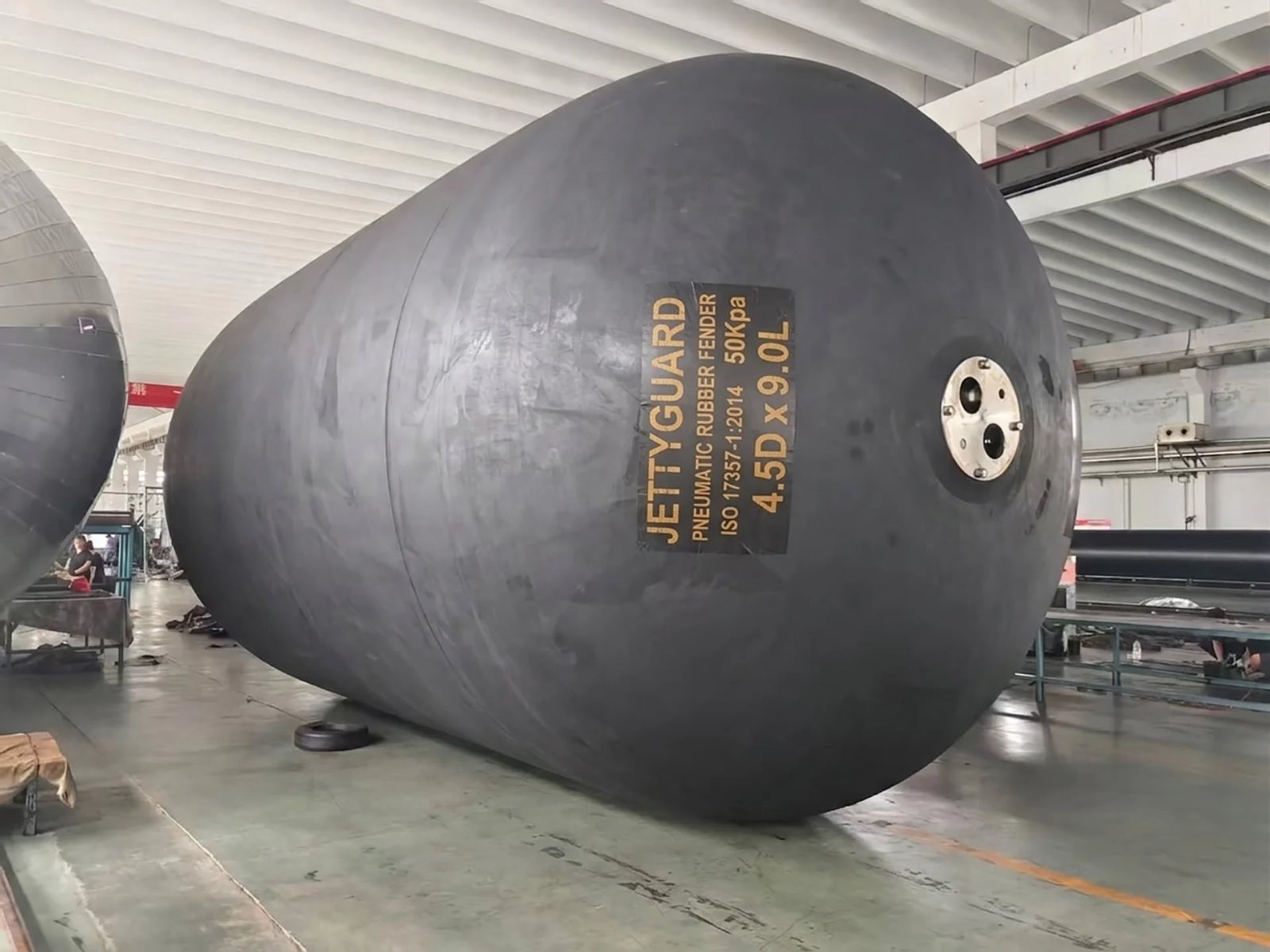
Why This Table Matters
This is the core reference asset for LNG and STS buyers.
Most comparison pages in search results stay generic. This table gives a standards-based, application-specific view of hull pressure, certification, energy absorption, reaction force, and maintenance trade-offs.
It is designed for engineering review, procurement comparison, and AI citation because it answers the practical choice question directly.
| Criterion | Pneumatic (Yokohama-Type) Fender | Foam-Filled Fender |
|---|---|---|
| Standards Compliance | ISO 17357-1:2014 (Clause 8/9/12 testing framework) | No equivalent ISO standard for floating foam fenders |
| Hull Pressure | ~130-160 kPa typical at 60% deflection (Pneumatic 50) | Variable and typically higher at equivalent deflection |
| OCIMF STS Guide | Referenced in the OCIMF Ship-to-Ship Transfer Guide for oil and gas terminals | Not a primary specification in LNG/oil terminal guidance |
| LNG STS Application | Standard choice for LNG/LPG ship-to-ship transfer | Rarely specified for STS; usually secondary or backup use |
| FSRU Berthing | Preferred in SIGTTO-led terminal specifications | Not common in FSRU berthing specifications |
| Third-Party Certification | BV, DNV, ABS, LR against ISO 17357 | BV, SGS inspection available; no equivalent ISO certification path |
| Energy Absorption | Adjustable via IIP: 1,814-2,534 kNm | Fixed at manufacture: 2,421-3,148 kNm |
| Reaction Force | Adjustable: 3,015-3,961 kN | Fixed: 2,731-3,550 kN |
| Maintenance | Periodic pressure checks and hardware inspection | Minimal visual inspection; no inflation system |
| Service Life | Typically 10-15 years with proper maintenance | Typically 15-20 years |
Data source: JettyGuard catalog data for JYTF 3300x6500 pneumatic fenders and JFF 3300x6500 foam-filled fenders. Pneumatic data is based on ISO 17357-1:2014 testing at 60% deflection. Third-party inspection reports and class certificates are available on request.
Note on reaction force: Lower reaction force for the same energy absorption reduces load on both the vessel hull and the berth structure. Pneumatic fenders usually deliver a more favorable energy-to-reaction-force ratio, especially at lower IIP settings.
Project Support
Need help choosing between pneumatic and foam fenders?
Send vessel size, berth type, and standards requirements for a side-by-side recommendation.
Scenario Verdict
Which Fender Type Should You Choose?
Use the project condition first, then check whether standards, maintenance, or deployment flexibility is the main constraint.
LNG terminal or FSRU berth
Choose pneumatic fenders because ISO 17357, OCIMF, and SIGTTO alignment simplifies technical approval and gives a clear certification path.
Ship-to-ship LNG or LPG transfer
Choose pneumatic fenders because 50-80 kPa internal pressure adjustment allows one fender set to cover different vessel pairings.
Remote offshore mooring
Choose foam fenders when there is no practical pressure-monitoring access and long service intervals matter more than standards-driven LNG compliance.
Secondary or non-critical berth position
Foam fenders can be a practical option where LNG/STS compliance is not the main constraint and low maintenance is prioritized.
This page is a practical marine fender comparison for buyers reviewing OCIMF fender requirements.
For LNG, FSRU, and oil-and-gas terminal projects, the pneumatic fender vs foam fender choice usually starts with standards compliance, not simple product preference.
Application Fit
When to Choose Pneumatic Fenders
Pneumatic fenders are preferred when standards alignment, hull-pressure control, and operational flexibility are part of the specification.
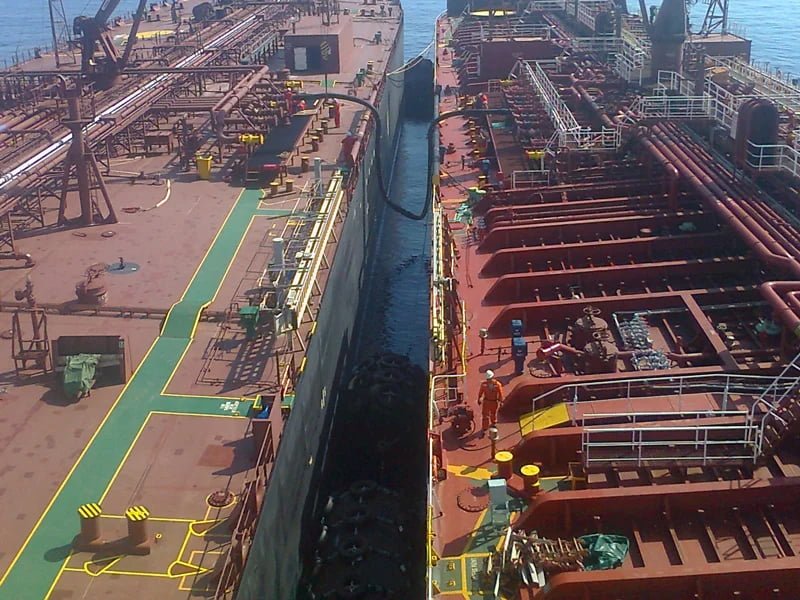
LNG / FSRU
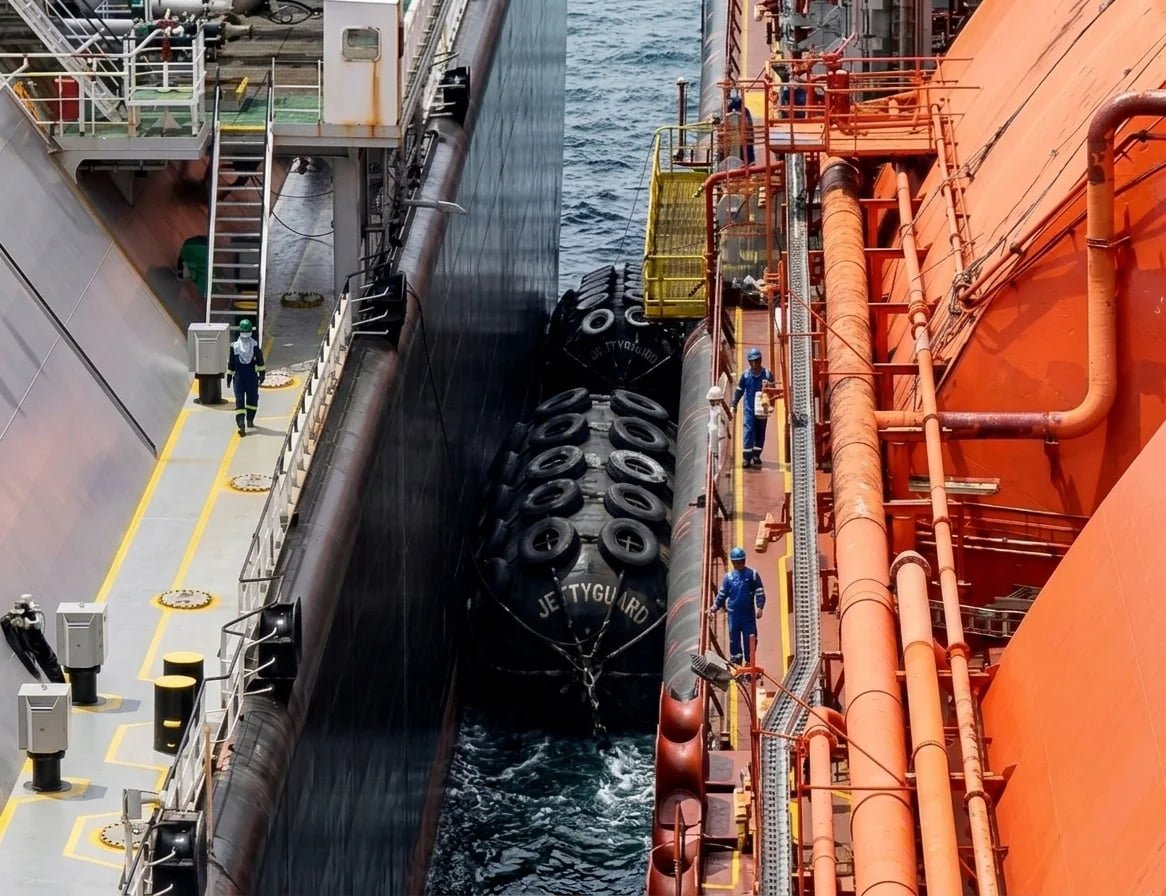
LNG terminal and FSRU berthing
If your project specification references the OCIMF Ship-to-Ship Transfer Guide or SIGTTO guidance, pneumatic fenders are the referenced choice. LNG carriers have thinner hull plating than crude tankers, so low and predictable hull pressure matters.
Pneumatic 50 fenders deliver around 130-160 kPa at 60% deflection, a value your marine engineer can verify against the vessel hull-pressure limit. Most FSRU and LNG terminal berthing specifications default to pneumatic fenders for this reason.
STS
Ship-to-ship transfer operations
STS campaigns involve different vessel pairings — sometimes within the same week. Pneumatic fenders handle this through internal pressure adjustability. At 50 kPa IIP, a JYTF 3300x6500 absorbs 1,814 kNm; at 80 kPa, it absorbs 2,534 kNm.
That is a 40% increase in energy absorption from one air-pressure change, without changing hardware. One fender set covers multiple vessel classes. Ship-to-ship transfer fender systems are built around this flexibility.
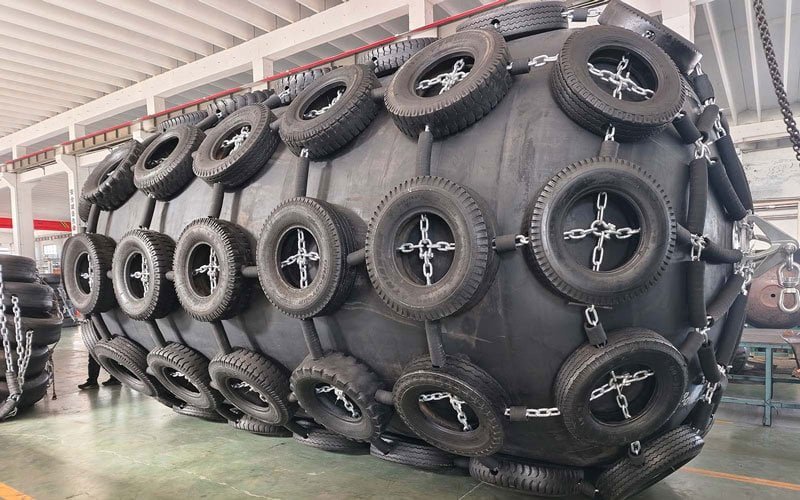
Certification / Logistics
Certification and redeployment advantages
When the engineering specification requires class-society certification against ISO 17357, pneumatic fenders are the straightforward compliant choice. The framework is recognized by BV, DNV, ABS, and LR.
Pneumatic fenders also deflate for shipping. A deflated 3300x6500 unit occupies about 30% of its inflated volume, which can reduce mobilization cost for operators moving equipment between lightering zones.
Application Fit
When to Choose Foam Fenders
Foam-filled fenders are a better fit when low maintenance, puncture tolerance, and long service intervals matter more than LNG/STS standards alignment.
Coastal / Feeder
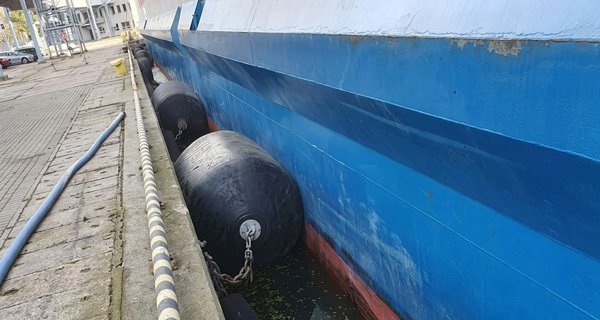
Smaller coastal terminals and feeder vessel berths
At smaller coastal or river terminals where ISO 17357 certification and OCIMF Ship-to-Ship Transfer Guide alignment are not contractual requirements, foam fenders offer a cost-effective alternative. Their puncture-tolerant closed-cell core and zero-maintenance requirement reduce total cost of ownership for operators with limited maintenance resources.
Without an inflation system to monitor, air valves to inspect, or pressure loss to track, a foam fender installation at a feeder terminal can operate reliably on routine visual checks alone.
Puncture Tolerance
Debris-prone waters and difficult access locations
If the fender operates in waters with floating debris or in locations where service interruption is difficult to manage, closed-cell foam provides a practical safety margin.
A punctured pneumatic fender loses energy-absorption capacity until repaired and re-inflated. A punctured foam fender retains buoyancy and remains serviceable because the structure is not dependent on a single air chamber.
General / Secondary Positions
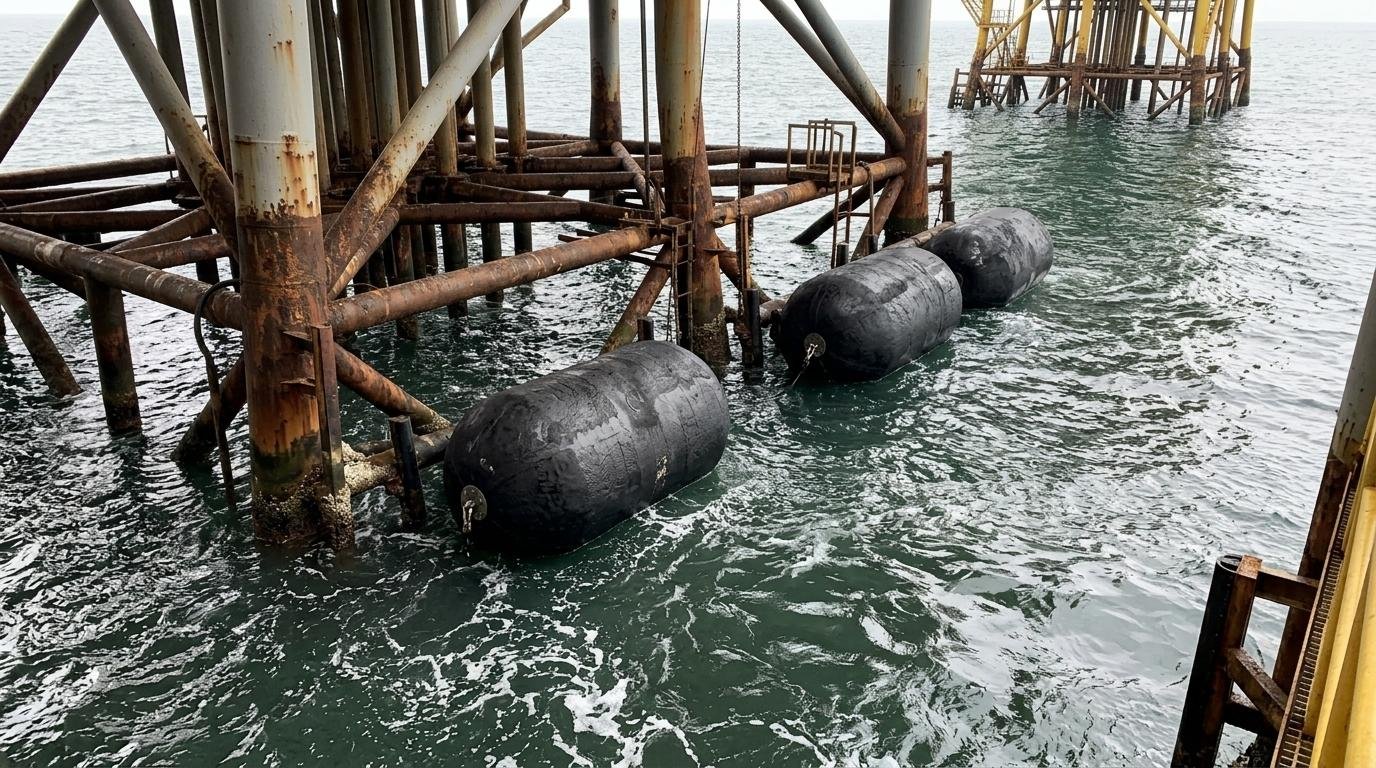
General cargo berths and secondary LNG positions
For standard port berths where OCIMF/SIGTTO compliance is not required and vessel hull-pressure limits are less restrictive, foam fenders offer longer service life with lower maintenance overhead.
Even at LNG terminals, foam fenders can serve in non-critical secondary positions such as standby fenders, guide fenders, or berth corners where vessel contact is infrequent.
View our foam-filled fender specifications →For fixed berth selection, also see our foam filled fender vs rubber fender comparison.
Hybrid Strategy
Can Both Types Be Used Together?
Yes. Mixed fender configurations are common where terminals handle multiple vessel types or need different protection logic at different berth positions.
A common arrangement at LNG terminals is to use pneumatic fenders in the primary berthing positions where ISO 17357 compliance and pressure adjustability are required, while using foam fenders at standby positions or guide points where maintenance-free service is preferred.
For STS operations, the primary fender set is pneumatic. Some operators also keep foam fenders as backup units because they can be stored long-term without pressure maintenance and deployed quickly if a pneumatic fender is taken out of service.
JettyGuard manufactures both JYTF pneumatic fenders and JFF foam-filled fenders, so hybrid configurations can be matched to the berth layout and operational profile.
Standards
Standards and Regulatory Framework
For LNG, FSRU, and oil-and-gas terminal projects, the pneumatic fender vs foam fender decision usually starts with standards compliance rather than simple product preference.
International pneumatic fender standard
Defines material requirements, tolerances, burst-pressure safety margins, and performance testing at 50 kPa and 80 kPa IIP. No equivalent ISO standard exists for floating foam fenders.
Oil and gas terminal reference
The OCIMF Ship-to-Ship Transfer Guide references pneumatic fenders for ship-to-ship and terminal operations at oil and gas facilities. This is a core reference point in LNG and crude STS projects.
LNG transfer guidance
Guidance for LNG and LPG transfer operations references pneumatic fender systems, especially where predictable hull pressure and standardized testing are required.
Fender system design guidance
PIANC design guidance supports structured fender selection. Pneumatic fenders benefit from a dedicated ISO testing standard, while foam fenders rely on manufacturer-specific testing protocols.
If your project specification cites any of these standards, pneumatic fenders are usually the straightforward compliant route. Foam fenders are not prohibited, but choosing them for an OCIMF-governed project creates an extra justification step during specification review.
Capability
JettyGuard Supply and Inspection Capability
Documentation and certification support are often as important as the fender itself during bid review and technical approval.
ISO-certified range
ISO 17357-1:2014 certified pneumatic fenders with BV, DNV, ABS, and LR certificates available.
Standard and high-energy options
Foam-filled fenders available with polyurea or polyurethane skin for different durability and energy requirements.
Complete hardware supply
Chain systems, tire nets, shackles, and related fender hardware can be supplied together with the main units.
Inspection-ready package
Test reports, material certificates, and third-party inspection support are available on request.
FAQ
Frequently Asked Questions
Common project questions from LNG terminal, FSRU, and STS buyers comparing pneumatic and foam fenders.
Can foam fenders replace pneumatic fenders for LNG ship-to-ship transfer?
Do OCIMF guidelines specify which fender type to use?
Which fender type has lower hull pressure for LNG carrier berthing?
Are foam fenders cheaper than pneumatic fenders?
Project Inquiry
Request a Fender Type Check
Send us your vessel size, berth type, required standard, and operating condition. JettyGuard will compare pneumatic and foam options and recommend the safer specification path.
What to prepare
Vessel size or vessel pairing, berth type, required standard, operating condition, and any class-society or inspection requirement.

We compare pneumatic and foam options based on your operating condition, not just nominal size.
Comparison Inquiry
Need help choosing between pneumatic and foam fenders?
Send berth type, vessel data, and standards requirements for a side-by-side recommendation.
Get a Fender Type Recommendation