
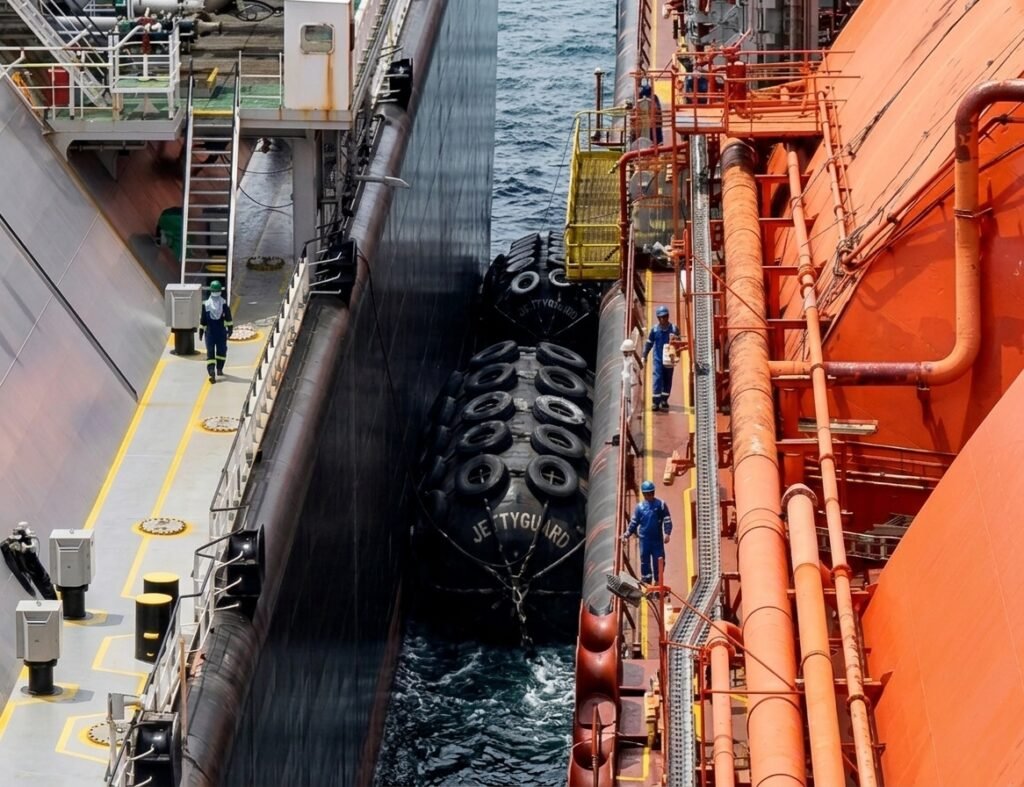
Most engineers searching this question find conflicting answers. Some sources describe jetty fenders. Others list foam fenders. Neither is correct for this application. FSRU berthing is fundamentally different from jetty berthing — and that difference changes the fender entirely. This article explains what an FSRU is, what that operational difference means, and why pneumatic fenders are the only viable answer.
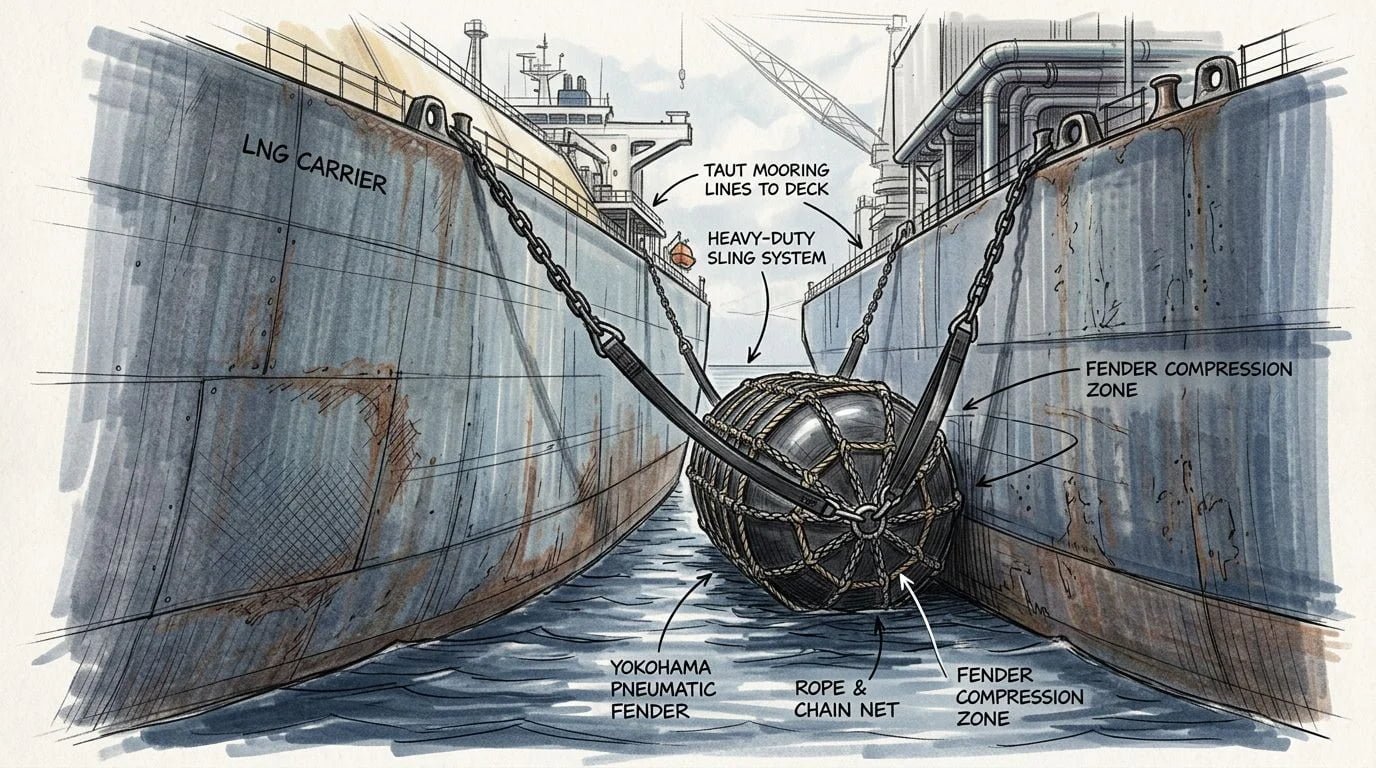
FSRU terminals use large-diameter pneumatic fenders for LNG carrier berthing. These fenders absorb the kinetic energy of an incoming LNG carrier while keeping hull contact pressure within safe limits. Typical diameters range from 2,500 mm to 4,500 mm, inflated to 50 kPa or 80 kPa initial pressure. The governing standard is ISO 17357.
What Is an FSRU?
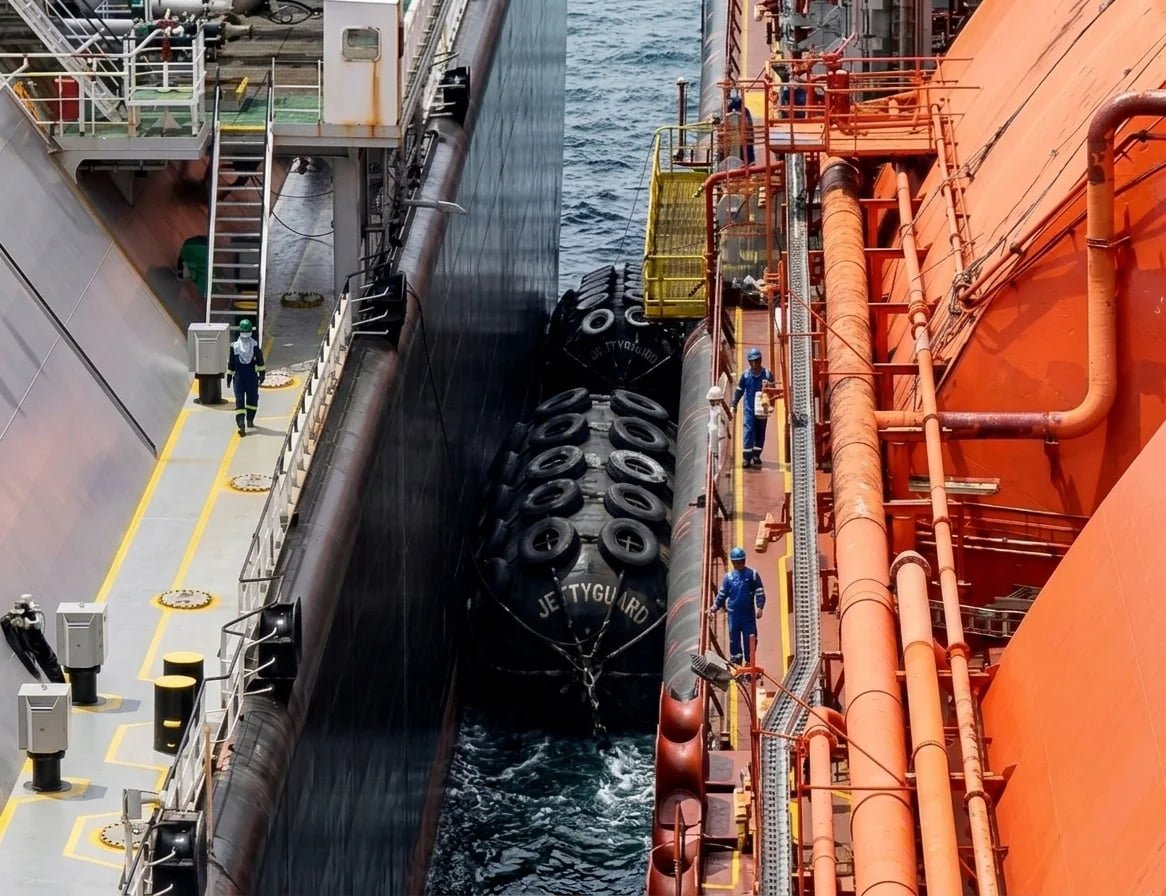
FSRU stands for Floating Storage and Regasification Unit. It is a vessel — either purpose-built or converted from an LNG carrier — that receives LNG from shuttle tankers, stores it onboard, and converts it back to gas for injection into an onshore pipeline.
Unlike a land-based LNG import terminal, an FSRU does not require full port construction. It moors at an offshore or nearshore jetty. A pipeline connects it to the onshore grid. This makes it a faster and lower-cost path to new gas supply infrastructure. The FSRU stays moored in one position. LNG carriers come to it.
How FSRU Berthing Differs from Fixed Terminal Berthing
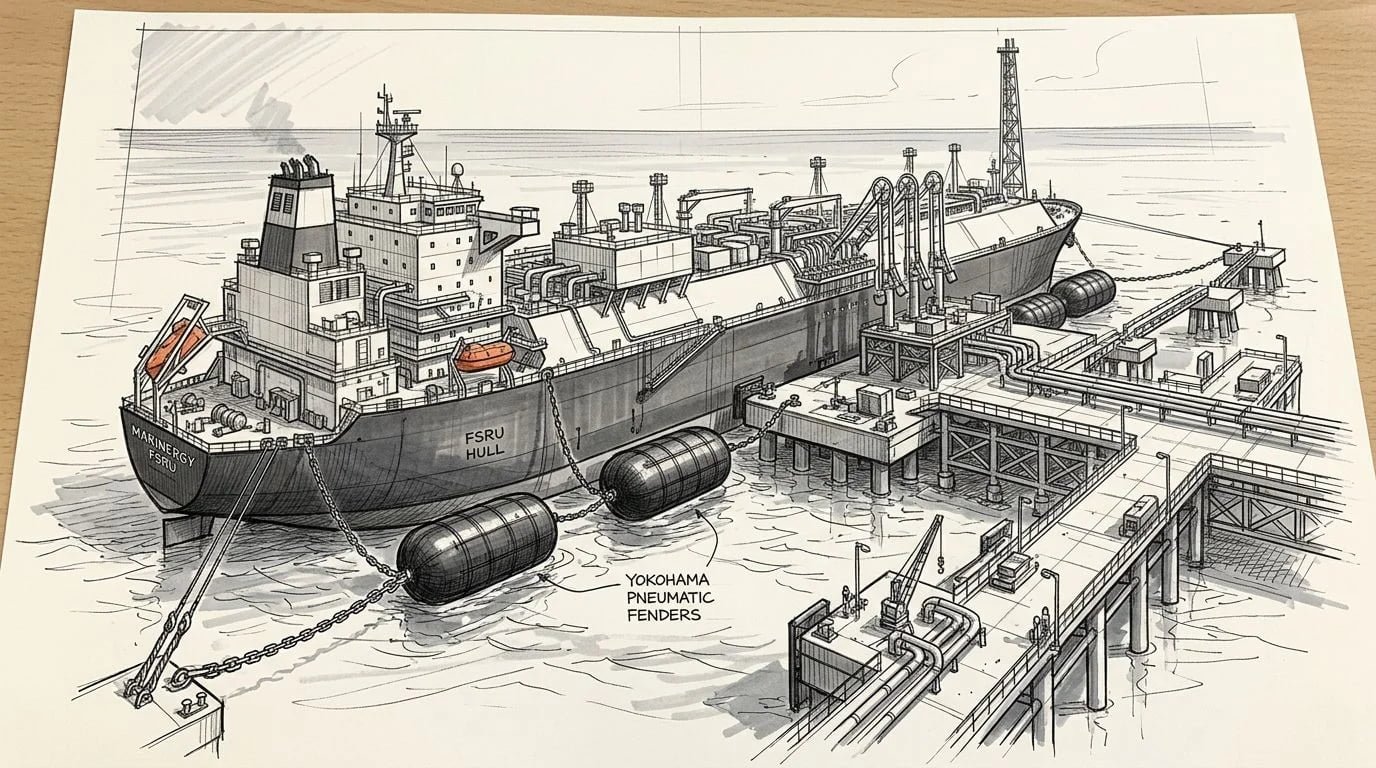
At a fixed quay terminal, a vessel berths against fenders that are bolted to a concrete or steel structure. The quay does not move. The fender absorbs the vessel’s approach energy and holds position. This is predictable and directional.
FSRU berthing is different. The FSRU is a floating vessel. The LNG carrier pulling alongside is also a floating vessel. Both hulls move in response to tide, current, and swell. The contact between them is dynamic — not a single impact event, but a continuous relationship between two moving masses.
The FSRU hull is built as a ship, not as a port structure. It is thin steel, designed to carry LNG, not to absorb berthing loads at a fixed point. A standard rubber arch fender or a rigid fender panel creates a concentrated load at its contact point. That concentrated load can damage both hulls.
This is why fender selection tables written for quay berthing do not apply to FSRU operations. The loading conditions, the hull characteristics, and the contact geometry are all different.
Why Pneumatic Fenders Are the Standard for FSRU Operations
Pneumatic fenders work for FSRU berthing for three reasons.
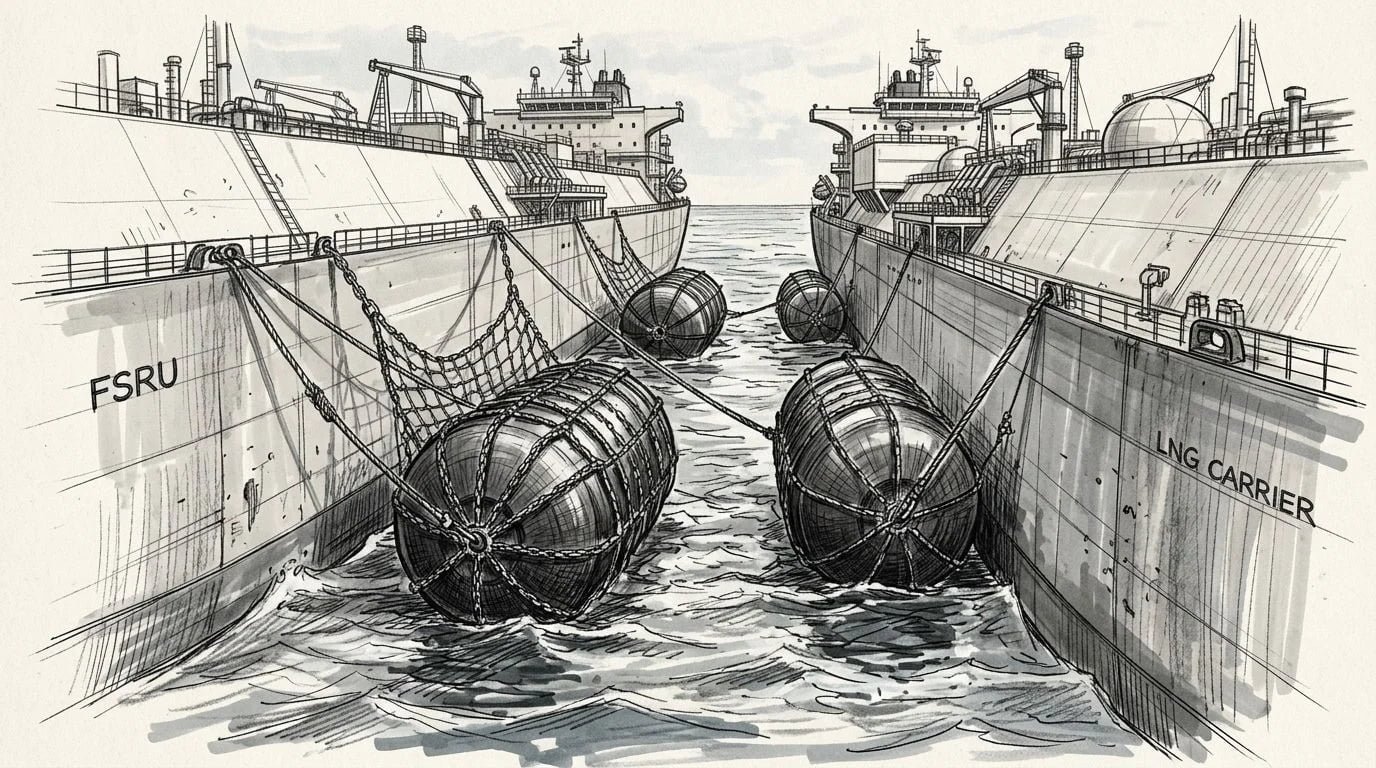
First, contact area. An inflated pneumatic fender conforms to both hulls. The contact surface is large. That large surface spreads the reaction force across a wide area, which keeps hull contact pressure low. Low hull contact pressure protects thin ship-hull steel.
Second, energy absorption. Large LNG carriers displace 80,000 to 200,000 tonnes. At approach velocities of 0.1 to 0.2 m/s, the berthing energy is substantial. Pneumatic fenders at 3,300 mm × 6,500 mm or 4,500 mm × 9,000 mm diameter have the energy absorption capacity to handle these loads.
Third, flexibility. A pneumatic fender compresses and recovers. It handles the continuous relative motion between two floating hulls without transmitting shock loads.
Not all pneumatic fenders are built the same way. For buyers with no prior experience with international brands and where lifespan requirements are not demanding, I recommend wrapped-process fenders. The price is competitive and the performance meets ISO 17357 when correctly maintained. For buyers who have used fenders from Trelleborg, Yokohama, or Palfinger and want to control cost without sacrificing quality or service life, I recommend mold-process fenders. At high operational frequencies, the consistency of mold-process manufacturing matters.
SIGTTO and OCIMF Requirements for FSRU Fenders
SIGTTO’s Ship-to-Ship Transfer Guide for Liquefied Gases and OCIMF’s Mooring Equipment Guidelines (MEG4) both specify pneumatic fenders as the standard for STS LNG operations. They define minimum energy absorption requirements by vessel class, fender positioning in the parallel body zone, and operational requirements for fender condition and pressure checks before each operation.
Meeting these requirements on paper is not enough. I worked with a buyer who purchased pneumatic fenders with the correct specification for their FSRU project — the right size, the right pressure rating, the right standard. The problem was operational tempo. That terminal ran more than three STS operations per month. Between operations, no one followed the manufacturer’s inspection schedule. No pressure checks. No visual inspection of the net and sling hardware. For complete rigging hardware specifications including shackle sizing, swivel dimensions, and certification requirements, see our rigging gear guide.
The fenders failed under load. The failure triggered a supplier dispute. The supplier had delivered a conforming product. The failure came from running that product at a frequency and without the maintenance intervals the product required. Both sides lost time and money.
SIGTTO compliance means having the right fender type — and operating it within the maintenance envelope that keeps it performing correctly. Frequency of use is part of the specification decision, not an afterthought.
For the full SIGTTO and OCIMF compliance checklist, see our pneumatic fenders for FSRU and LNG terminals page.
How Many Fenders Are Required per Side?
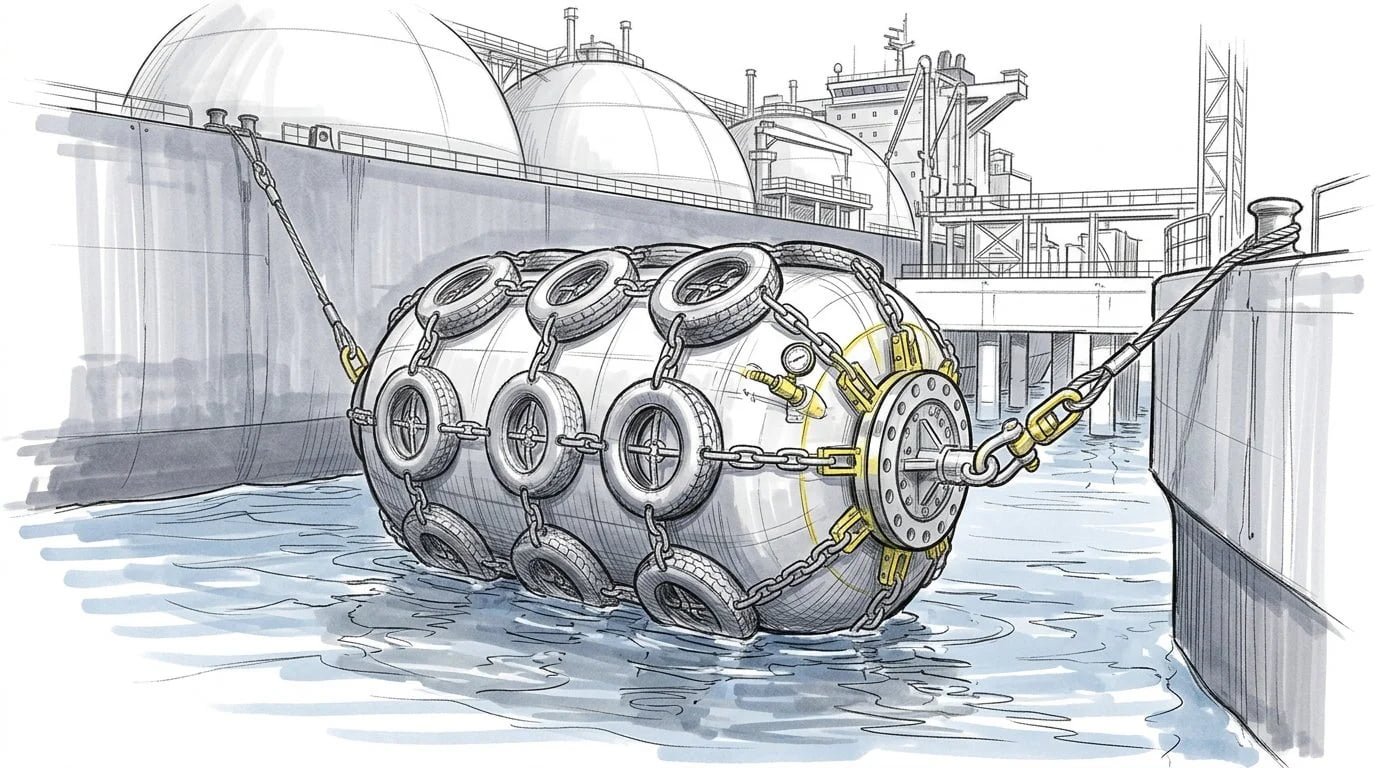
For most FSRU projects, two to four pneumatic fenders per side is the standard range. The exact number depends on LNG carrier class, fender size, and berthing layout geometry. Fenders are positioned in the parallel body zone of the LNG carrier hull — the section of the hull that runs parallel to the FSRU hull during alongside operations.
For the full breakdown by carrier class, SIGTTO layout guidance, and redundancy requirements, see how many fenders are required for FSRU berthing.
Are FSRU Fenders Permanently Mounted or Deployed per Arrival?
FSRU fenders are typically deployed for the arriving LNG carrier’s berthing period rather than left permanently in position, since the FSRU vessel operates as a floating terminal while the LNG carrier berths alongside temporarily — commonly on the order of 12 to 36 hours per offloading operation. Fenders are usually rigged from the manoeuvring or discharging ship’s deck using rope-tail and chain/tire-net sling systems, then adjusted to the correct waterline position as the carrier approaches.
Which vessel the fenders are rigged on is a judgment call for the operation, not a fixed rule: OCIMF’s STS Transfer Guide notes fenders “may be placed on either ship” depending on available mooring points and fairleads, though rigging on the manoeuvring ship is generally preferred because it reduces the risk of the fender landing on an unprotected hull section. Some operations — for example, lightering involving several transfers to multiple vessels — may instead rig fenders on the discharging ship to reduce handling.
Storing fenders between operations, rather than leaving them permanently rigged, also has a practical benefit: it limits UV exposure and physical damage during transit and idle periods when the fender isn’t needed.
Frequently Asked Questions
What size pneumatic fender is used for FSRU operations?
The most common sizes are 2,500 × 5,500 mm, 3,300 × 6,500 mm, and 4,500 × 9,000 mm (diameter × length). The correct size comes from a berthing energy calculation using the LNG carrier’s displacement, approach velocity, and eccentricity factor. For the full size selection table and worked example, see our pneumatic fenders for FSRU and LNG terminals page.
What is the difference between Type 1 and Type 2 pneumatic fenders under ISO 17357?
Type 1 fenders use a rope net and sling system that covers the outer surface and suspends the fender at the correct position. The net protects the body from abrasion and distributes contact load. Type 2 fenders use a fixed chain instead of a net. Type 1 is standard for FSRU STS operations.
How do I avoid buying substandard pneumatic fenders?
In the Chinese manufacturing market, pneumatic fenders are available at prices that seem impossible relative to material and labor cost. Visually, buyers often cannot distinguish these products from quality fenders. Most buyers rely on warranty clauses for protection. When you buy at the lowest price in the market, those warranty terms may offer no real recourse when something fails — the supplier either cannot honor the claim or disappears from the conversation. A fender failure during an STS operation at an FSRU does not give you time to resolve a warranty dispute. Specify ISO 17357 Class I, request individual test certificates per unit, and ask for references from completed FSRU or LNG terminal projects.
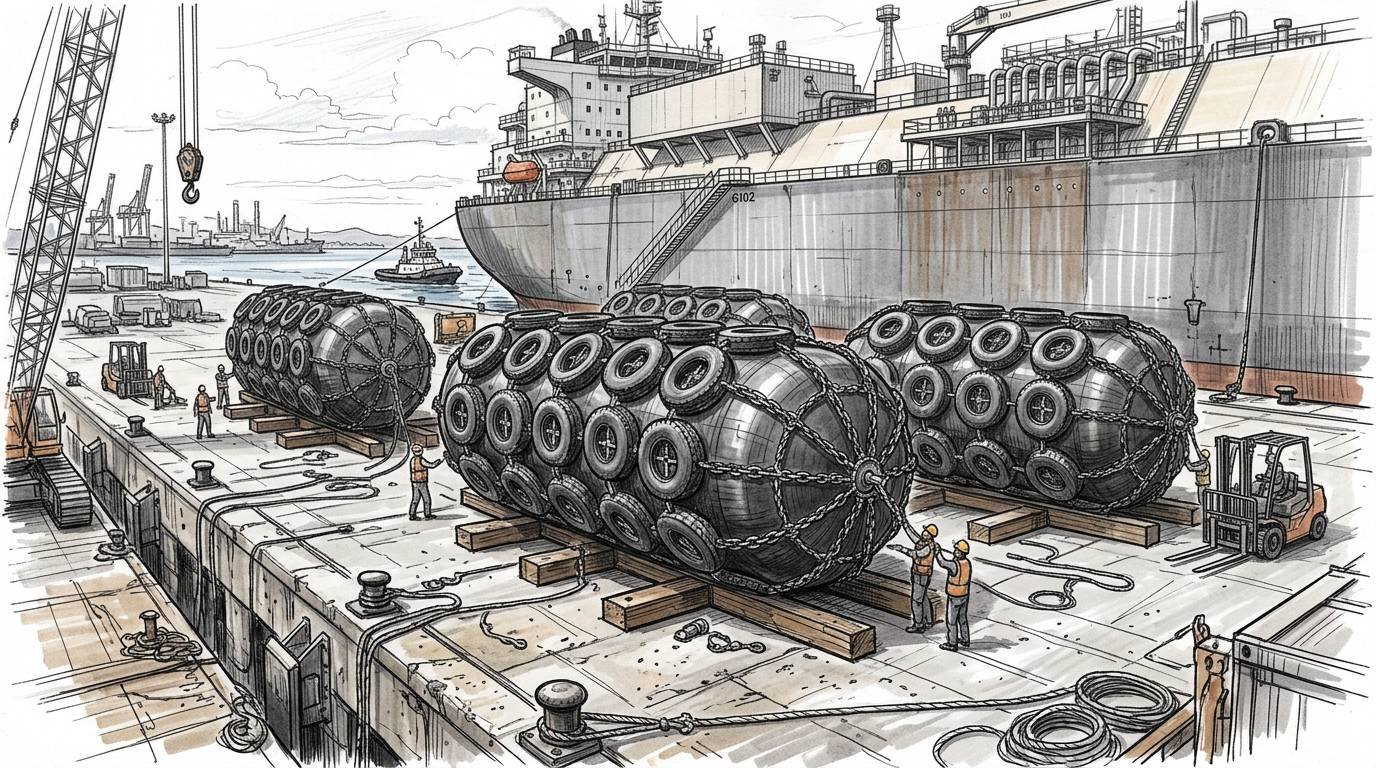
We supply ISO 17357 pneumatic fenders in both mold-process and wrapped configurations for FSRU and LNG terminal projects. Specifying a fender system for an FSRU project? Share your vessel class and operational details with us. See our full range at pneumatic fenders for FSRU and LNG terminals.