
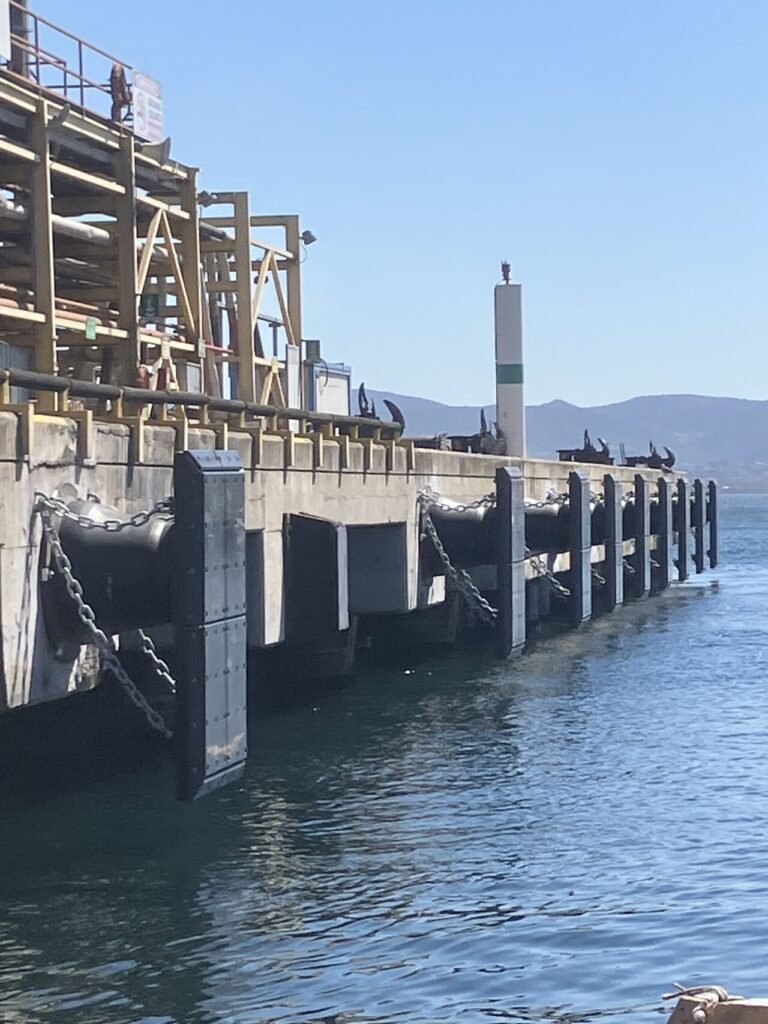
Cracked rubber, a drooping unit, a tilted panel or a slack chain forces a quick call: repair or replace? Visible damage alone can point the decision the wrong way.
Inspect the complete fender system—rubber body, anchors, supports, panel, facing pads, chains and interfaces—make a dated record of each finding, and apply the manufacturer guide and site requirements before deciding.
When a berth walkdown finds a cracked rubber body, a drooping unit, a tilted panel or a slack chain, the useful question is not immediately “repair or replace?” It is: what is the condition of the complete fender system, what does the controlling documentation require, and what evidence is needed before the next decision?
This guide covers inspection of fixed marine rubber fender systems—the rubber body together with its anchors and fixings, supports, panel, UHMW-PE facing pads, chains and structural interfaces—and explains how to turn a visual observation into a dated, technically useful record. It also identifies where routine maintenance ends and technical review, replacement scoping or engineering escalation begins. The applicable manufacturer maintenance guide, site requirements and system design basis govern each installation; public guidance can structure an inspection and its records but cannot replace them. Pneumatic and foam-filled fenders are separate systems and are outside this scope.
What Does a Marine Fender Inspection Cover?
Inspections often focus on visible rubber damage, yet a sound-looking body can sit in a system that is already failing elsewhere.
A marine fender inspection covers the entire load path—rubber body, anchors and fixings, supports, panel, UHMW-PE facing pads, chains and structural interfaces—with each observation recorded against the manufacturer guide and site documents.
A fender inspection covers the complete load path, not only the rubber element. The rubber body absorbs berthing energy, but anchors, supports, panels, facing pads and chains keep that energy controlled and transferred to the structure; a defect in any of them can change system behaviour even when the rubber itself appears intact. Looking only at the rubber can therefore give a false picture of the unit and leave a damaged anchor, panel or chain unrecorded. The following components belong in a single inspection scope, adjusted to the actual installed design.
| Component | Function in the system | Example observations to record |
|---|---|---|
| Rubber fender body | Primary energy-absorbing element | Cracks, tears, chipping, missing rubber, permanent deformation, over-compression, unit droop |
| Anchors and fixings | Transfer loads between fender and structure | Missing, loose, bent, cut or corroded bolts, anchors and fittings |
| Supports and mounting parts | Maintain body position and alignment | Significant corrosion, bending, distortion or misalignment |
| Fender panel | Distributes contact load across the fender | Non-vertical or tilted panel, deformation, steel or coating damage |
| UHMW-PE facing pads | Provide the low-friction contact face | Cuts, wear, missing sections, pad wear reaching or exposing fastener heads |
| Chains, tension members and fuses | Restrain the panel and limit movement | Loose, broken or missing chains, connectors or fuse elements |
| Structural interfaces | Connect the assembly to the berth and adjacent equipment | Corrosion, abnormal gaps, rubbing or contact damage at brackets and the wharf face |
Configurations differ: not every system contains every listed component, and some designs include project-specific parts. The inspection should therefore follow the component list and requirements in the applicable manufacturer guide and site documentation. Each observation is evidence to record and evaluate; on its own, it does not establish safe operation or determine repair versus replacement. Findings that go beyond routine maintenance are the basis for technical review, replacement scoping or engineering escalation.
How Should the Rubber Fender Unit Be Inspected?
A quick visual walk-past rarely shows what changed since the previous check, and memory alone is a weak basis for repair or supplier discussion.
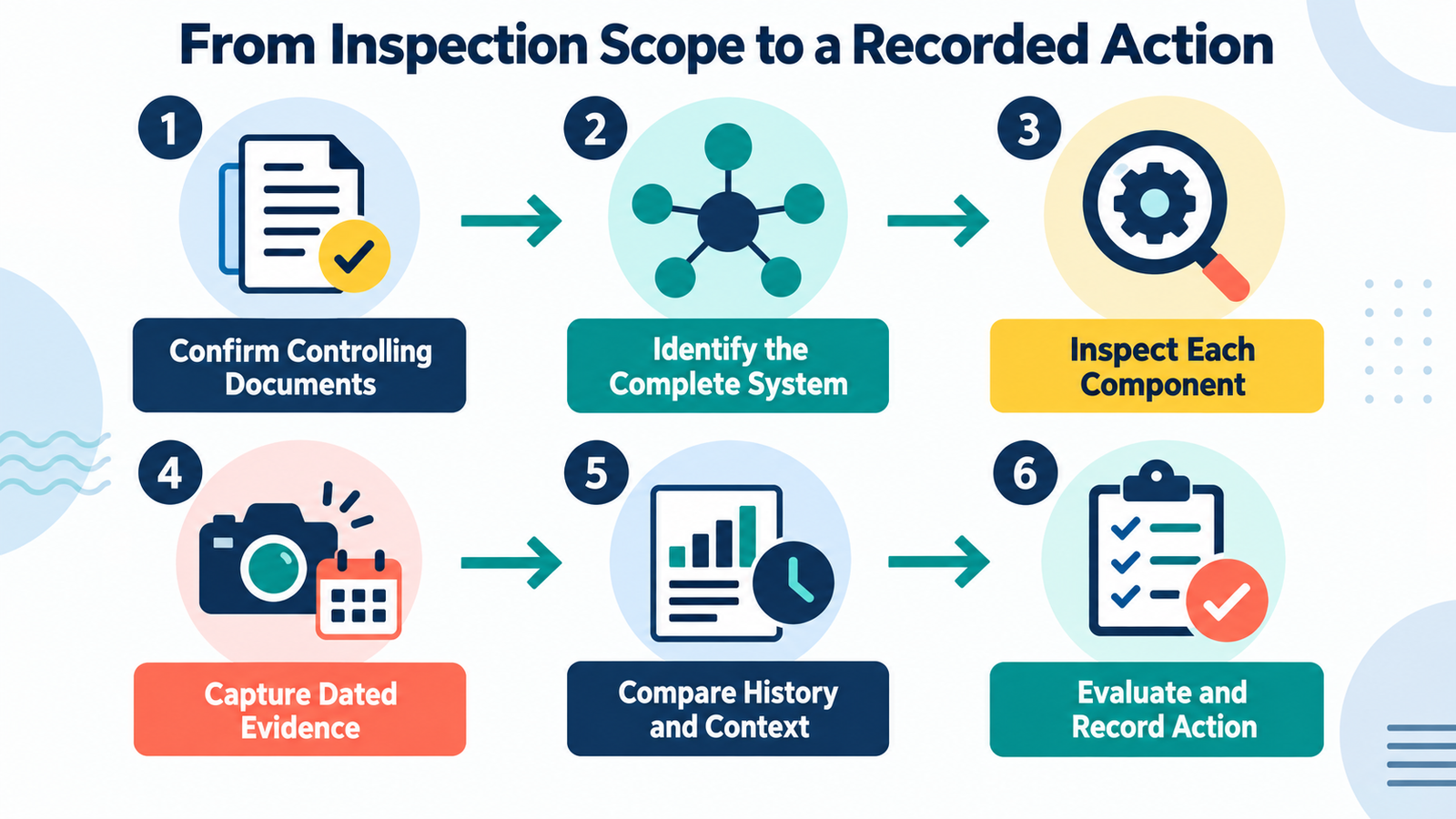
Inspect the rubber unit against the applicable manufacturer maintenance guide and site procedure at the intervals they set, capture dated observations and photographs in a repeatable record, and route the findings for evaluation rather than deciding a repair on the spot.
Start with the documents that control the system: the manufacturer maintenance guide, the site inspection procedure, and any port or local requirements. These define scope and interval for that installation. PIANC describes annual inspection of all fender systems as a general minimum, together with recurring and event-driven checks; the programme at a given berth also reflects equipment age, berth criticality and occupancy, spare-part availability, environmental conditions and operating philosophy. That is general guidance, not a universal interval for a specific product.
Use a repeatable sequence so records can be compared over time. Identify the unit and location, note date, inspector and inspection type, and record the berth condition and any recent abnormal contact. Examine the full rubber body, not only the first damaged face. PIANC examples of meaningful observations include cracks, over-compression and unit droop; CDIT lists tears, permanent deformation, missing rubber, chipping and cracks as deterioration modes to record. Note the position and extent of each observation, photograph the whole unit and the detail, and compare both with the previous record.
After an abnormal event, PIANC recommends a thorough inspection before berth operations resume. The inspection ends in evaluation, not an on-the-spot repair decision: results are reviewed against the manual and applicable requirements to determine the next action. Dated, detailed photographs do not prove fault or create claim entitlement; they make a later technical conversation with the supplier more productive and give a quality-management review usable evidence.
Inspection-record checklist
- Unit identity, exact location and the reference manual or site procedure used.
- Date, inspector name, inspection type (scheduled, recurring or post-event) and berth condition.
- Recent berthing events or abnormal contact reported before the check.
- Full-unit photographs plus close-up photographs of each observation, with scale where practical.
- Rubber body observations: cracks, tears, chipping, missing rubber, permanent deformation, over-compression or droop.
- Position, size or extent of each observation, using any measurement method the applicable guide specifies.
- Comparison with the previous inspection record and a note on what has changed.
- Any measurement, drawing or document review requested before the next operational decision.
- Record of who evaluated the findings and what action, if any, was approved.
How Should Panels, UHMW-PE Pads, Chains and Anchors Be Inspected?
Panels, pads and fittings carry and transfer berthing loads, yet damage is easy to miss when every inspection note stays on the rubber body.
Inspect the panel, UHMW-PE pads, chains, anchors and fixings as separate line items against the manufacturer guide and site requirements; record each symptom with photographs and request technical review where the documents or an abnormal event require it.
A panel fender is only as well documented as its weakest accessory. CDIT defines the marine rubber fender as a system that includes the rubber body, fixing anchors, supporting parts and fender panels, and it calls for the body, fixings, supports and resin pads to be evaluated separately on a fender with a panel. A body-only note cannot show whether the panel still sits correctly, whether the face pad still protects it, or whether the load path through chains and anchors remains as designed.
Look at the panel as an assembly first. PIANC identifies non-vertical panels as a condition worth recording, together with loose or broken chains and fuses and missing fixings or fittings. On steelwork and supports, observe bending, dents, significant corrosion and coating condition. CDIT gives missing, cut, bent or corroded fixings, and significant support corrosion or bending, as example conditions. These are observations to route to the manual and a qualified review, not symptoms with a single fixed meaning.
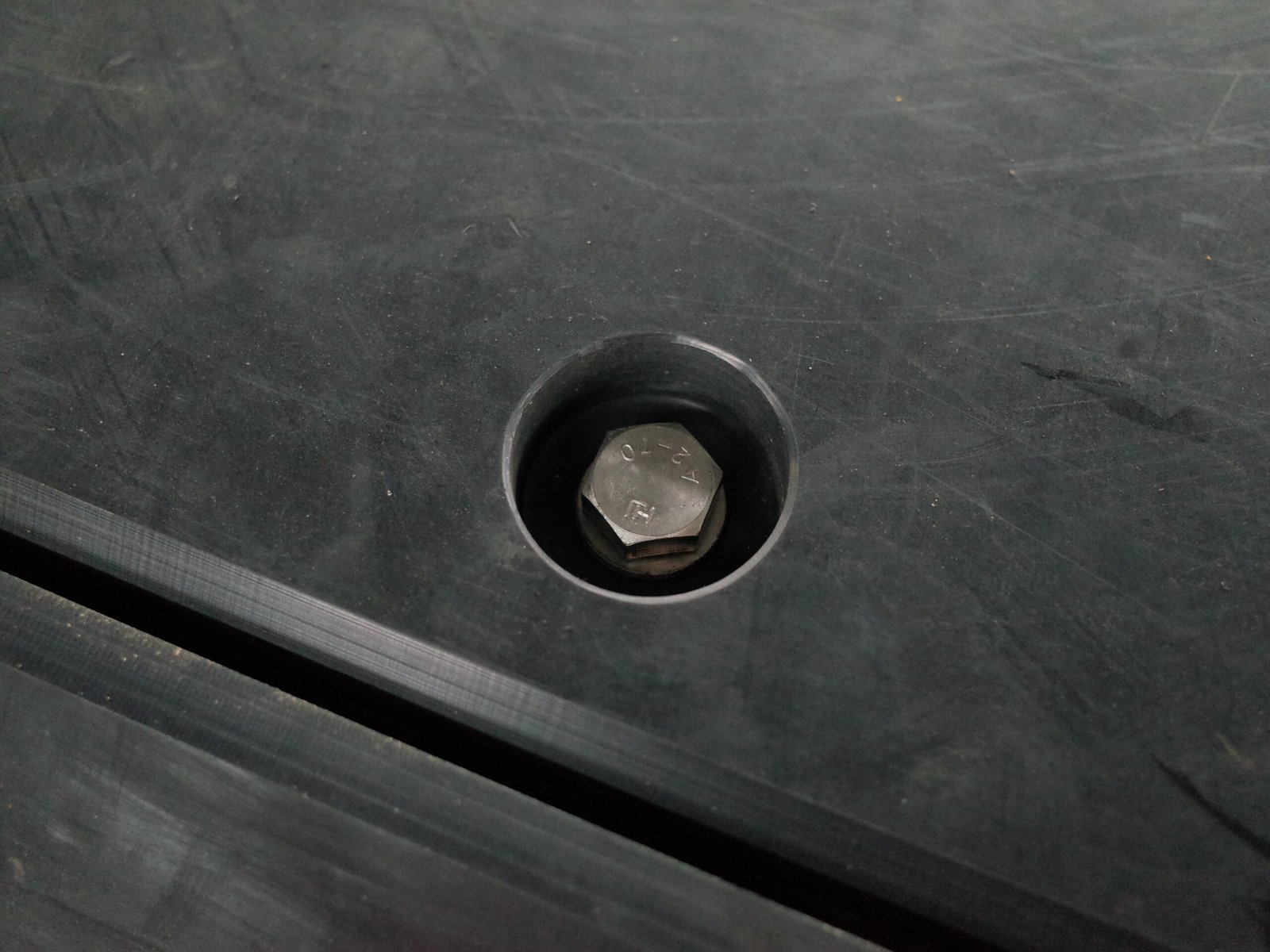
Treat the UHMW-PE face pads on their own line. Record wear pattern and depth, cuts, splits, loosening or detachment, and the condition of pad fasteners. CDIT uses pad wear reaching a bolt head as an example condition; whether that requires action at a particular installation depends on the design and the applicable guide, so the photograph and measurement belong in the record before any conclusion is drawn.
For chains, anchors and other fixings, observe slack and tension pattern, broken or damaged links, corroded or missing fittings, and any visible displacement of exposed anchor points. The condition of parts embedded in concrete cannot be inferred from a surface view, and no torque or acceptance figure should be applied unless the site documents give one. One accessory symptom does not by itself determine safe operation; the separate records give the manufacturer, engineer or port reviewer the evidence to decide.
| Component | Observations to record | Separate-record note | Example route to review |
|---|---|---|---|
| Panel, frame and supports | Alignment (including non-vertical position), bends, dents, significant corrosion, coating loss | A mark or stain is not the same evidence as structural deformation; describe what is visible without grading capacity | Non-vertical panel, significant bending or corrosion, or any condition the applicable guide lists for review |
| UHMW-PE face pads | Wear pattern and depth, cuts, splits, looseness, detachment, pad fastener condition | Record wear relative to the pad and fasteners; do not convert a photograph into a universal wear limit | Wear reaching a bolt head (CDIT example), detachment, or a limit defined in the manufacturer guide |
| Chains and tension fuses | Slack or tension pattern, broken or damaged links, bent fittings, corrosion, missing parts | Chain condition reflects loading history, but one photograph is not a load or fatigue diagnosis | Loose or broken chains or fuses (PIANC example), abnormal tension pattern, or post-event inspection requirement |
| Anchors and fixings | Missing, cut, bent or corroded fixings; exposed washer, nut or plate condition; visible displacement | Hidden embedment and substrate condition cannot be judged from appearance alone | Missing fixings or fittings, bent or corroded components per the applicable guide, or an engineering request for further examination |
Common Fender Damage and What It Can Mean
A crack, droop or missing fitting is easy to spot, but a photograph alone does not establish why it happened or whether the berth is safe.
Record the symptom, exact location, extent, date and photo context, then review the manufacturer guide, site requirements and prior records before assigning cause or action.
PIANC lists cracks, over-compression, unit droop, non-vertical panels, loose or broken chains and fuses, and missing fixings or fittings among conditions that inspection should catch. CDIT uses a wider deterioration vocabulary for fixed systems—tears, permanent deformation, missing rubber, cracks and chipping—and treats a panel fender as more than its rubber body. Fixings, supports and face pads need separate observations; examples include missing, cut, bent or corroded fixings, significant support corrosion or bending, and pad wear that reaches a bolt head.
These terms describe what can be seen, not who or what caused it. A torn body may be associated with an abnormal berthing event, while long-standing cracking or deformation may become clear only when earlier records are compared. A loose chain can affect how a panel hangs; a non-vertical panel may indicate an accessory problem rather than rubber failure. Such links are possibilities to check, because overlapping symptoms and missing history can make an image-based conclusion unreliable.
A useful record captures the symptom, position on the unit or system, measurable extent where practical, surrounding contact marks, date, operating or event context if known, and photographs with scale and identification. It should also identify the fender or panel and link the observation to previous checks. PIANC recommends a thorough inspection after an abnormal event before berth operations resume, and results should be evaluated against manufacturer and applicable port or local requirements rather than closed out as a routine repair. Dated, detailed photographs can support technical communication with the supplier and a quality-management review; they do not by themselves establish fault, warranty cover or a claim outcome.
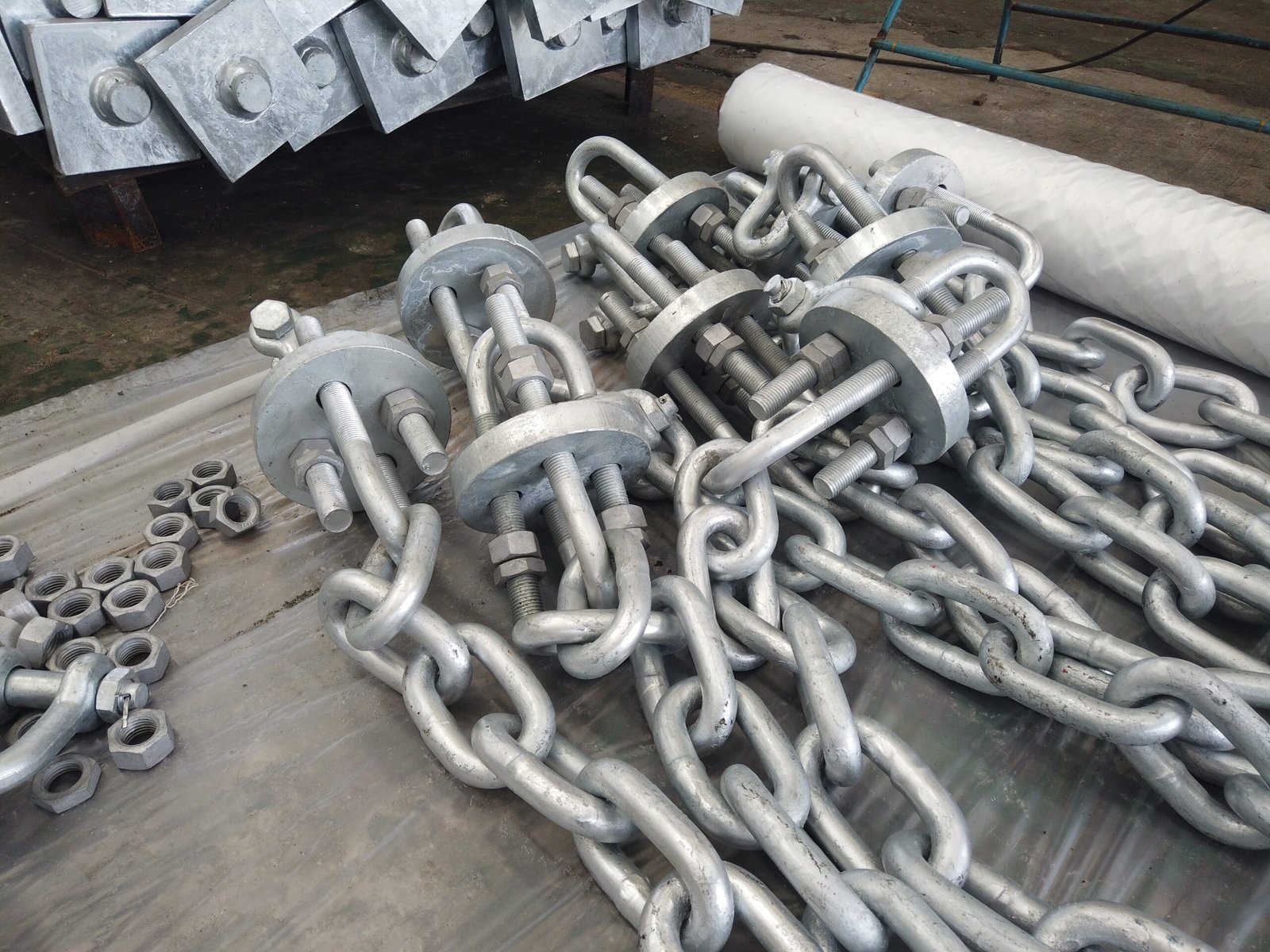
| Observed symptom | What to capture | Bounded document review and next action |
|---|---|---|
| Cracks, tears, chipping or missing rubber on the body | Exact location, visible length or area, edge condition, close and wider photographs, and comparison with earlier records | Review the manufacturer guide, site requirements and history; request technical assessment if the extent, cause or progression is unclear |
| Over-compression, permanent deformation or unit droop | Current shape or position, visible set, panel angle, contact marks and any related berthing event | Check against drawings, manual criteria and operating records; follow the abnormal-event procedure before further berthing if applicable |
| Non-vertical panel or face-pad wear reaching a bolt head | Panel alignment, wear zone, pad condition, bolt exposure and separate photographs of panel and rubber body | Evaluate the panel, pad, supports and body separately; do not treat the observation as a rubber-only diagnosis |
| Loose or broken chains/fuses, or missing, cut, bent or corroded fixings | Component type, location, quantity, visible corrosion or bending, attachment condition and photographs | Review manufacturer and site requirements with maintenance or engineering personnel; a visual check alone does not confirm safe operation |
How Do Rubber Fenders Degrade in Service?
Some fender conditions appear suddenly after an event; others develop over years of berthing and environmental exposure. The records need to show which path applies.
Separate sudden damage from gradual ageing or deterioration, review operating exposure and maintenance history, and refer progressive conditions for evidence-led evaluation under the governing documents.
CDIT explicitly distinguishes sudden damage from ageing and deterioration. Its named deterioration modes include tears, permanent deformation, missing rubber, cracks and chipping; these are condition categories, not a timetable. PIANC similarly frames maintenance around the specific installation: a programme should consider equipment age, berth criticality and occupancy, spare-part availability, environmental conditions and operating philosophy. That is why two fenders of the same age can present different conditions, and why age alone is not a replacement rule.
Gradual deterioration usually becomes meaningful through comparison. A maintenance file containing dated checks, diagnoses, functional evaluations and measures gives a reviewer basic information to see whether cracking, deformation, wear or corrosion is stable, recurring or advancing. Event history matters as well: after an abnormal event, PIANC recommends a thorough inspection before berth operations resume, because damage absent from earlier photographs may have a different significance from long-term change.
Operating exposure should be reviewed rather than assumed. Occupancy, use patterns, environmental setting, contact conditions and any history of over-compression or accessory failure help the responsible reviewer interpret the rubber body, supports, fixings, panels and pads as one system. Where records are absent, the correct conclusion is not that the fender has reached a fixed age limit; it is that the evidence base is incomplete and the manufacturer guide, site requirements, system drawings and qualified engineering review carry more weight. Suppliers’ maintenance recommendations and part-replacement guidance, where provided, should be part of that review. No public guideline can supply a universal service life, damage threshold or replacement date for a fixed fender system.
| Condition path | Evidence to retain | Evaluation boundary |
|---|---|---|
| Sudden, event-related damage | Event date and context, affected system components, before-and-after photographs where available, and the post-event inspection record | Supports the required abnormal-event review; it does not determine cause or fitness without the governing documents |
| Gradual ageing or deterioration | Successive dated observations, location and extent of each condition, prior measures, and exposure or operating history | Shows whether a condition appears stable or progressive; it is not evidence of a fixed service-life limit |
| Mixed or unknown history | Fender and panel identity, drawings, manufacturer guide, available photographs, accessory details and gaps in the record | Incomplete history calls for document and engineering review, not an age-based or image-only replacement decision |
Can a Damaged Marine Fender Be Repaired?
A repair quote can arrive before anyone has confirmed what the system is, what failed, or whether the governing documents permit repair.
Sometimes, but only after the applicable manufacturer guide, system drawings, dated inspection record and condition evidence are reviewed; engineering review is needed where the guide or site requirements call for it. No generic repair approval applies across fender systems.
The first question is not whether rubber can be patched. It is whether the documents that govern the installed system allow the proposed action at all. PIANC notes that suppliers should provide maintenance recommendations and detailed part-replacement guidance with their products, and that inspection results should be evaluated before a next action is chosen, with manufacturer and port or local requirements remaining relevant. That evaluation has to treat the fender as the system CDIT defines: rubber body, fixing anchors, supporting parts and fender panel. On a panel fender, the body, fixings, supports and resin pads are evaluated separately, because a sound-looking body does not settle the condition of significantly corroded or bent supports, missing or cut fixings, or a pad worn down to a bolt head.
CDIT treats records of checks, diagnoses, functional evaluations and measures as basic information for appropriate evaluation and action. Before accepting a repair proposal, the operator can ask for the manufacturer guidance that names permitted repair or part-replacement methods, the drawings that identify the actual components, and a dated inspection record with photographs and the measured extent of each observation. Sudden damage after an event and gradual ageing or deterioration are different starting points, and each needs its own evidence. Where the guide or site requirements call for calculation or sign-off, the decision belongs to a qualified engineering review. Price should not be used as a shortcut: a lower repair price on its own does not establish fitness, traceability or quality control, and it cannot replace the governing documents.
Repair-assessment record
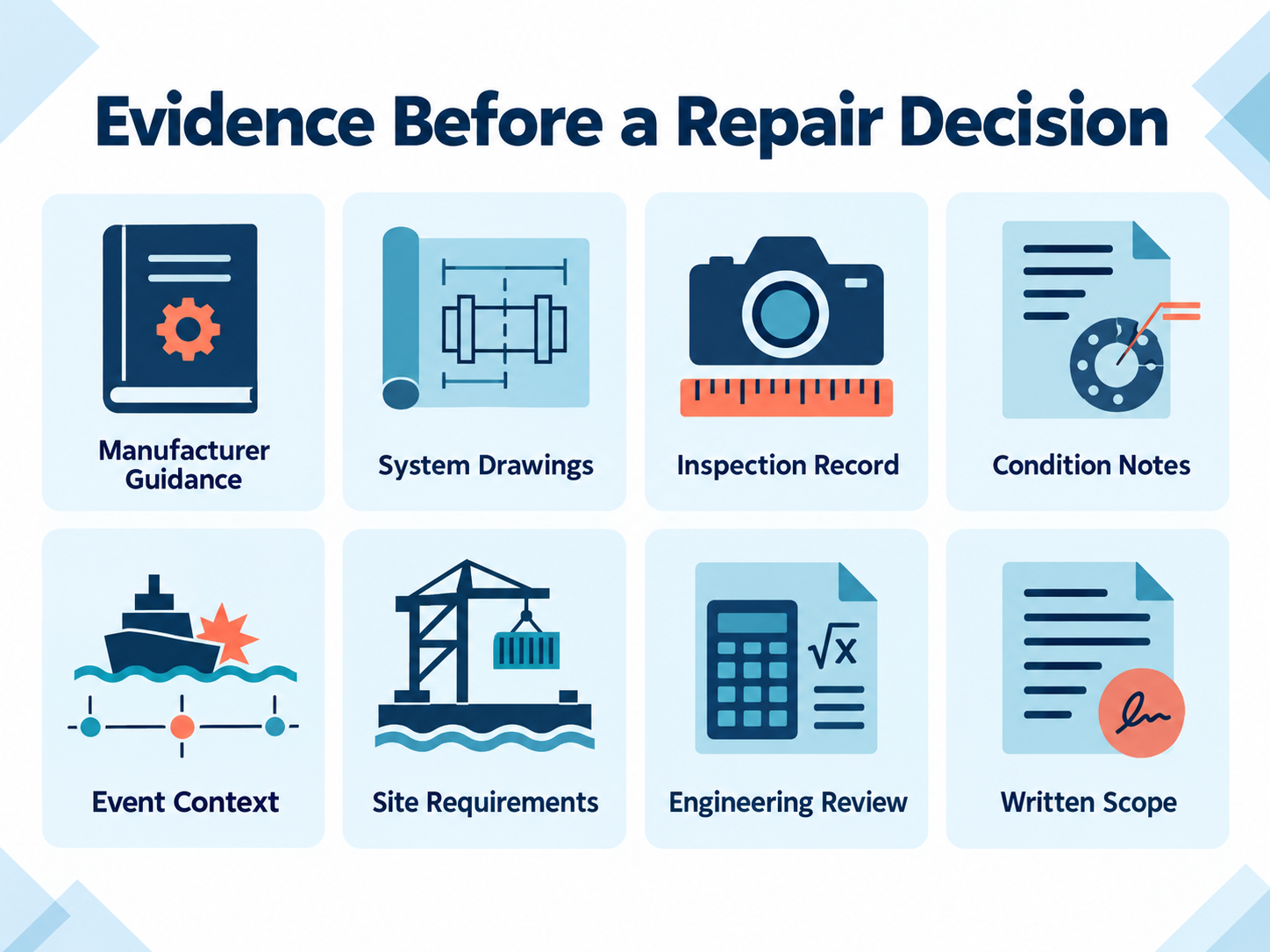
- Manufacturer maintenance and part-replacement guidance for the exact installed model, including any repair limits or prohibited methods
- System and as-built drawings showing rubber body, panel, supports, fixings, chains, fuses and anchors
- Dated inspection record with photographs, location and measured extent of each observation
- Separate condition notes for rubber body, fixings, supports and resin pads, where fitted
- Event and operating context: routine finding, post-abnormal-event finding, or repeated and progressive condition
- Applicable port, local and site requirements, including any required sign-off
- Engineering review or calculation where the guide or site requirements call for one
- Written repair scope, replacement-part references, and a record of the decision and measures completed
When Should a Fender Be Replaced or Re-engineered?
Some damage cannot be closed with a replacement part: it may point to the system’s design basis, a missed event, or berth conditions that have changed.
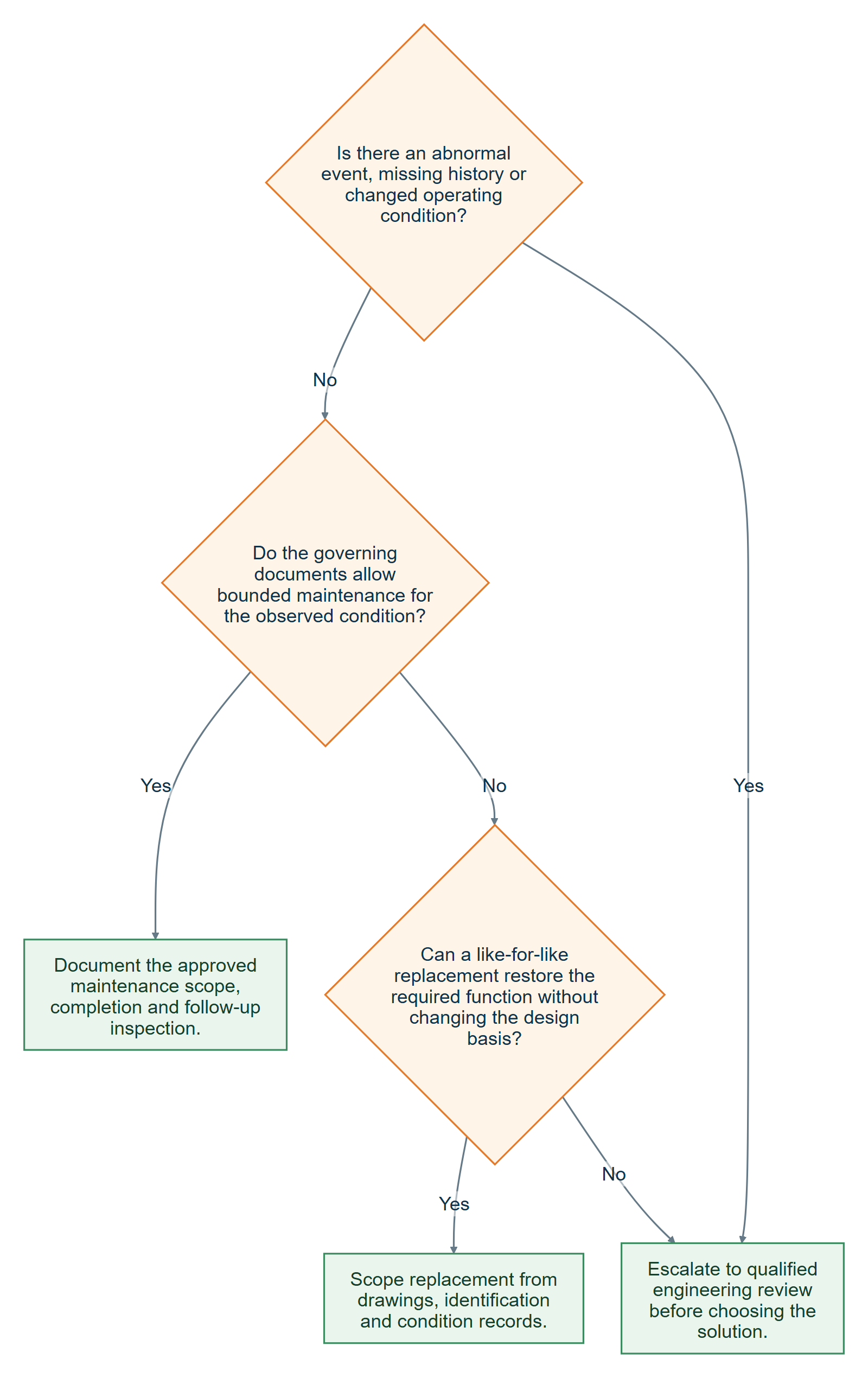
Escalate to replacement or engineering review when evaluation against the manufacturer guide, site requirements and condition records shows component maintenance cannot restore the system, or after an abnormal event, history gap, or changed operating condition. Only qualified review can decide.
Replacement moves one unit or component out of service; re-engineering questions whether the installed system still matches the berth. PIANC expects a thorough inspection after an abnormal event before berth operations resume, and it frames every inspection result as something to be evaluated before the next action is chosen. The same guidance notes that maintenance planning has to consider equipment age, berth criticality and occupancy, spare-part availability, environmental conditions and operating philosophy. Those factors can also make a like-for-like renewal the wrong answer: if occupancy, environment or operating pattern no longer matches the system’s basis, the fender arrangement deserves an engineering look rather than an automatic order for identical parts.
CDIT supports the same boundary. It distinguishes sudden damage from ageing and deterioration and describes functional evaluations, with records of checks, diagnoses, evaluations and measures serving as the basic information for a decision. A history gap matters for the same reason. Without dated records and photographs, the owner cannot tell whether one cracked body is an isolated event or part of a progressive pattern, and a supplier or engineer is being asked to judge the system without its baseline. In that situation, the defensible move is a system-level assessment, not an on-the-spot replacement call.
No single crack depth, droop angle or age figure can be quoted here as a universal trigger; limits belong to the manufacturer guide, the design basis and the site requirements. Replacement is the appropriate scope when evaluation shows component work cannot restore the required function, when the manufacturer’s part-replacement route is not available for the observed condition, or when damage across body, supports, fixings and panel goes beyond bounded maintenance. Re-engineering is the route when the berth itself has changed, when abnormal events repeat, or when a functional evaluation indicates the existing arrangement no longer suits the service. Qualified engineering review, supported by the complete record, decides which route applies.
What Information Is Needed for a Replacement RFQ?
A replacement RFQ often arrives with a single photo and a request for “the same fender,” leaving suppliers to guess at type, dimensions and the surrounding system.
Prepare one evidence package for every respondent: fender identity, exact location, drawings and dimensions, dated photographs of the body and accessories, inspection history, event context, and the scope being sought.
Public guidance gives a clear reason for this approach. CDIT describes records of checks, diagnoses, functional evaluations and measures as basic information for appropriate evaluation and action; the same record set gives a replacement reviewer something concrete to work from. PIANC notes that suppliers should provide maintenance recommendations and detailed part-replacement guidance with their products, and that exchange works best when the buyer can identify both the product and the system around it.
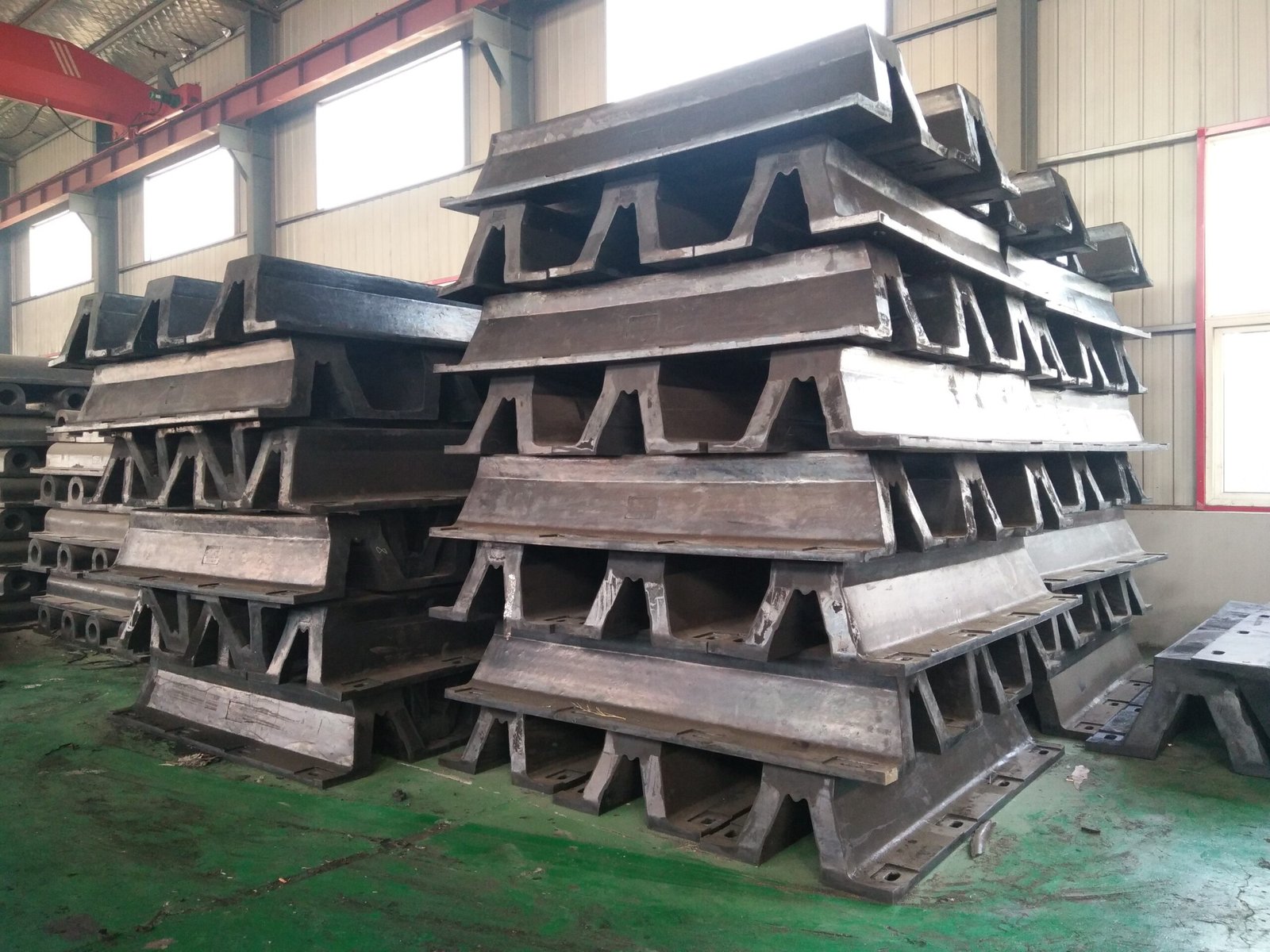
The request should describe the system, not only the rubber body. CDIT defines a marine rubber fender system as the rubber body, fixing anchors, supporting parts and fender panels, and it separately evaluates the body, fixings, supports and resin pads on panel fenders. A buyer who reports only a torn body may omit pad wear reaching a bolt head, bent or corroded supports, missing fixings, or a chain condition that affects how the panel sits. Those details can change what needs to be quoted.
Context matters as much as dimensions. PIANC frames maintenance around equipment age, berth criticality and occupancy, spare-part availability, environmental conditions and operating philosophy, and it recommends a thorough inspection after an abnormal event before berth operations resume. If the request follows such an event, the dated record and photographs should show what was observed and when; PIANC expects results to be evaluated against the manufacturer guide and applicable port or local requirements before a next action is chosen.
Dated, detailed photographs and records are a communication practice: they help a supplier or engineer understand the request without a site visit and support a quality-management review if one is needed. They do not establish fault or entitle anyone to a claim outcome. As a bounded buyer-side caution, price alone is not enough evidence of fitness, traceability or quality control; a complete evidence package is what lets a respondent understand the request. Where nameplate data, drawings or history are missing, the RFQ should say so rather than present a guess as fact, and it should state whether the aim is like-for-like supply, accessory renewal or engineering review. No package guarantees a quotation, a proposed solution or a performance result.
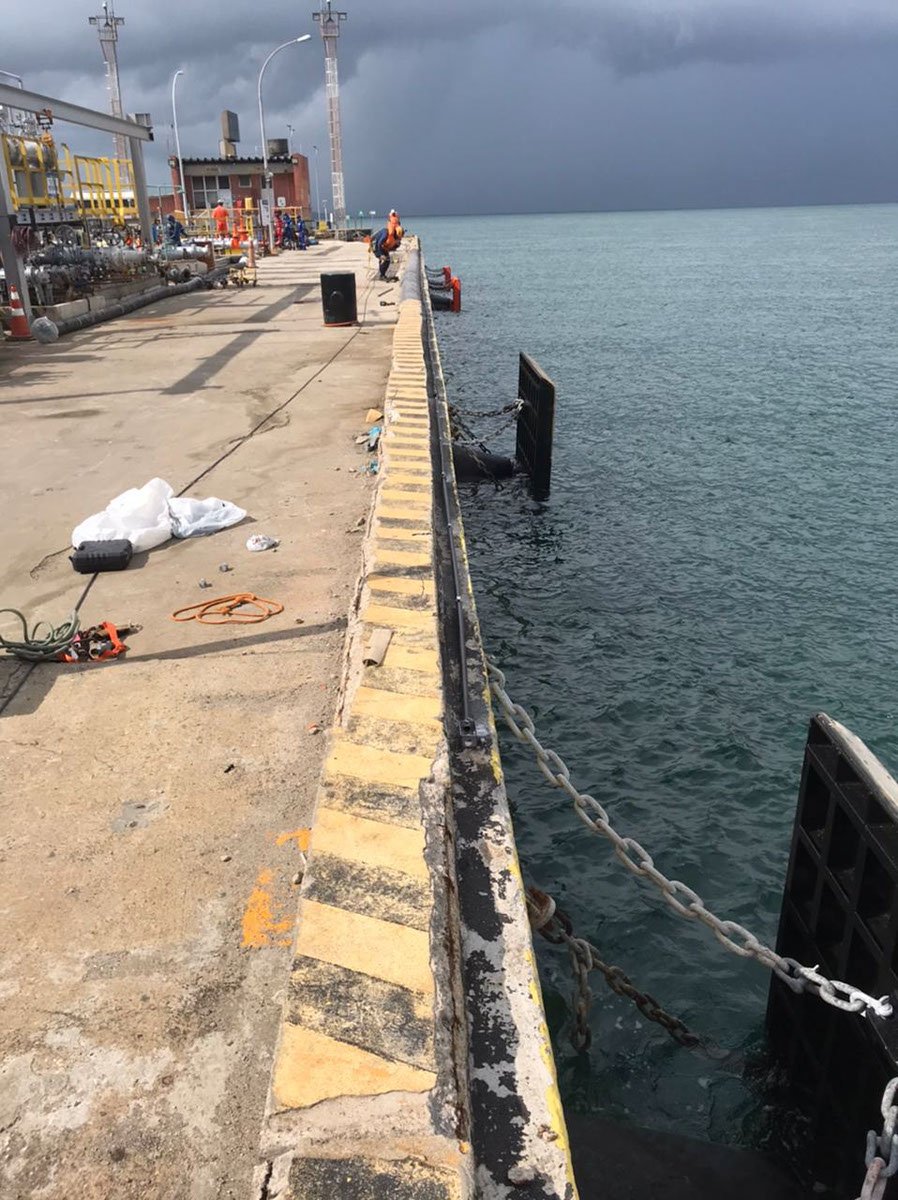
A practical RFQ evidence set can include:
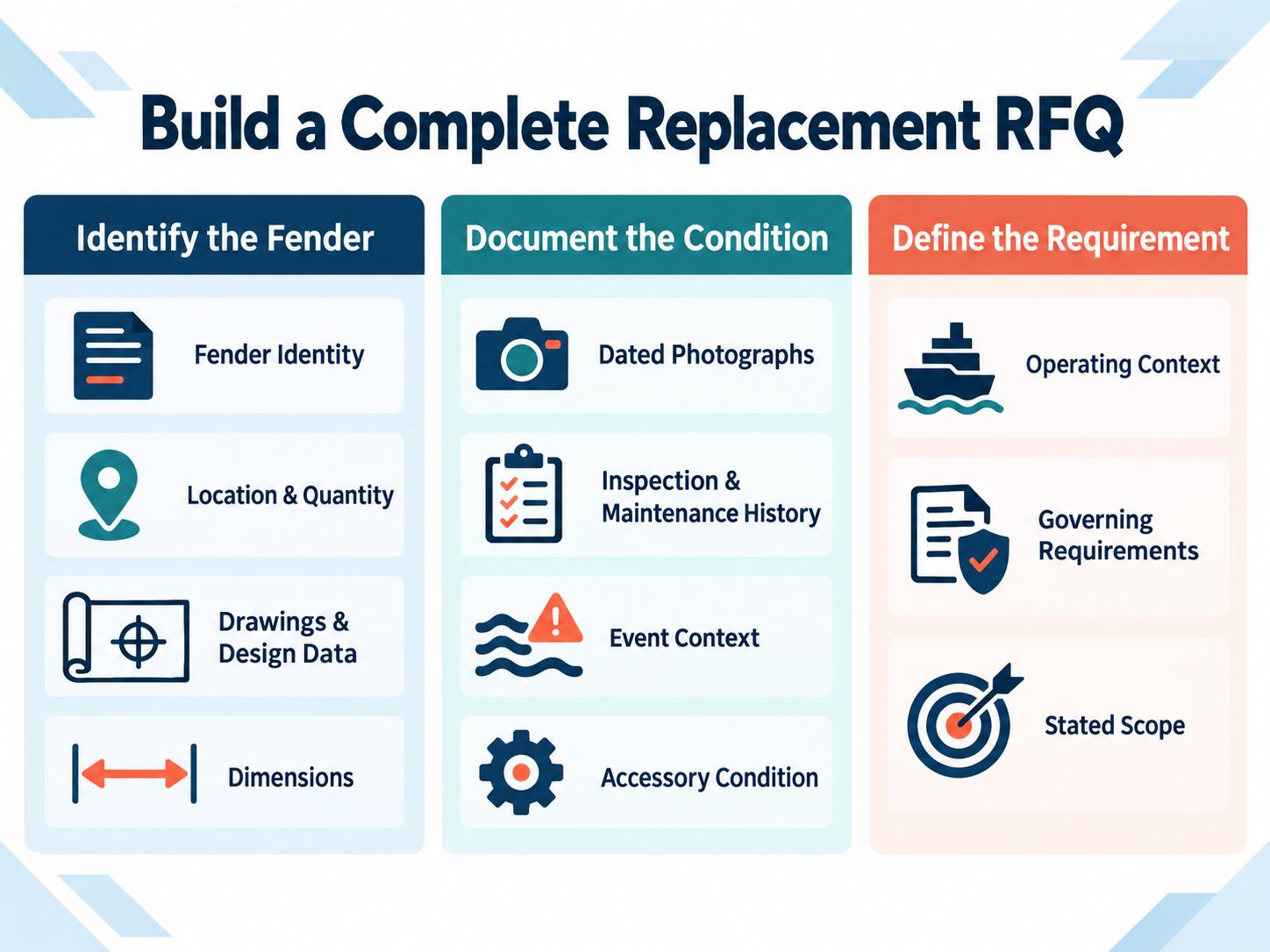
- Fender identity: manufacturer, fender type, model or moulded markings, and any readable nameplate or rubber-grade data
- Location and quantity: berth or terminal, fender position or number, mounting orientation, and number of units required
- Drawings and design data: general arrangement, installation or as-built drawings, and rated performance data where available
- Dimensions: rubber body size, panel dimensions, bolt or anchor pattern, and chain sizes and lengths
- Dated photographs: an overview of the installed system, close views of the reported condition, markings, panel, facing pads, chains and anchors
- Inspection and maintenance history: check sheets, condition records, earlier repairs, prior replacements, and known age
- Event context: whether this is planned renewal or follows an abnormal berthing or contact event, with the date and known circumstances
- Accessory condition: panel and steelwork condition, UHMW-PE pad wear, chain or fuse status, and missing, bent, cut or corroded fixings
- Operating context: vessel range, berth occupancy and exposure conditions where they are documented
- Governing requirements: the applicable manufacturer guide, site or port requirements, and any standards or certification the replacement must meet
- Stated scope: like-for-like supply, separate accessory supply, installation support, or engineering review, with missing records marked as gaps
Conclusion
Inspect the fixed fender system as a whole, follow the applicable manufacturer guide and site requirements, and keep dated records and photos. A complete file is the basis for any engineering or replacement RFQ discussion.