
Berth, berthing, mooring, docking, anchoring. Tender documents mix these words, and the wrong one sends a fender enquiry to the wrong engineering team.
Berthing is the controlled movement of a vessel to its assigned berth, up to the point where it is secured alongside. The berth is the wharf space itself. Mooring, docking and anchoring describe different stages, and each one changes what a project must review.
I read a lot of early enquiries where the words are used loosely. That is normal, and it is not a problem while the discussion stays general. It becomes a problem when a berth, a vessel and a set of weather conditions are already fixed, because at that point the terms decide who has to do the calculation. This article stays on the informational side: what the terms mean, how a berthing operation is sequenced, which conditions shape it, and where the conversation has to move to a project-specific engineering review.
What Is a Berth?
A drawing says “Berth 3”. A crew list also says “berth”. Same word, two different worlds, and buyers sometimes read the wrong one.
In shipping, a berth is the designated space at a wharf or quay at which a ship docks. It is a location on the waterfront structure, identified by a number or name, and it is not a sleeping place on board.
| Term | What it identifies here | What it does not mean here |
|---|---|---|
| Berth (noun) | The designated wharf or quay space where a ship docks | A bed or accommodation space on board |
| Berth (verb) | To bring a vessel into that space, or to lie in it | Any commercial charge or booking term |
| Wharf / quay | The fixed structure along the water that the berth belongs to | The vessel-side equipment |
| Berth number | The administrative label used to allocate the space | A technical specification of the structure |
Port terminology published by the Maryland Port Administration describes a berth as the wharf space at which a ship docks, and also uses “berth” as a verb. That is the meaning I work with in every technical conversation, and it is worth fixing early because a berth is a physical place with physical properties. A berth has a length, a water depth, a face structure, a fixed level or a tidal range, and a set of neighbouring berths. Those properties are the reason a berth cannot be treated as an interchangeable slot. Two berths in the same port can carry the same label format and still behave very differently, because one sits behind a breakwater and the other is exposed to current. When someone tells me a vessel “can use any berth of that length”, I take that as an administrative statement, not an engineering one. The length may be sufficient. The approach, the depth under the keel, the structure face and the exposure still have to be checked separately.
What Does Berthing Mean in Shipping?
An operator reads “berthing” in one document and “berthing charge” in another. One is a manoeuvre. The other belongs to a commercial schedule.
Berthing in shipping means the vessel’s controlled movement from the approach area to its assigned berth, ending when the vessel is stopped and secured alongside. It describes an operation, not a fee line and not a booking.
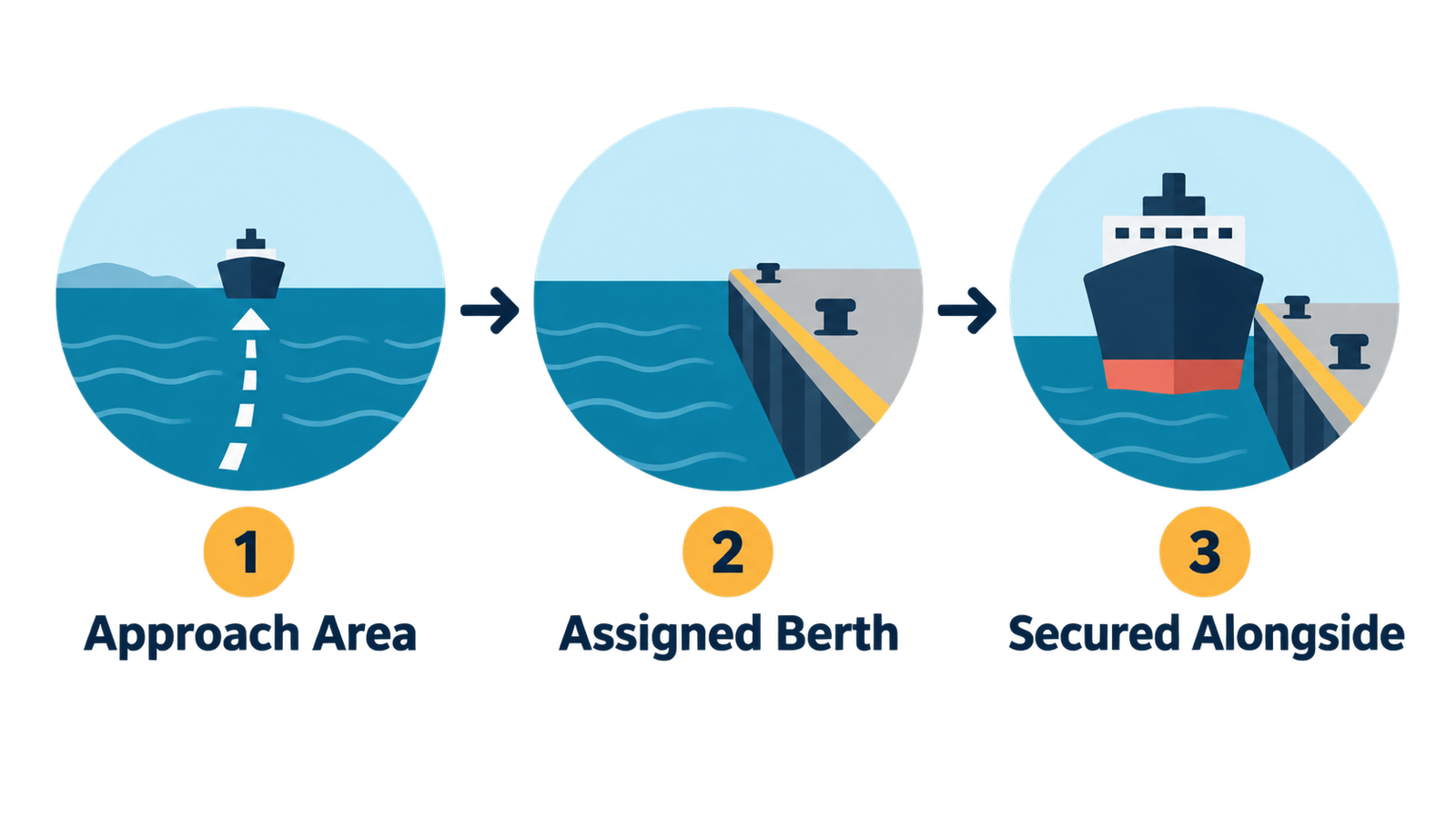
The IMO training and watchkeeping material referenced in STCW work treats berthing and unberthing as manoeuvres carried out under wind, tide and current, with or without tug assistance, including the interaction between the ship and the tugs. That framing matters more than a dictionary line. Berthing is a movement with a speed, a heading, a rate of turn and an approach angle, and all of them are changing while the vessel closes on the structure. The vessel is also losing the steering effect it has at higher speed, so the control comes increasingly from external help and from the way the manoeuvre was planned. This is why I separate the word from anything commercial. A charge can be agreed in an office. A manoeuvre depends on the ship, the day and the berth, and it is the manoeuvre that produces contact with the structure. When an enquiry says “berthing”, I always ask which part is meant: the arrival movement, the securing, or the whole port call. The answer usually tells me whether the reader needs terminology or engineering input.
The following example is illustrative only. It is written to show how the terms line up in one movement, not to describe a real vessel, a real port call or a recommended way of working.
A vessel is allocated a berth on the north quay. It waits in the designated area, then receives its slot. It moves in under its own power at low speed with assistance, turns onto a line roughly parallel to the quay face, and closes the remaining distance slowly and almost sideways. Contact with the fender line happens at low speed and at a small angle. Lines then go ashore and are tensioned. Up to the moment the vessel is stopped and held, the operation is berthing. After that point, holding it in position is mooring. The whole event may still appear as one line in the port call record.
Berthing vs Mooring, Docking and Anchoring
A tender uses all four words for the same event. Then a reviewer asks which stage the load case belongs to, and the answer is not in the document.
Berthing is the movement to the berth. Mooring is holding the vessel in position with lines and equipment. Docking is the general act of coming alongside, and in some uses a dry-dock entry. Anchoring is waiting off the berth on an anchor.
| Term | What is happening | Vessel state | Main interface |
|---|---|---|---|
| Berthing | Controlled movement towards and onto the berth | Moving, slowing, turning | Approach control, assistance, fender line at first contact |
| Mooring | Holding the vessel in the required position | Stopped alongside | Lines, winches, bollards or hooks, fender line under standing loads |
| Docking | Coming alongside in general use; entering a dry dock in another use | Depends on the use | Depends on the use; confirm which one is meant |
| Anchoring | Waiting away from the berth on the anchor | Held by ground tackle | Anchor, cable, holding ground |
The IMO’s safe mooring work sits on the mooring side of that table. It gives guidance around mooring equipment and its use, and that is exactly where I keep it. Mooring equipment guidance does not describe the whole berthing manoeuvre, and I would not use it to answer a question about approach control. The distinction is practical rather than academic. Berthing produces a moving contact, so the question is how much energy arrives at the structure and at what angle. Mooring produces sustained loads while the vessel sits alongside, so the question is how the vessel is held against wind, current, passing traffic and level change. Anchoring keeps the vessel away from the structure altogether. “Docking” is the loosest of the four, and I always confirm whether the writer means coming alongside or entering a dry dock, because those two readings lead to completely different scopes. Fixing the term first prevents a review from answering the wrong question well.
How Does a Vessel Berthing Operation Work?
Readers often want a step list. A generic list is fine for understanding, and dangerous if someone treats it as a procedure for a real berth.
A berthing operation moves through planning, approach, controlled final movement, securing and handover. Every step is conditional on the vessel, the berth and the conditions of the day, and the real sequence is set by the port and the pilot, not by a general description.
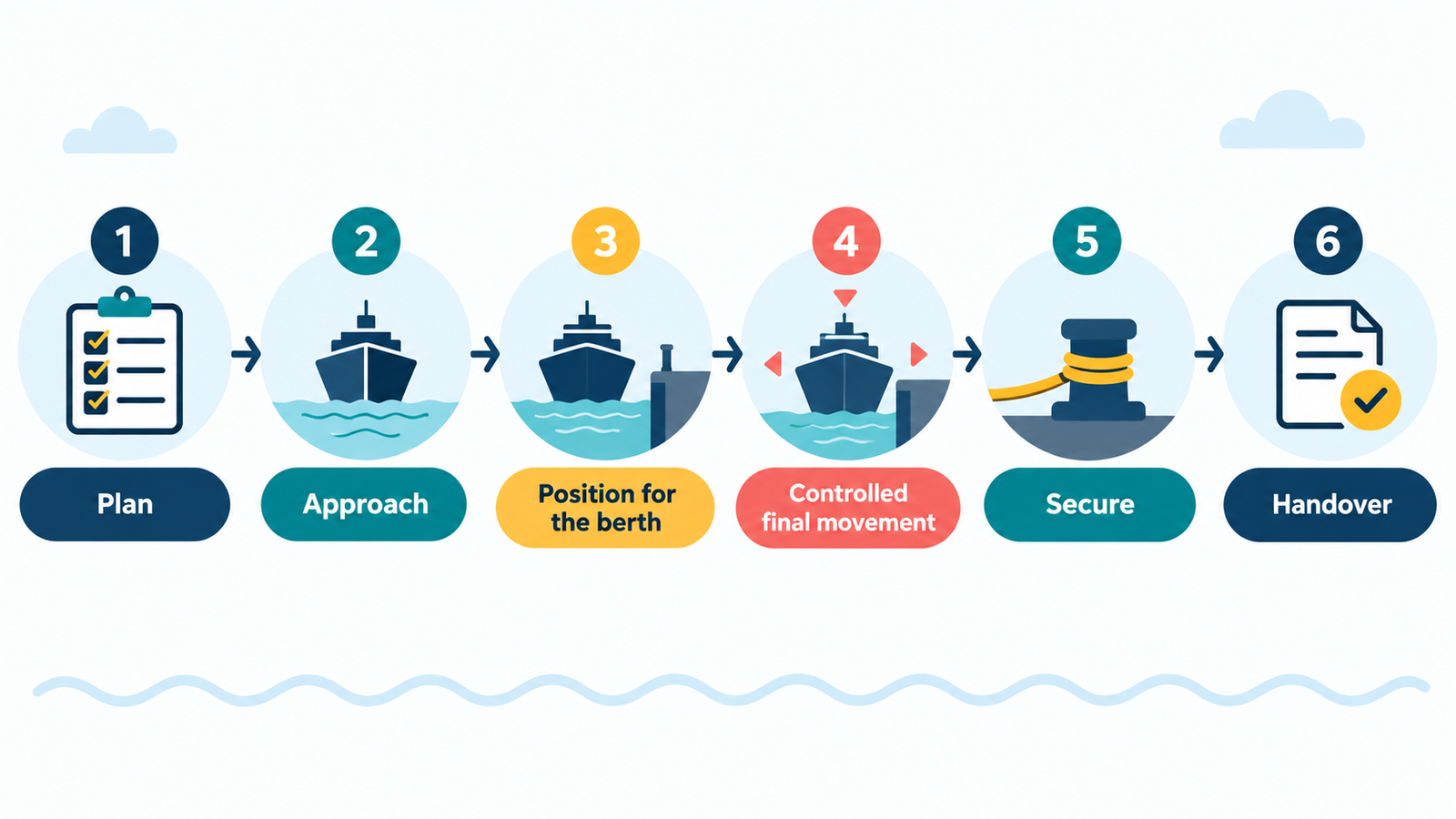
- Plan. The vessel, berth, tide window, expected wind and current, assistance arrangement and the intended side alongside are agreed before the movement starts.
- Approach. The vessel comes into the port approach area, speed comes down, and the assistance arrangement is put in place.
- Position for the berth. The vessel is brought onto a heading and a track that suit the berth face and the intended final movement.
- Controlled final movement. The remaining distance is closed slowly, with the approach speed and angle kept low, until the vessel contacts the fender line and stops.
- Secure. Lines go ashore in the planned order and are tensioned so the vessel is held in its required position.
- Handover. Control passes to the alongside phase, and the terminal’s operations begin.
I describe this sequence as a way to read a berthing discussion, not as an instruction. The IMO material around berthing and unberthing under wind, tide and current makes the reason clear enough: the same six steps behave differently when the environmental inputs change, and the interaction between the ship and its assisting tugs is part of the operation rather than an add-on. The order can also change. Some movements need a turn well before the berth. Some need the vessel to stop and hold while a window opens. Unberthing is not simply the reverse of the same steps, because the vessel starts with no way on and has to be taken off the structure before it has steering control. For a project reader, the useful part of the sequence is the fourth step. That is where the vessel meets the structure, and that is the step whose conditions feed a fender system review.
Which Factors Affect a Berthing Operation?
Someone asks how many tugs a berthing needs. A number sounds helpful. Given as a rule, it is the wrong answer to a real question.
A berthing operation is shaped by the vessel’s type, tonnage, draft and manoeuvring behaviour, the berth geometry and exposure, the wind, current and tide of that moment, and the assistance actually available. No single tug count answers it.
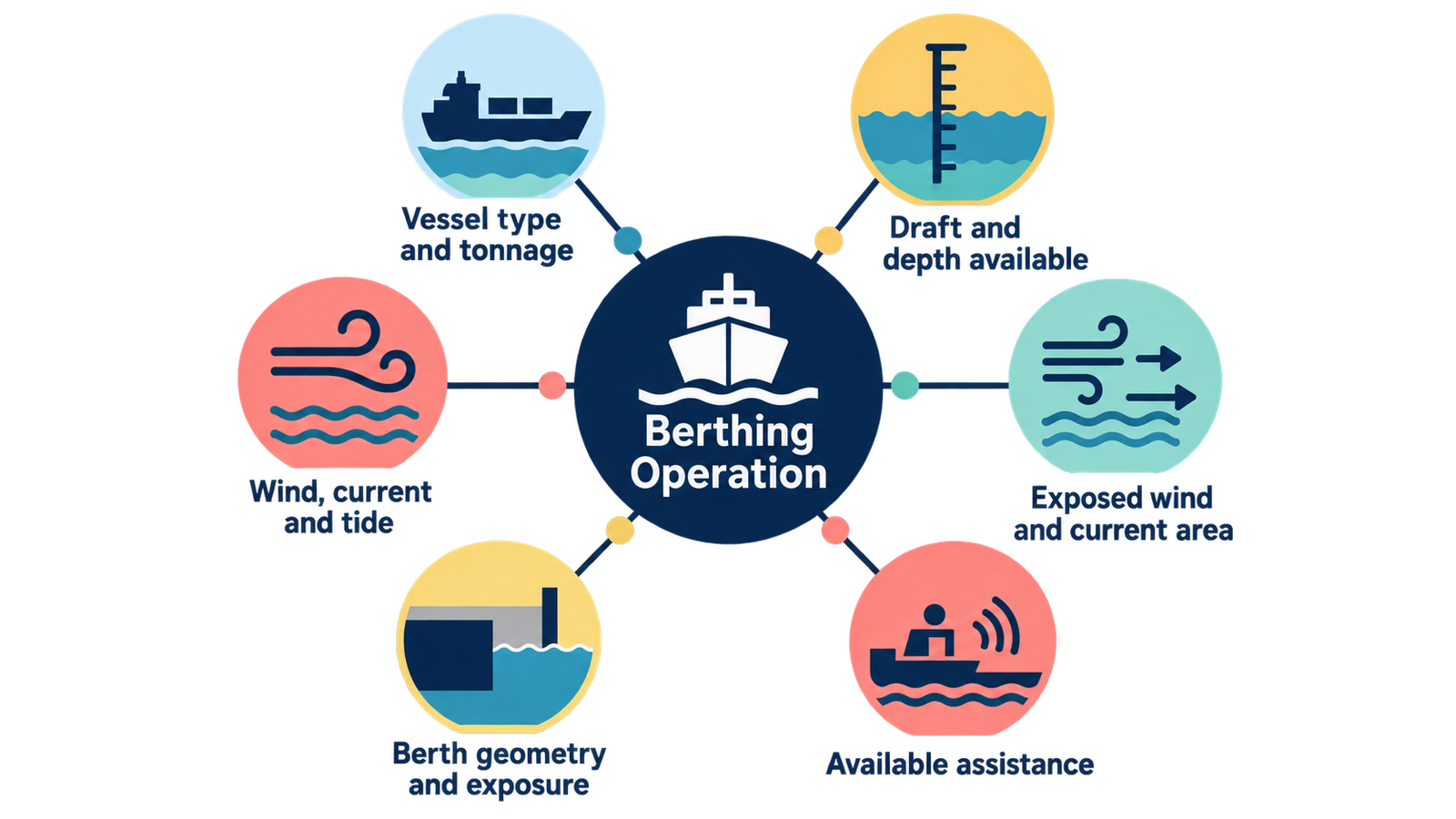
| Factor | What it changes in the manoeuvre | Why a generic answer fails |
|---|---|---|
| Vessel type and tonnage | Mass in motion and the response to steering and assistance | The same berth handles very different vessels |
| Draft and depth available | Under-keel clearance and low-speed handling | A tidal window can change the same movement |
| Exposed wind and current area | Force the vessel receives from wind and current | Two ships of similar length can differ a lot |
| Berth geometry and exposure | Approach track, final angle, room to turn | An exposed berth is not a sheltered berth |
| Wind, current and tide | Drift, set and the usable time window | These change hour by hour |
| Available assistance | Force that can be applied, and from where | Nominal power is not applied force |
Here is one operational example from my own experience, and it is specific to that port and that vessel size. At Yantian Port, an ultra-large vessel is handled with two 7,000-horsepower tugs plus one 5,000-horsepower tug for berthing, and for unberthing the allocation is reversed. In that operating experience, three tugs are a common starting point for ultra-large vessels, and unberthing may still need a different allocation than berthing. I want to be clear about the boundary: this is a port-specific and vessel-specific arrangement, not a universal tug-allocation standard, and I would not carry those numbers to another port or another ship. What travels is the reasoning. The selection follows the ship type, tonnage, draft, tide, wind and current, the exposed wind and current area, the berth conditions and the tug power actually on hand.
The way the force is applied matters as much as the number. In practice the assistance may be taken through a centre lead, worked at the ship’s side, applied as a push, or used to tow the vessel out, and combinations of these are normal. IMO facilitation material describes the same picture in general terms: tug assistance can be used to control the vessel’s speed and to compensate for wind and current, and the methods include towing on a line, operating at the ship’s side, and combinations of both. Coordination is part of the arrangement. Pilots generally liaise directly with the tug masters, while the ship’s master still has to understand each tug’s force, its direction and its operating angle. Local practice adds its own details. Some tugs also serve as pilot boats, as at Shanghai Yangshan Port. Again, that is a local observation about how those ports work, not a rule for anyone else’s terminal.
How Do Berthing Inputs Affect Fender System Design?
An enquiry arrives with a vessel size and a request for a fender size. The inputs that decide it are usually still missing.
Berthing inputs define the review a fender system needs; they do not produce a design outcome online. Once vessel, berth and environmental conditions govern the approach, the terminology question has ended and a project-specific engineering review starts.
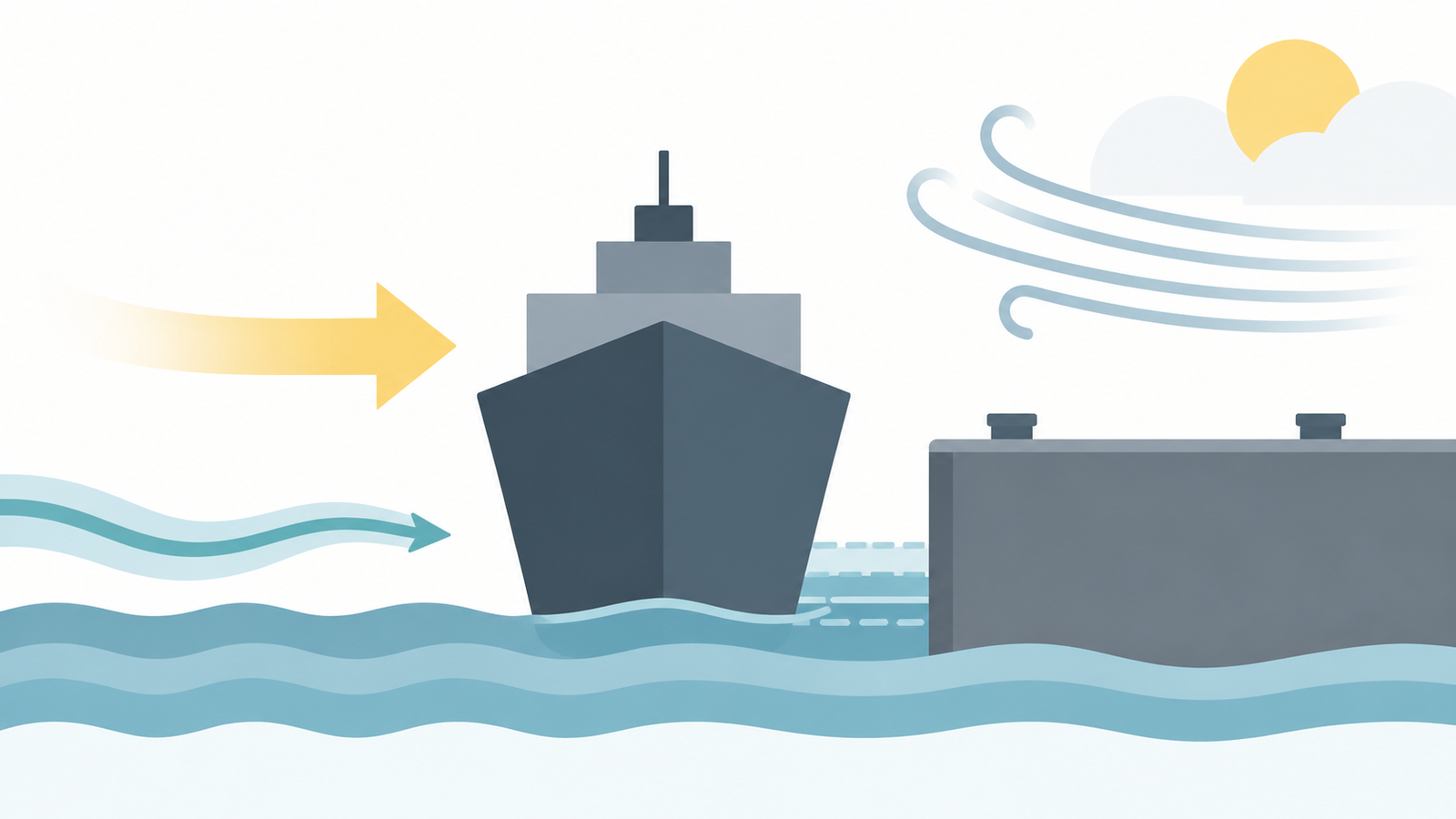
The link between the two halves of this article is the fourth step of the sequence. A fender system exists to receive a moving vessel at the berth face, so the inputs that shape the final movement are the same inputs an engineering review needs: which vessels the berth will actually serve, their loaded and ballast conditions, the berth structure and its geometry, the approach the pilot can realistically use, and the environmental conditions that are normal and exceptional at that location. This is also where the tug discussion stops being a curiosity. Assistance affects how the vessel arrives, and how the vessel arrives is a project input rather than a fixed value. I will not give a fender size, an energy figure or a specification from a definition article, and I would treat any supplier who does so from a vessel name alone as guessing.
Use this to decide where you are:
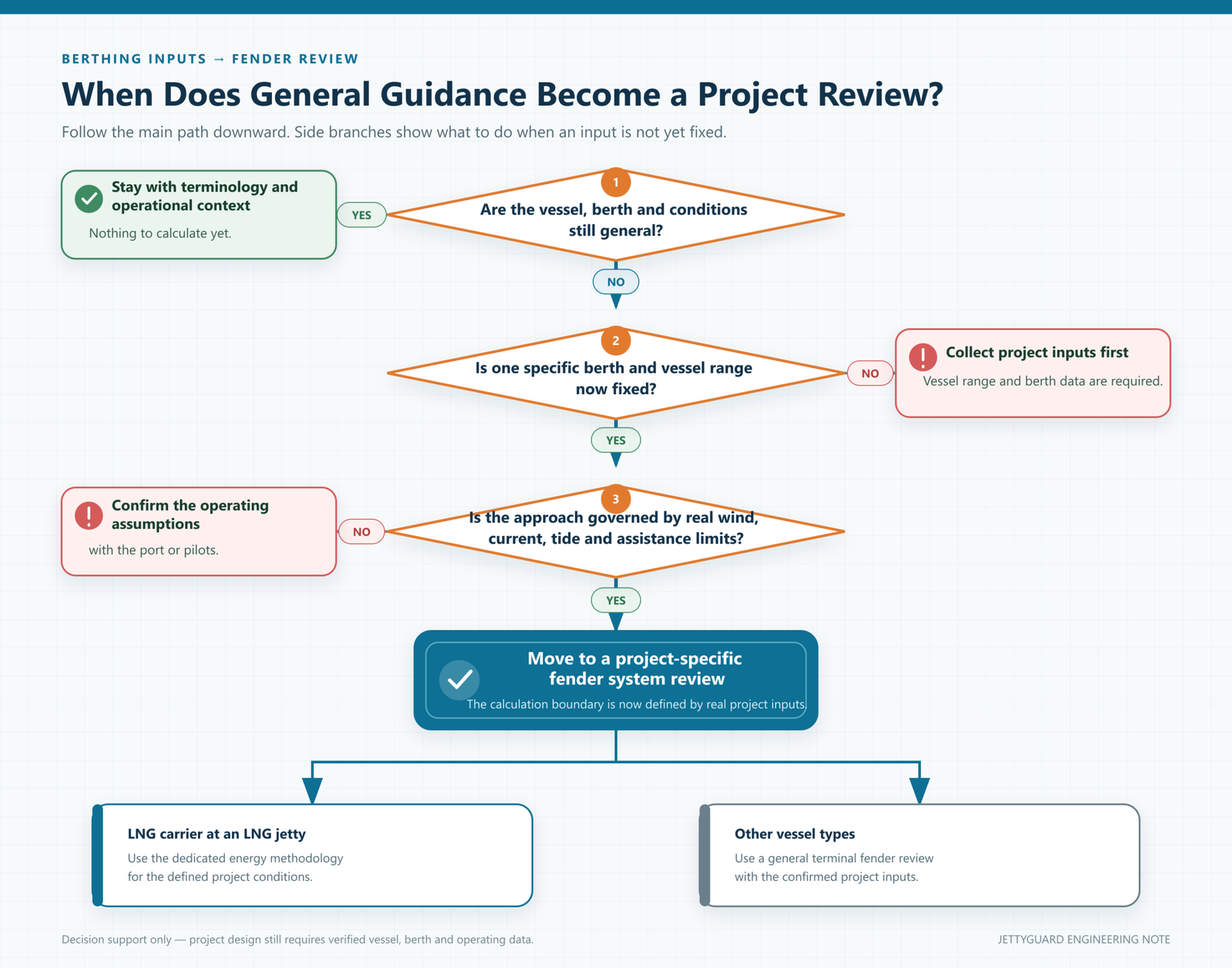
For the LNG branch, the methodology is handled separately in our LNG carrier berthing energy calculation article, because that vessel type and terminal type carry their own approach limits and acceptance expectations. Keeping it separate is deliberate. A definition article should tell you which door to walk through, and it should not pretend to be the calculation behind the door.
What Information Is Needed for Fender Selection?
Half-complete enquiries cost weeks. The supplier asks, the buyer forwards, the pilot is on leave, and the review has not started yet.
An early fender enquiry needs the vessel range, berth structure and geometry, environmental conditions, operating limits and the applicable project documents. With those, a review can begin. Without them, any figure returned is an assumption, not a selection.
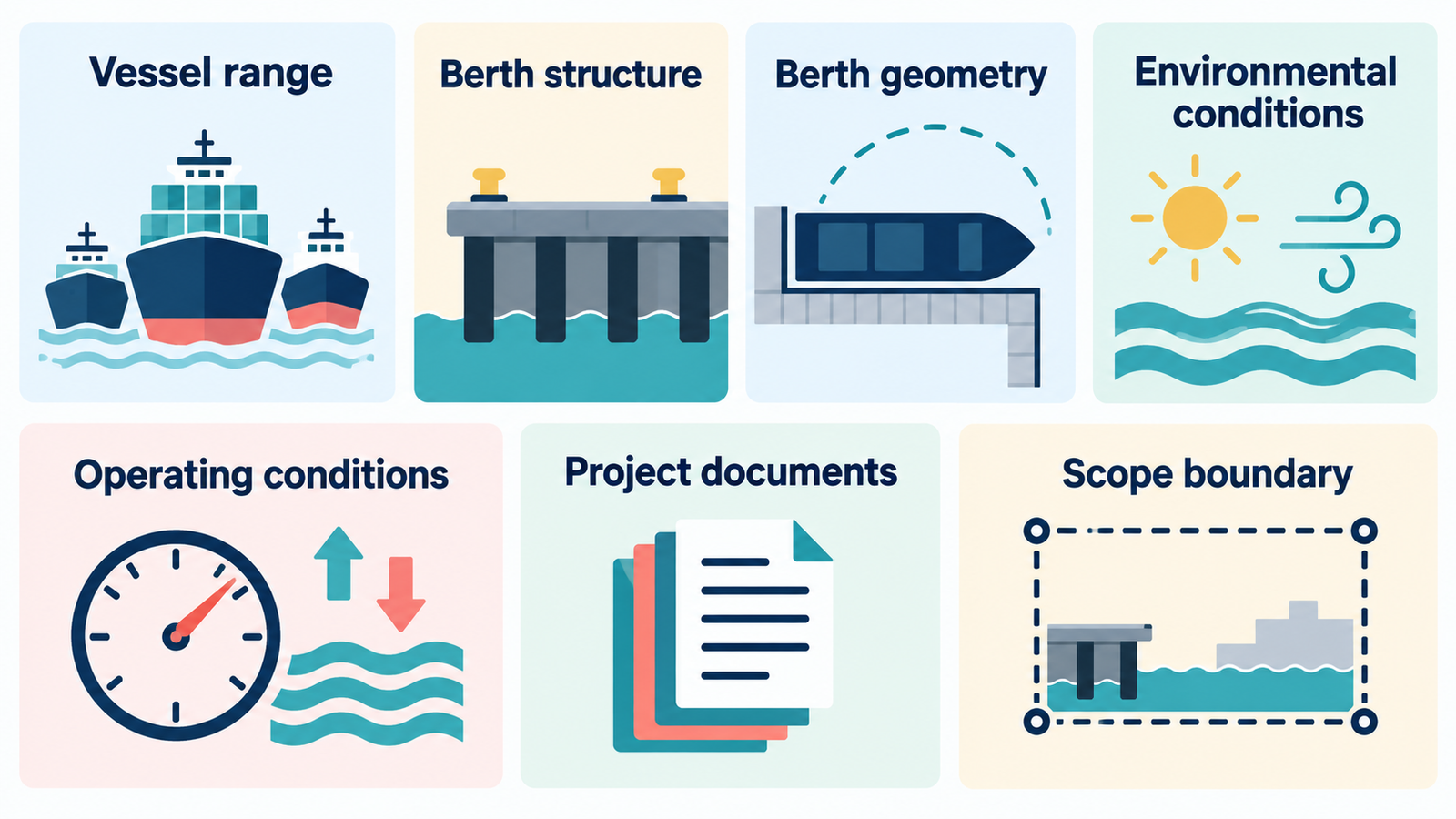
- [ ] Vessel range. Largest and smallest vessels, type, deadweight or displacement, length, beam, and loaded and ballast draft.
- [ ] Berth structure. Type of structure, face arrangement, fixing points available, deck level and any known constraints.
- [ ] Berth geometry. Berth length, water depth alongside, tidal range and the position of the vessel relative to the structure.
- [ ] Environmental conditions. Normal and exceptional wind, current and wave conditions at that location, plus the tidal window in use.
- [ ] Operating conditions. How the vessel is expected to approach, the assistance normally available, and any port-imposed limit on approach speed or angle.
- [ ] Project documents. Drawings, applicable standards or specifications named by the project, and any client or class requirement already fixed.
- [ ] Scope boundary. Whether fixings, accessories, replacement of existing units or interface steelwork are inside the enquiry.
This list is deliberately an input checklist and nothing more. It has no sizing rule, no energy method and no commercial content in it, because those belong to the review stage and to the people responsible for the design basis. I put the vessel range first for a reason. A single “design vessel” hides the case that often controls the arrangement, which is the small or lightly loaded vessel at the same berth. I put the operating conditions in because a berth with a strict approach limit and reliable assistance is not the same problem as an exposed berth where the window is short. The environmental data is where enquiries are thinnest, and it is usually available from the port even when it is not in the enquiry. For terminal-specific context on a gas berth, our LNG terminal fender system article covers that arrangement in more detail. If you can complete this checklist, you are ready for a project-specific review. If you cannot, the missing lines are the next task.
Conclusion
Get the terms right, then let the project inputs decide. If your berth, vessel range and conditions are already fixed, send us the checklist above and we will review a JettyGuard fender arrangement with you as a project-specific engineering exercise.