
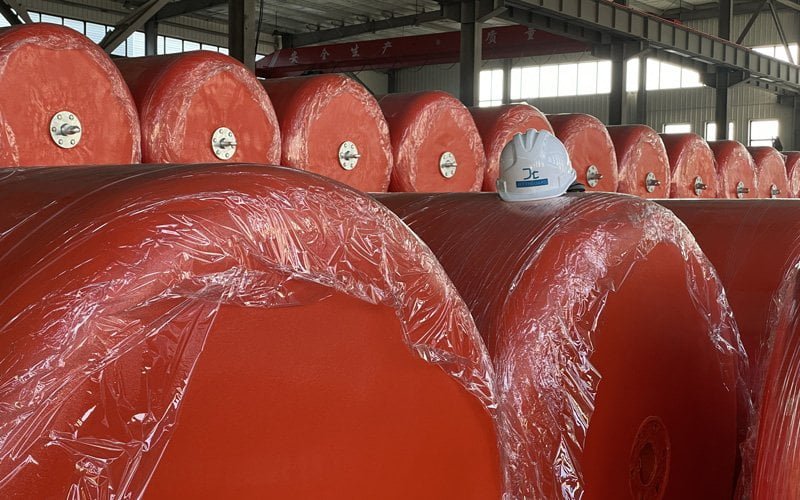
Most buyers start with fender size. That is the wrong starting point. The right starting point is the application — what vessels berth here, how fast, at what angle, and under what sea conditions.
To choose a foam filled fender, identify the application type first, then calculate berthing energy from vessel DWT and approach speed. Use those inputs to select fender diameter, foam density (typically 65–95 kg/m³), and coating type. Rated energy absorption should be confirmed against UFGS 35 59 13.17 and PIANC MarCom Report 211.
For a full product overview, see the foam filled fender product guide.
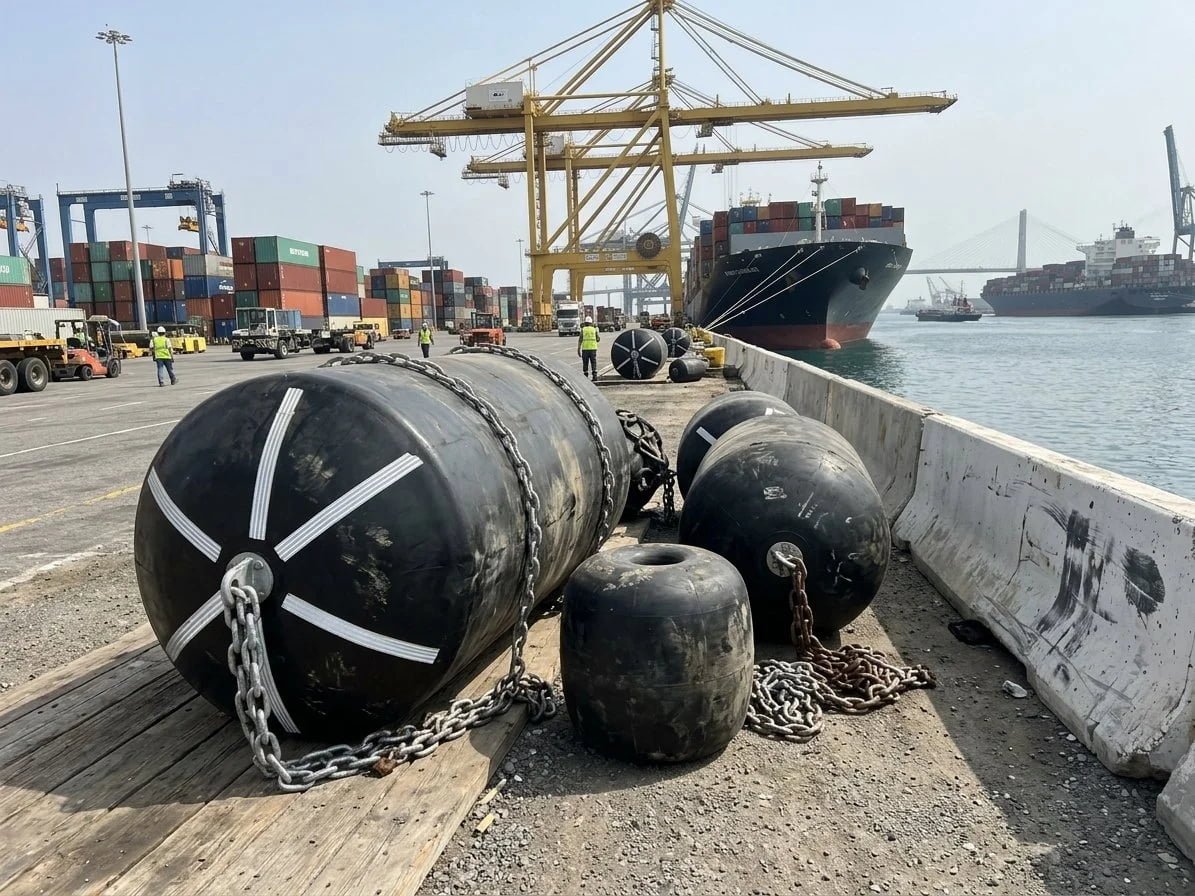
Start With the Application, Not the Fender Size
The application defines everything else. Fender diameter, foam density, coating specification, and hardware requirements all follow from where the fender is used and what type of vessel it contacts.
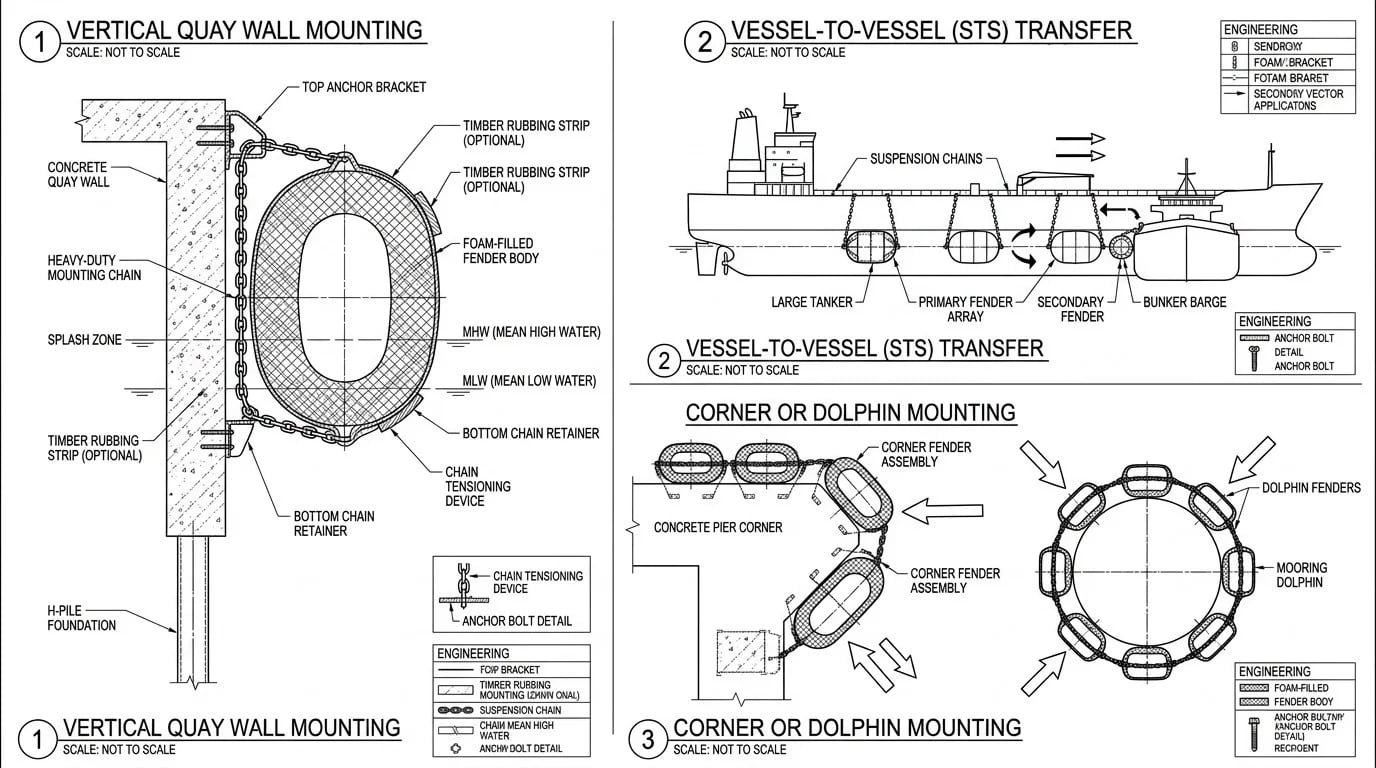
There are five main application contexts for foam filled marine fenders:
Permanent quay berthing. Fixed fenders on a quay wall for routine cargo or ferry operations. The vessel class is usually known and consistent. Selection focuses on rated energy absorption and hull pressure limits for that vessel type.
Ship-to-ship (STS) transfer. One or both vessels are moving during the operation. Dynamic loading from vessel motion means the fender needs filament reinforcement to resist lateral and torsional forces. For large tanker STS operations, see ship-to-ship transfer fender systems.
LNG terminal and FSRU berthing. Large vessel classes, high freeboard variation, strict hull pressure limits. PIANC MarCom Report 211 governs fender sizing for LNG applications. Fenders often need to perform across a wide tidal range. For LNG-specific fender requirements, see FSRU and LNG terminal fender systems.
Pilot boat, crew transfer vessel (CTV), and small workboat berthing. Smaller vessels, lower energy loads, but frequent and repetitive berthing cycles. Surface finish consistency matters here — a boat builder specifying hull-side protection needs every fender unit to match.
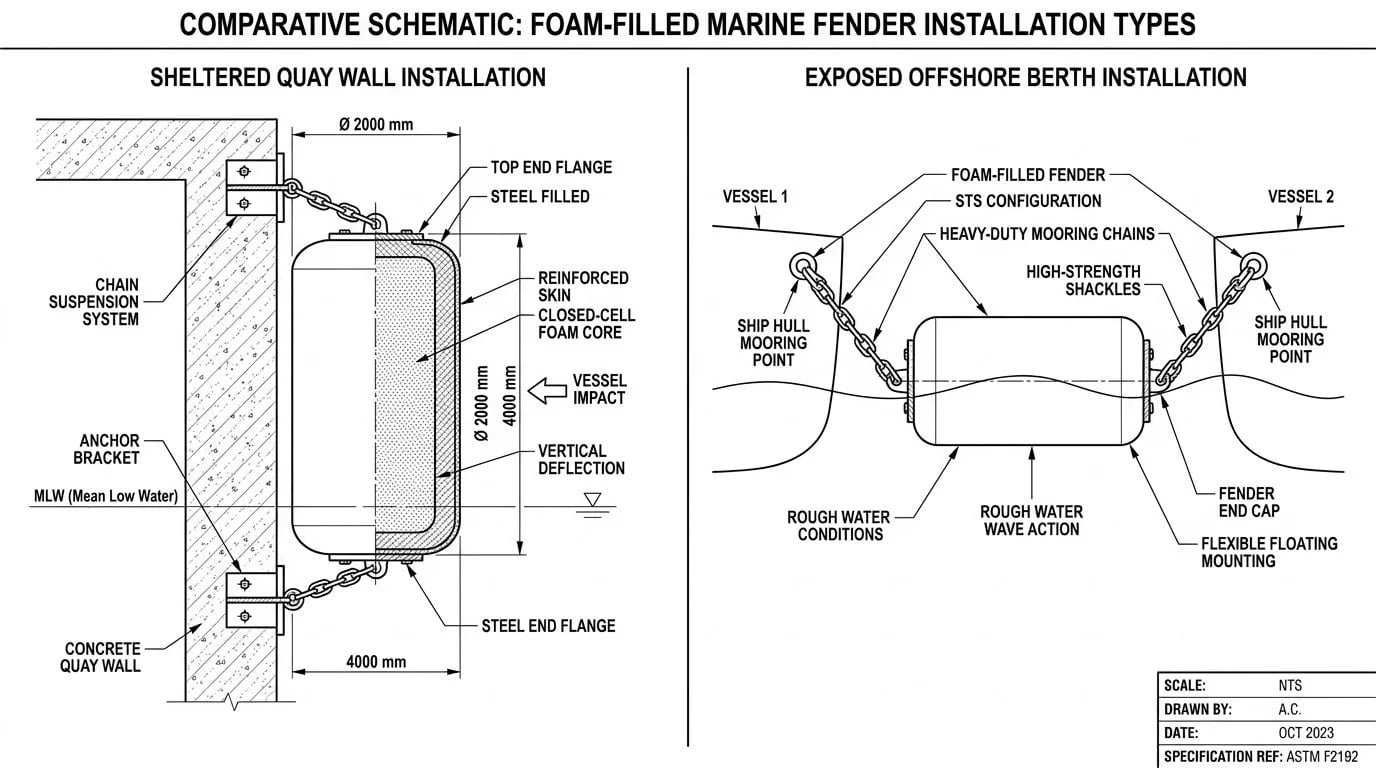
Offshore exposed berths. Wave action and vessel surge add dynamic loads that static calculations cannot fully capture. Foam filled fenders with polyurea SPUA coating are preferred here because they resist UV degradation and saltwater immersion without maintenance.
| Application | Key Selection Driver | Minimum Construction Requirement |
|---|---|---|
| Permanent quay berthing | Rated energy absorption vs vessel DWT | Standard EVA foam, polyurea coating |
| Ship-to-ship (STS) transfer | Dynamic load resistance, filament wrap | Filament reinforcement mandatory |
| LNG / FSRU terminal | PIANC compliance, hull pressure limits | High-density foam, SPUA coating |
| Pilot boat / CTV | Repetitive cycles, surface consistency | CNC-finished surface, uniform density |
| Offshore exposed berth | UV resistance, wave surge tolerance | SPUA coating, stainless hardware |
Check Vessel Size, Berthing Energy, and Hull Pressure
Three engineering inputs determine fender size: vessel DWT, berthing speed, and allowable hull pressure.
Berthing energy (E) is calculated from vessel displacement, approach speed, and berthing coefficients. The simplified formula from PIANC MarCom Report 211 is:
E = ½ × M × V² × Cm × Ce × Cs × Cc
Where M = vessel displacement (tonnes), V = approach velocity (m/s), and the C-factors account for added hydrodynamic mass, eccentricity, softness, and berth geometry.
A 10,000 DWT tanker berthing at 0.2 m/s produces approximately 140–180 kJ of kinetic energy, depending on the berth configuration. A fender rated below that will bottom out — reaching full deflection before absorbing all energy, transferring the remainder as impact force directly to the hull and structure.
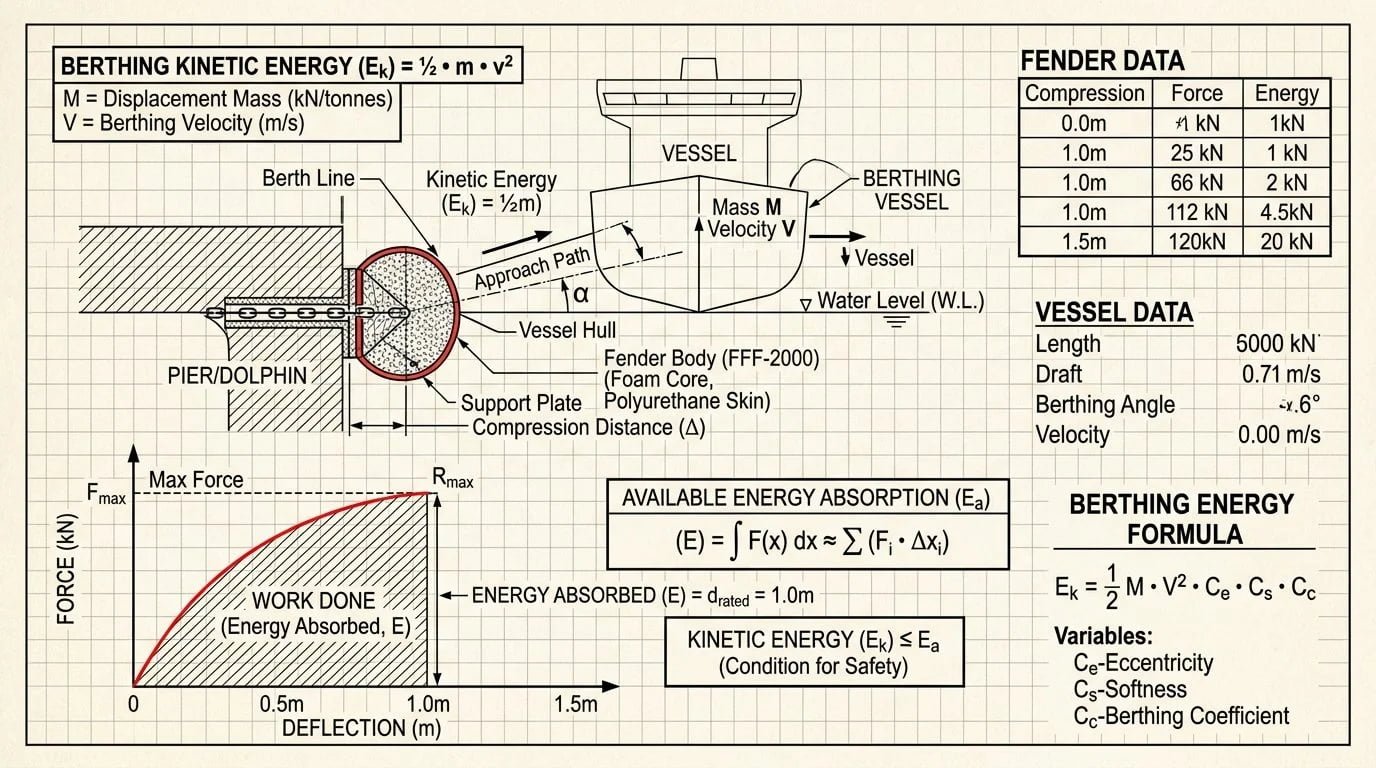
Hull pressure (P) is the second constraint. Gas carriers (LNG/LPG) have a maximum hull pressure of up to 200 kN/m² per PIANC WG211 Table 6-6. Larger tankers and bulk carriers tolerate more. Foam filled fenders distribute load across the fender contact panel — the larger the fender diameter, the larger the contact area, the lower the hull pressure for a given reaction force.
If you have both the energy requirement and the hull pressure limit, you can cross-check them against the fender’s energy-reaction curve. The fender must absorb the required energy without exceeding the hull pressure limit at that deflection point.
When either figure is missing, request them from the port engineer or vessel operator before specifying. Guessing produces undersized or oversized fenders — both are expensive mistakes.
Choose the Right Foam Fender Construction
Not all foam filled fenders are built the same way. Construction method directly affects how the fender performs after repeated compression cycles.
The foam core. The core is closed-cell EVA foam — a PE-family closed-cell foam. (The UFGS 35 59 13.17 procurement baseline specifies closed-cell cross-linked polyethylene as the reference core material.) Closed-cell means water cannot penetrate even if the outer coating is damaged — the fender will not absorb water or lose buoyancy. Foam density ranges from 65 kg/m³ for lighter-duty applications to 95 kg/m³ for high-energy offshore use. Higher density means higher energy absorption capacity and higher reaction force. For the specification gap, compressive set, and rebound trade-off, see our EVA foam core guide.
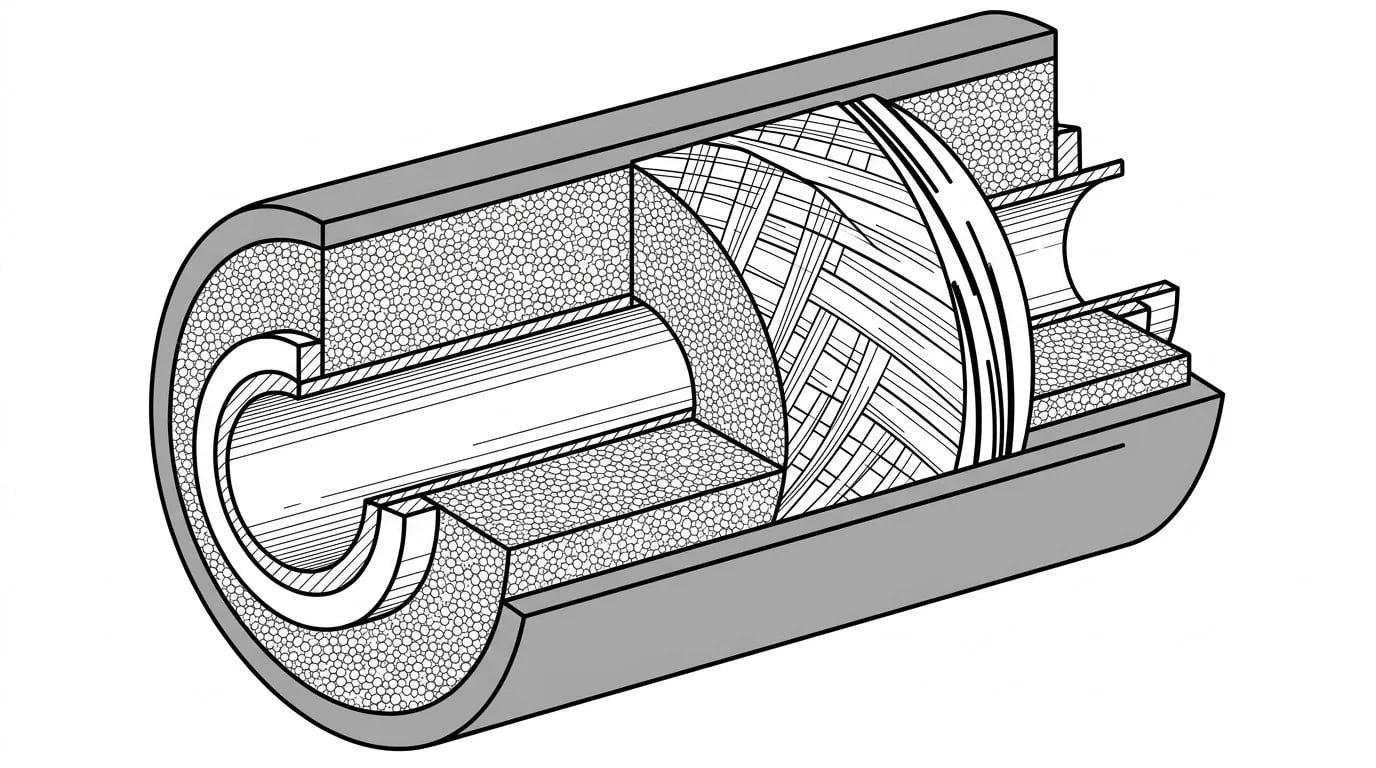
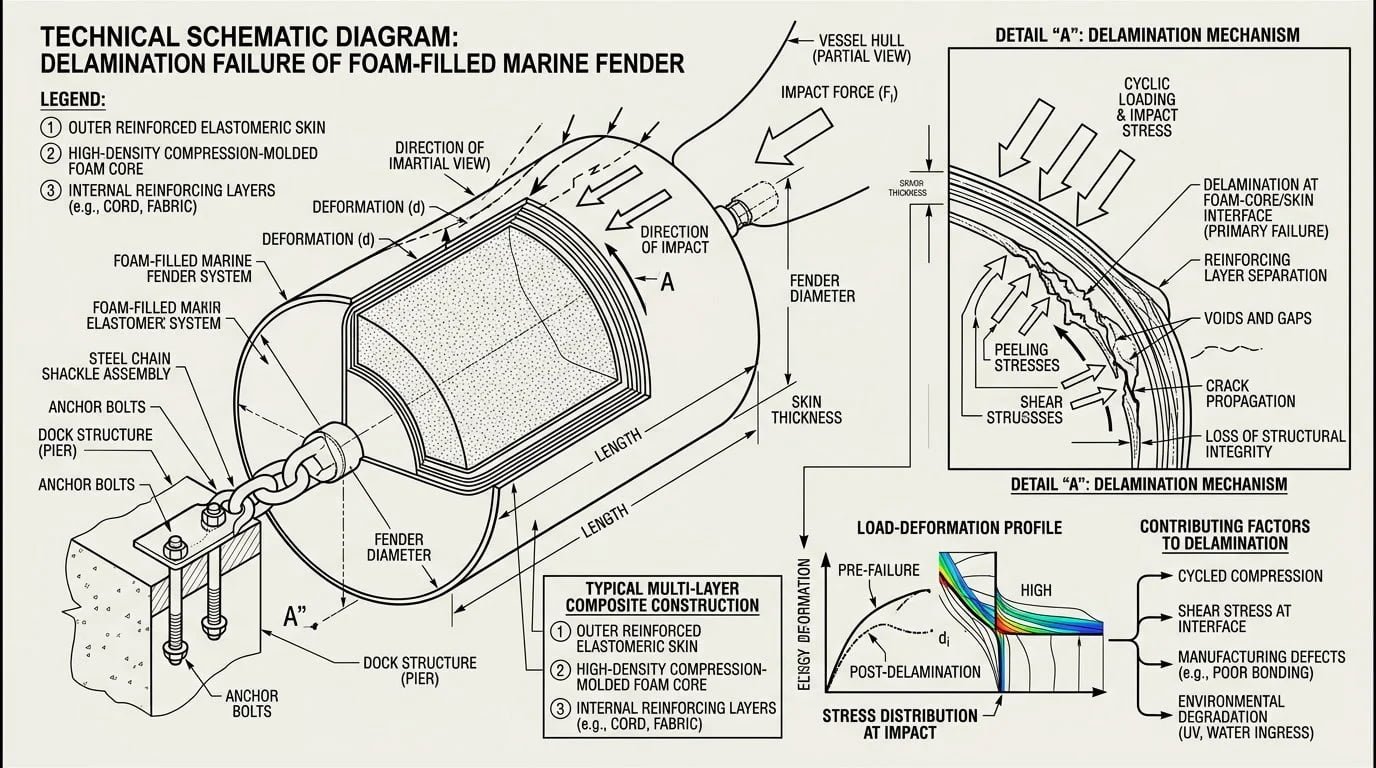
How the core is built matters. I’ve seen the two most common manufacturing approaches fail in the same way. Chinese factories typically roll large foam boards into shape. Trelleborg and some overseas factories wind narrow foam strips around a mandrel. Both methods create excessive bonding layers — too many glue joints, too much surface area exposed to shear stress. Under repeated compression cycles, the foam core delaminates and goes loose inside.
We use thick-cut circular foam blocks bonded in fewer layers. Less bonding area means fewer failure points. The fender core stays solid and integrated even after years of berthing impacts.
Surface finish. For smaller vessel fenders, most domestic factories use manual surface cutting. It works, but the surface flatness is poor and you get visible inconsistency between fender segments. Boat builders notice this — it affects the aesthetic consistency along the hull. We switched to CNC machining for surface finishing. The result is smooth, uniform, and every fender segment matches. If you need appearance consistency alongside protection, ask how the surface is finished before placing an order.
Filament reinforcement. A wrapped filament layer — glass fiber or polyester — applied over the foam core before coating adds tensile resistance. For STS and offshore applications where lateral loading is expected, specify filament reinforcement. Without it, repeated lateral impact can cause the coating to separate from the foam.
Outer coating. Two options are standard in the industry: polyurea SPUA (spray-applied, seamless) and rubber skin (sheet-wrapped with nylon cord reinforcement). Polyurea coatings applied at 6–8 mm thickness offer better UV resistance, lighter weight, and a seamless bond to the foam surface. Rubber skin provides higher elasticity and impact absorption, performs well in cold climates, but adds weight and has seams that can split under repeated impact. For offshore and LNG applications where UV exposure and maintenance access are concerns, polyurea SPUA is our recommended specification.
| Construction Factor | Standard Method | JettyGuard Method | Why It Matters |
|---|---|---|---|
| Foam core assembly | Rolled foam boards or wound strips | Thick-cut circular blocks, fewer layers | Fewer glue joints = fewer delamination points |
| Surface finish | Manual cutting | CNC machining | Uniform flatness, consistent appearance |
| Filament reinforcement | Optional or absent | Standard on STS/offshore spec | Lateral load resistance, coating adhesion |
| Outer coating | Rubber skin (sheet-wrapped) | Polyurea SPUA at 6–8 mm (seamless, spray-applied) | UV resistance, no seams, lighter weight |
| Foam density range | 65–95 kg/m³ | Specified to application energy requirement | Match density to rated energy, not default selection |
Match Fender Type to Site Conditions
Construction quality is necessary but not sufficient. Site conditions determine which fender configuration is the right fit for installation and long-term service.
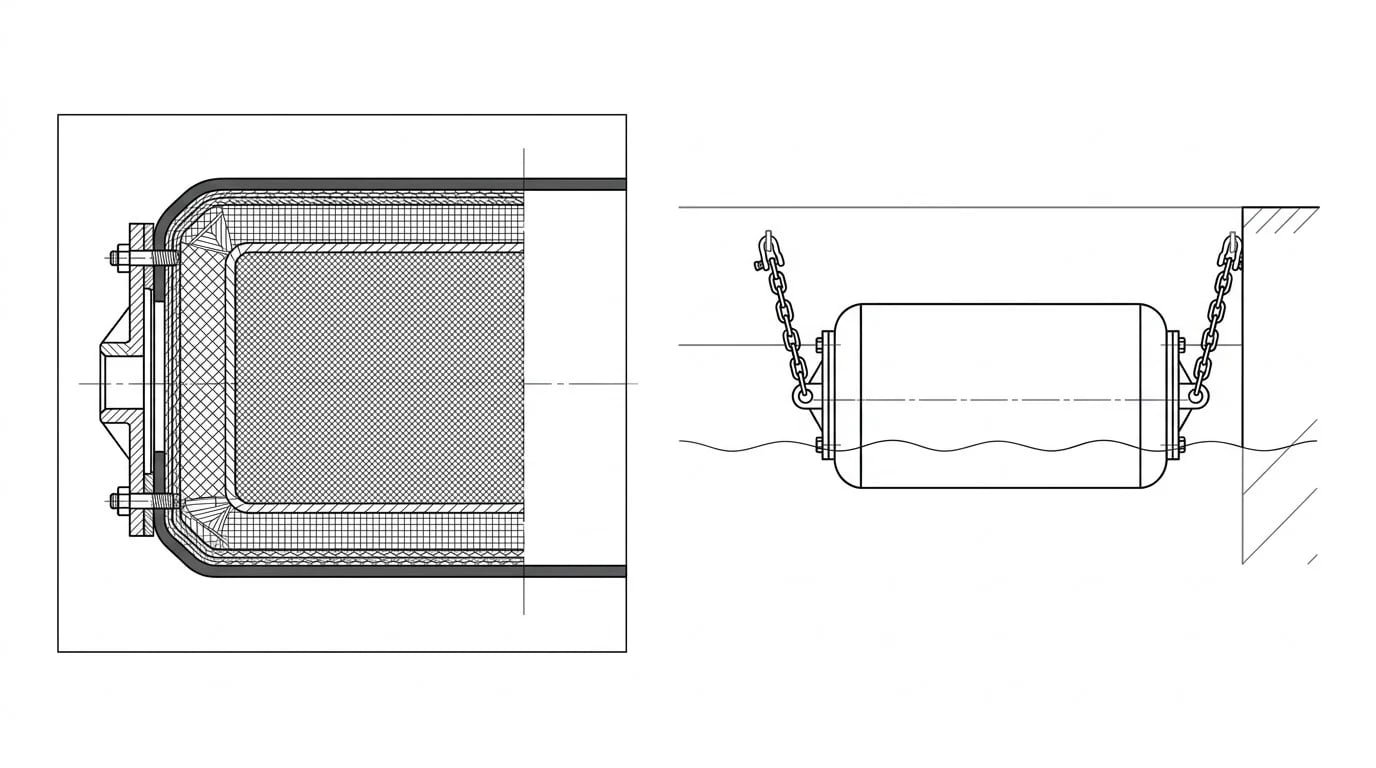
Permanent vs temporary installation. Permanent quay fenders are typically chained to a backing structure with stainless or galvanized chain hardware and shackles. Temporary or floating fenders for STS use different rigging — rope tails or soft lines. Specify the installation type when requesting a quote, because the hardware package changes.
Tidal variation. Large tidal ranges mean the vessel freeboard changes significantly over the course of a tidal cycle. The fender must cover the full vertical range where the hull contacts the structure. For berths with more than 3 m of tidal variation, a vertical fender panel array or a longer fender cylinder may be needed.
Sheltered vs exposed berths. A sheltered harbor berth in calm water allows standard foam density and coating. An exposed offshore berth — a loading terminal, an FPSO mooring, or a jetty with direct ocean swell exposure — needs higher foam density, polyurea SPUA coating rather than rubber skin, and stainless steel hardware throughout. Standard galvanized chain corrodes within 18 months in full offshore exposure.
Water depth and ground clearance. For fenders that hang near the waterline, check that the fender diameter plus any tidal drop does not push the fender into the seabed at low water. This is particularly relevant for shallow-water quay applications with large-diameter fenders.
Foam Filled Fender vs Pneumatic Fender: When to Choose Each
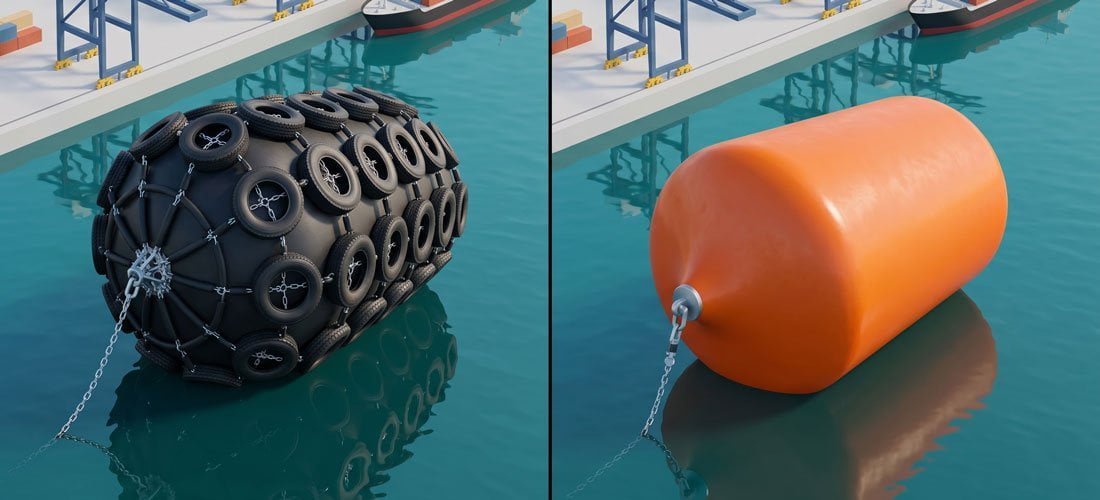
These two fender types are not interchangeable. Each has a defined range of applications where it performs better.
For a detailed application comparison for LNG and STS operations, see the pneumatic vs foam filled fender comparison.
| Factor | Foam Filled Fender | Pneumatic Fender |
|---|---|---|
| Energy absorption mechanism | EVA foam compression (elastic) | Compressed air pressure change |
| Maintenance requirement | None — no inflation, no valves | Regular pressure checks, valve maintenance |
| Risk of failure | Low — foam cannot deflate | Moderate — puncture or valve failure causes loss of performance |
| Hull pressure | Moderate to high depending on size | Low — large contact area, low pressure |
| Applications | Quay berthing, STS, pilot boat, CTV, offshore | LNG carrier, large tanker STS, VLCC |
| Standard reference | UFGS 35 59 13.17, PIANC MarCom Report 211 | ISO 17357, PIANC, OCIMF STS Transfer Guide |
| UV and saltwater resistance | High (polyurea SPUA coating) | Moderate (rubber skin) |
| Lead time | 3–6 weeks typical | 4–8 weeks typical |
Pneumatic fenders carry risk of loss of performance from pressure loss — this matters for LNG carrier berthing where hull pressure tolerance is strict. Foam filled fenders carry no such risk because the foam cannot deflate. For permanent quay installations and any application where maintenance access is limited, foam filled fenders are generally the lower-risk choice.
For offshore FSRU and LNG terminal fender specification, see FSRU and LNG terminal fender systems.
Specification Checklist Before Requesting a Quote
Before contacting a supplier for a foam filled fender quote, gather these data points. A quote without this information is a guess — and you will need to revise it when engineering reviews the selection.
For a complete breakdown of fender specification parameters, see foam filled fender specifications.
Vessel data:
1. Vessel DWT (or displacement in tonnes)
2. Vessel LOA and beam (for reference, not primary sizing input)
3. Vessel hull material (steel, aluminum, FRP)
4. Maximum approach speed at berthing (m/s)
5. Approach angle to the berth
Site data:
6. Berth type (quay wall, jetty, STS, offshore mooring)
7. Tidal range at site (m)
8. Water depth at fender location
9. Exposed or sheltered berth
10. Backing structure material (concrete, steel, timber)
Operational data:
11. Frequency of berthing operations per month
12. Required fender service life (years)
13. Chain and hardware specification (galvanized, stainless steel, or customer-supplied)
14. Any classification society or port authority standards that apply
15. Quantity and delivery location
Common Selection Mistakes
These are the errors I see most often in fender enquiries. Each one leads to either a fender that fails early or a specification that costs more than it should.
-
Sizing by LOA instead of DWT and berthing energy. Vessel length is not a reliable proxy for energy load. A 150-metre cargo vessel and a 150-metre tanker have very different displacements. Use displacement and berthing speed — not length — as the sizing input.
-
Ignoring approach angle. A vessel approaching at 5–10 degrees generates a very different load distribution than a parallel approach. Ignoring this underestimates the shear and torsional forces on the fender and its mounting hardware.
-
Specifying rubber-skin fenders for offshore UV exposure. Rubber skin coatings degrade faster under UV and saltwater immersion than polyurea SPUA. For exposed offshore berths, polyurea SPUA at 6–8 mm is the more durable specification. Rubber skin is adequate for sheltered quay applications where UV exposure is limited and impact absorption is the priority.
-
Skipping filament reinforcement for STS applications. Standard foam filled fenders without reinforcement are designed for perpendicular berthing loads. STS operations create lateral drift and torsion. Without a filament layer, the coating separates from the foam under these loads within 1–2 years of service.
-
Requesting a quote without hull pressure data. A supplier can calculate fender energy — but without the vessel’s hull pressure tolerance, there is no way to confirm that the reaction force at maximum deflection stays within the vessel’s structural limit. This is the step most buyers skip.
-
Accepting the cheapest rolled-foam fender without asking about core construction. A fender built from rolled foam boards or narrow wound strips has more internal glue joints than one built from thick-cut blocks. Under cyclic compression, those joints fail. The fender softens, loses its energy rating, and eventually goes loose inside the coating. Ask specifically how the foam core is assembled before placing an order.
Foam Filled Fender Selection Checklist
Use this checklist to confirm your selection before submitting an RFQ. Steps 1–6 can be confirmed from available engineering data; steps 7–8 require supplier confirmation.
- Application type identified (quay, STS, LNG, pilot boat, offshore)
- Vessel DWT confirmed and berthing energy calculated per PIANC MarCom Report 211
- Hull pressure tolerance confirmed for the vessel class
- Fender diameter and length selected to absorb required energy within hull pressure limit
- Foam density specified to application (65–95 kg/m³ range)
- Filament reinforcement specified for STS or offshore applications
- Coating type confirmed — polyurea SPUA for offshore/UV exposure, rubber skin for sheltered quay or cold-climate applications
- Chain and hardware specification confirmed — stainless steel for offshore, galvanized acceptable for sheltered
For STS operations, confirm the fender specification against ship-to-ship transfer fender systems before finalizing.
Frequently Asked Questions
What size foam filled fender do I need for a 10,000 DWT tanker?
At standard berthing speed (0.15–0.20 m/s), a 10,000 DWT tanker generates approximately 120–180 kJ of berthing energy depending on berth geometry and approach angle. A foam filled fender in the OD1500–OD2000 mm range typically covers this load. Confirm with a full berthing energy calculation per PIANC MarCom Report 211 before finalizing the specification.
Can foam filled fenders be used for LNG terminal berthing?
Yes, with conditions. Gas carriers have a strict hull pressure limit — up to 200 kN/m² per PIANC WG211 Table 6-6. The fender must absorb the vessel’s berthing energy without generating a reaction force that exceeds this limit. Larger-diameter, lower-density foam fenders distribute load over a greater contact area. For very large LNG carrier classes, pneumatic fenders may provide a lower hull pressure profile. Compare both options against the vessel’s berthing data before specifying.
What is the difference between polyurea and rubber coating on foam filled fenders?
Polyurea SPUA coating is spray-applied in a seamless layer, typically 6–8 mm thick. It bonds directly to the foam surface, resists UV degradation and saltwater immersion, and is lighter than rubber. Rubber skin coating is sheet-wrapped with nylon cord reinforcement — it provides higher elasticity and better cold-weather flexibility, but is heavier and has seams that can split under repeated impact. For offshore and UV-exposed installations, polyurea SPUA is preferred. For sheltered berths in cold climates where impact absorption is the priority, rubber skin works well.
How long do foam filled fenders last?
With a polyurea SPUA coating and stainless steel hardware, a foam filled fender in normal quay service should last 10–15 years without replacement. Offshore or high-frequency berthing conditions reduce this. The foam core does not degrade in water contact — failure typically starts at the coating surface or at internal glue joints in poorly constructed cores.
Do foam filled fenders require maintenance?
No regular maintenance is required. There are no valves to check and no internal pressure to monitor. Periodic visual inspection of the coating surface and hardware is good practice — check for coating cracks or chain wear at contact points. The closed-cell EVA foam will not absorb water even if surface damage occurs.
What is the lead time for foam filled fenders?
Standard sizes (OD500–OD1500 mm, common lengths) typically ship in 3–5 weeks from order confirmation. Large-diameter fenders (OD2000 mm and above) or custom specifications — non-standard lengths, specific foam density, special hardware — run 5–8 weeks. For project timelines, confirm lead time at enquiry stage, not after contract award.
Specifying foam filled fenders for a port project or vessel application? Send us the vessel class, berthing energy estimate, and site conditions. We will return a fender recommendation with an energy-reaction curve and hardware specification. Visit the foam filled fender product guide to get started.