
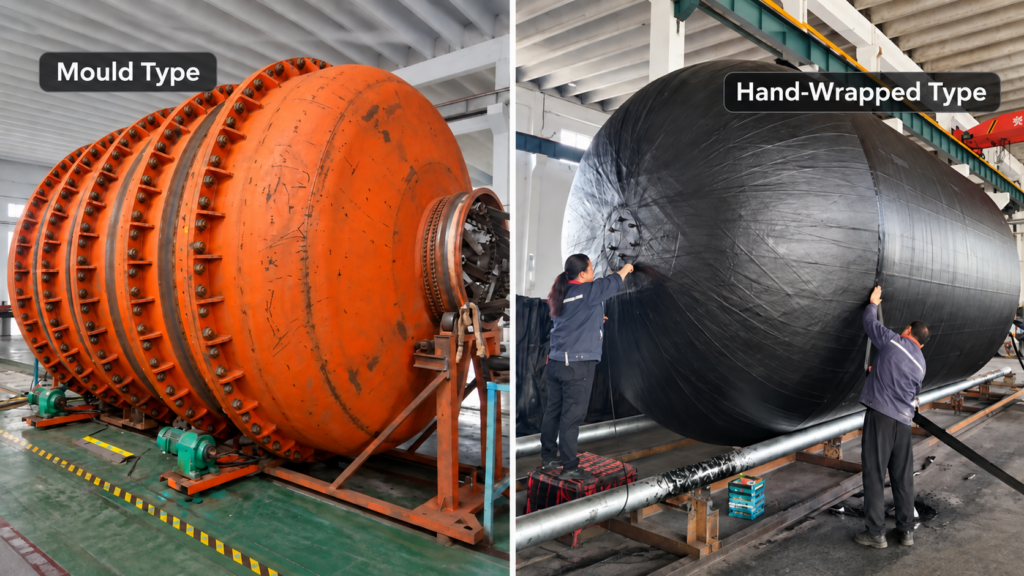
When an operator asks for a “Yokohama fender,” they often believe all large pneumatic fenders with tyre nets are the same product. They’re not.
A Yokohama fender is a market term for a pneumatic rubber fender, but it does not mean all pneumatic fenders share the same construction, performance, or commercial value. Before comparing offers, clarify the product class, construction route, and operating context.
Understanding the difference between a brand name, a technical standard, and the construction questions that follow helps you avoid confusion when quoted prices show substantial variation for the same nominal size.
This guide explains what the term means, how pneumatic fenders work, which construction and protection questions matter, where they’re used, and what inspection boundaries you should understand before treating a fender as ready for service.
What Is a Yokohama Fender?
Buyers often see large pneumatic fenders with tyre-net protection and assume they’re all Yokohama fenders. The term creates confusion.
A “Yokohama fender” is a common market expression for a pneumatic rubber fender, but Yokohama is a brand name, not a technical category. ISO 17357-1:2014 defines the governing standard for high-pressure pneumatic fenders without requiring a specific brand.
| Aspect | What it is | What it is not |
|---|---|---|
| Brand | Yokohama Rubber Co., Ltd. manufactures pneumatic fenders under the Yokohama brand | Not every pneumatic fender is manufactured by Yokohama |
| Market term | Buyers often use “Yokohama fender” to mean any large pneumatic fender with tyre net | The term does not prove construction equivalence |
| Technical standard | ISO 17357-1:2014 governs high-pressure pneumatic fenders | ISO compliance does not require Yokohama manufacture |
| Construction | Yokohama uses a moulded process with fixed steel moulds | Many suppliers use hand-wound construction over a pre-vulcanized bladder |
I see buyers request a “Yokohama fender” and expect a universal product. They’re surprised when quotations for the same nominal size show substantial price variation. The outer silhouette and tyre net look similar, but the construction routes, material investment, and service characteristics differ. Before comparing offers, ask which product class and construction route the supplier is offering. For more on the standard framework, see our guide to the ISO 17357 pneumatic fender standard.
Is a Yokohama Fender Different from a Pneumatic Fender?
Buyers use the terms interchangeably, but the relationship is not one-to-one. The distinction matters for quotation clarity.
Yokohama is a brand name for one manufacturer’s pneumatic fenders. A pneumatic fender is the technical category governed by ISO 17357-1:2014. All Yokohama fenders are pneumatic fenders, but not all pneumatic fenders are Yokohama products.
| Term | Scope | What it tells you | What it does not tell you |
|---|---|---|---|
| Yokohama fender | Brand-specific product from Yokohama Rubber Co., Ltd. | Construction uses moulded process with steel moulds | Does not define the universe of pneumatic fenders |
| Pneumatic fender | Technical category for high-pressure pneumatic rubber fenders per ISO 17357-1 | Covers Type I and Type II configurations | Does not specify brand or construction route |
| Yokohama-type fender | Market term for a pneumatic fender benchmarked to Yokohama process and quality | Indicates construction intent or reference standard | Not a regulated term; verify construction details |
When a buyer asks for a “Yokohama fender,” I clarify whether they need a Yokohama-branded product or a pneumatic fender that meets the technical requirements. The brand name does not define the technical category, and the category does not require one brand. Suppliers position products differently. Some manufacture Yokohama-type fenders benchmarked to the moulded process and offer a cost advantage. Others use hand-wound construction at a lower price point. The outer appearance does not tell you which construction route was used. Ask before comparing.
How Does a Pneumatic Fender Work?
Pneumatic fenders absorb berthing energy through controlled air compression inside a sealed rubber body. The principle is straightforward, but the operating boundary depends on the air pressure, vessel contact, and interface conditions.
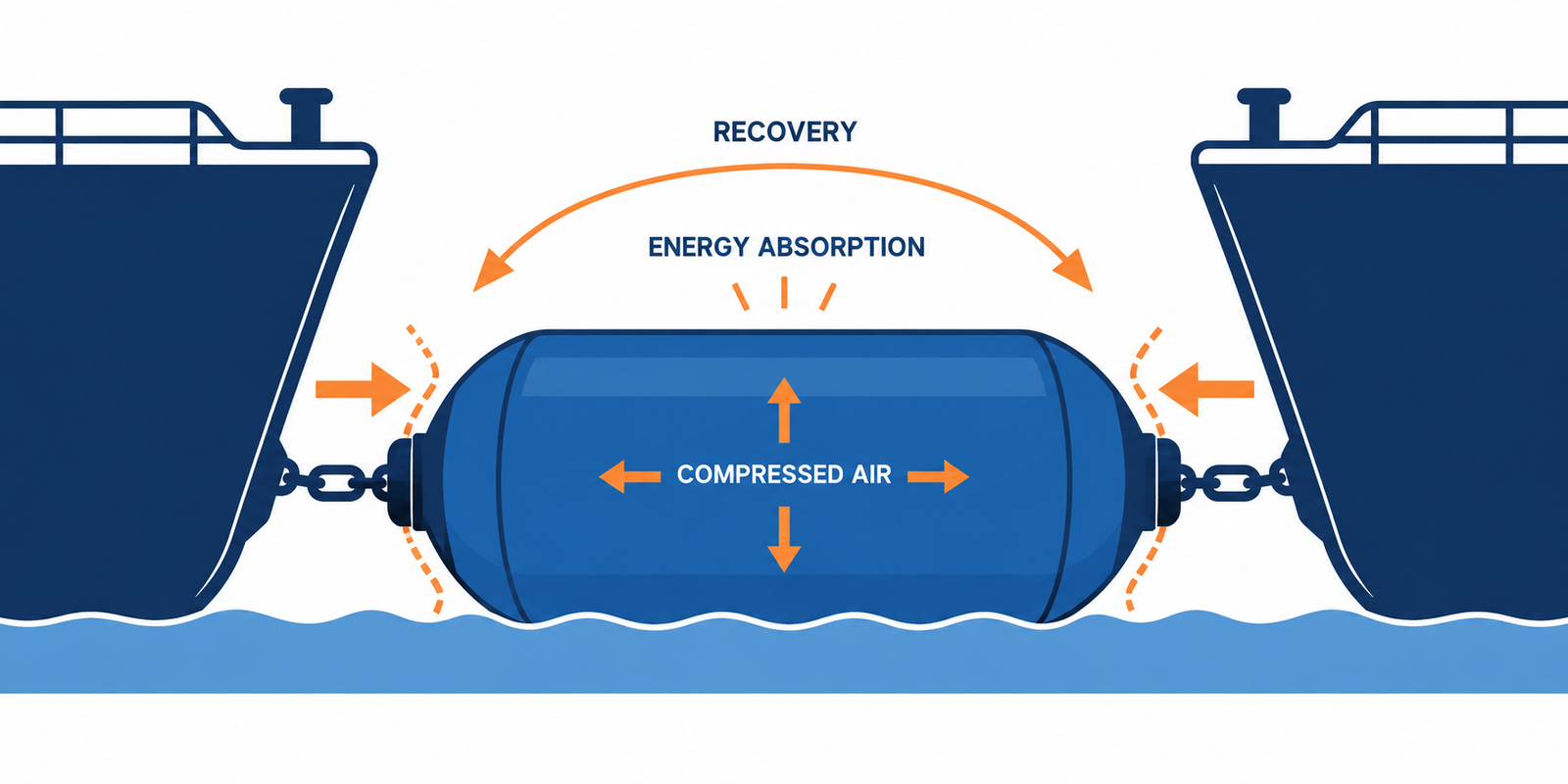
A pneumatic fender consists of a cylindrical rubber body filled with compressed air. When a vessel contacts the fender, the air compresses, absorbing energy and reducing impact force on the berth or adjacent vessel. The fender’s reaction force and deflection depend on internal pressure, contact area, and the degree of compression.
Basic Operating Principle
The fender works because air is compressible. When the fender is squeezed, the air inside compresses and stores energy. The rubber body contains the pressure and distributes the load. After contact, the fender returns to its original shape because the compressed air pushes outward. The energy absorption capacity depends on how much the fender deflects and the initial inflation pressure.
Pressure and Performance
ISO 17357-1:2014 defines two types. Type I fenders operate at an initial internal pressure of 50 kPa. Type II fenders operate at 80 kPa. Higher initial pressure increases the fender’s reaction force at a given deflection. The pressure must be maintained within the specified range. Under-inflation reduces energy absorption and increases deflection. Over-inflation increases reaction force and stress on the rubber body and the vessel hull.
Inflation and Valve
Each fender has a valve to inflate, check, and adjust pressure. The valve is accessible from outside the tyre net or protective sling. Before use, confirm the inflation pressure matches the fender type and the project specification. Pressure drops over time due to permeation through the rubber. Routine checks prevent under-inflation during service.
Interface and Protection
The rubber body contacts the vessel or berth directly or through an outer protective layer. The protection does not change how the fender works, but it does affect handling durability and surface wear. The next sections explain the protection types and construction routes that influence commercial and service decisions.
How Is a Pneumatic Fender Constructed?
Pneumatic fenders are built using either a moulded process inside a rigid steel mould or a hand-wound process over a pre-vulcanized bladder. Moulded fenders use fixed moulds for each size, delivering tighter dimensional control and layer consolidation. Hand-wound fenders are built without moulds, wrapping rubber and reinforcement layers around an inner bladder, which reduces tooling investment but affects layer consistency.
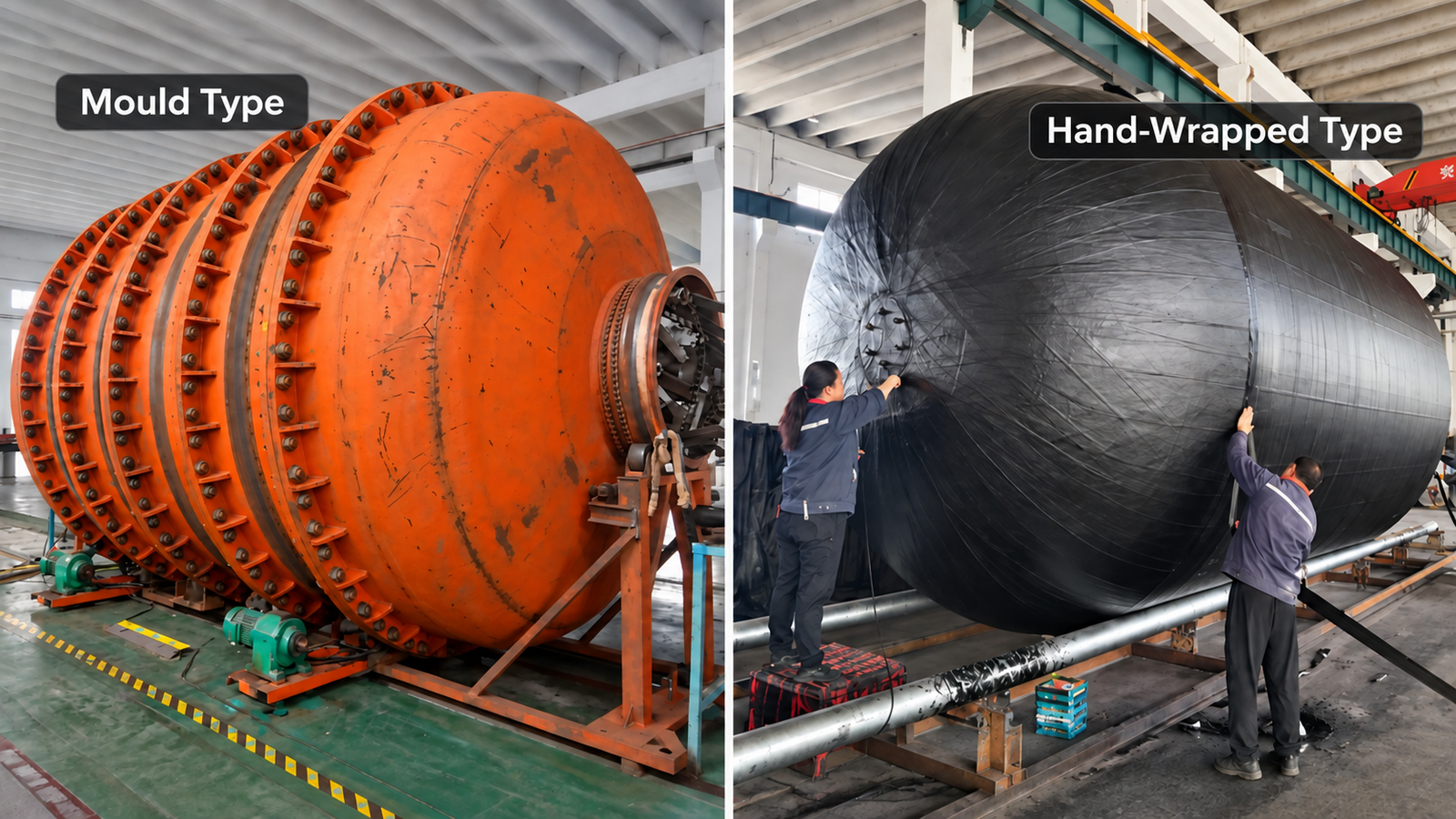
| Construction aspect | Moulded process | Hand-wound process |
|---|---|---|
| Tooling | Fixed steel mould for each fender size | No mould; built over a pre-vulcanized bladder |
| Layer consolidation | Layers compressed and cured inside the mould | Layers wrapped and cured without external constraint |
| Dimensional control | Tight tolerance due to mould geometry | Wider tolerance; shape determined by wrapping tension |
| Flange and bead ring | Integrated into the mould structure | Attached or formed separately |
| Material investment | Higher due to mould cost | Lower due to manual layup |
| Typical price range | Higher per unit | Lower per unit |
Why the Construction Route Matters
In our commercial experience, buyers request a 4.5 m × 9.0 m pneumatic fender and receive quotations that show substantial price variation. The outer appearance looks the same: a cylindrical body, a tyre net, metal fittings. The construction route is the variable. Moulded fenders require steel moulds for every size. The investment in tooling, layer control, and quality assurance raises the unit cost. Hand-wound fenders avoid that tooling cost by building the fender manually over an inner bladder. The result is a lower price, but also different layer consolidation and service behavior.
Construction and Service Behavior
In our experience, the construction route affects how the fender behaves when damaged. A moulded fender that develops a leak typically has a visible external puncture, and the damage can often be repaired if detected early. A hand-wound fender that leaks without external damage usually indicates inner-bladder failure, and the fender cannot be repaired. This is a construction distinction we observe commercially, not a universal engineering rule, but it reflects the difference in how layers bond and how internal pressure is contained.
Before comparing quotations, ask which construction route the supplier uses. The market term “Yokohama fender” does not specify construction. Many hand-wound suppliers use the term loosely, which blurs the process boundary and creates buyer confusion. Clarify the route before treating offers as comparable.
Chain-Tyre-Net vs Sling-Type Pneumatic Fenders
Pneumatic fenders use two main outer protection types: chain-tyre-net and sling. The protection does not change the fender’s pneumatic function, but it does affect handling, surface wear, and installation.
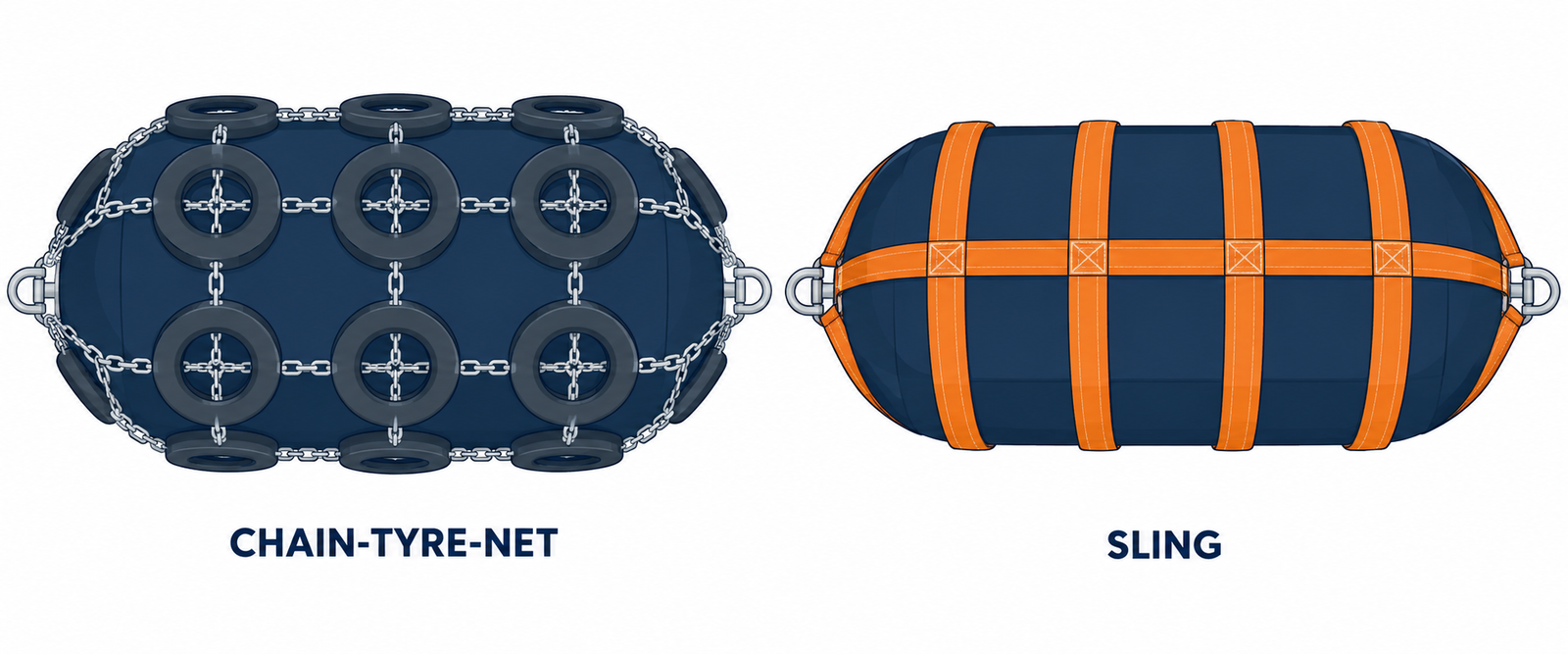
Chain-tyre-net (CTN) fenders have a galvanized steel chain net with rubber tyre sleeves protecting the body. Sling-type fenders use fabric or synthetic slings connected to metal end rings, with no tyre components. Both meet ISO 17357-1 requirements, but the CTN design offers better abrasion resistance during vessel contact and repeated mooring.
| Feature | Chain-tyre-net (CTN) | Sling-type |
|---|---|---|
| Outer protection | Galvanized steel chain with rubber tyre sleeves | Fabric or synthetic slings |
| Abrasion resistance | Higher; tyres buffer vessel contact | Lower; slings wear faster under repeated friction |
| Handling weight | Heavier due to chain and tyres | Lighter; easier to handle during installation |
| Maintenance | Inspect tyres for wear and replace as needed | Inspect slings for cuts, abrasion, UV damage |
| Typical application | Long-term mooring, ship-to-ship transfer, frequent contact | Lighter-duty transfer, temporary installations |
| End fittings | Metal flanges or rings with chain attachment | Metal flanges or rings with sling attachment |
Why the Tyre Matters
Yokohama’s pneumatic-fender handling manual identifies the tyre sleeves as wear components. They protect the rubber body from direct vessel contact. If a tyre sleeve is damaged and not replaced, the chain or vessel surface can abrade or puncture the pneumatic body. Tyre damage is not covered under typical warranty terms because it results from service wear, not manufacturing defect. I recommend checking tyre condition at least quarterly. Replace worn sleeves before the chain contacts the rubber.
Sling Protection and Inspection
Sling-type fenders are lighter and easier to deploy, but the slings wear faster than tyres. Inspect slings for cuts, fraying, UV degradation, and attachment integrity. If a sling fails during use, the fender can shift or tilt, changing the contact geometry and increasing stress on the remaining slings. Sling replacement is simpler than tyre replacement, but the inspection interval should be shorter.
Both protection types work. The choice depends on the operating context, contact frequency, and handling constraints. For applications with frequent vessel contact or long-term mooring, CTN offers better durability. For lighter-duty transfers or temporary installations, sling-type fenders reduce handling effort. For more on the product family, see our pneumatic fender overview.
Where Are Pneumatic Fenders Used?
Pneumatic fenders suit applications where a floating, flexible interface is needed between two moving or stationary structures. The operating context determines whether a pneumatic interface is appropriate and which inputs are required before configuration.
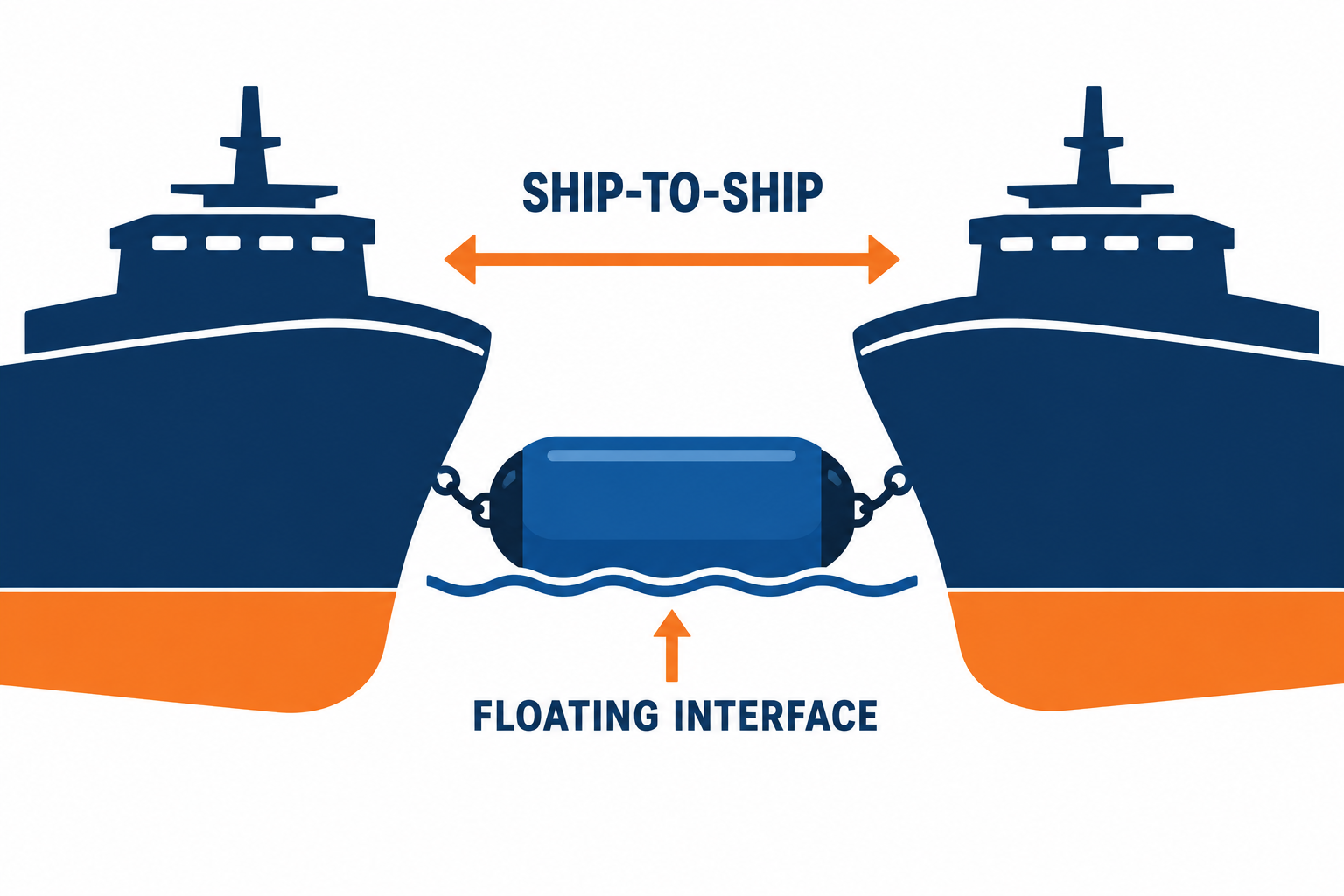
Pneumatic fenders are used in ship-to-ship transfer, lightering operations, temporary mooring, and floating berth protection. They absorb berthing energy in conditions where fixed fenders cannot be installed or where the interface must move with the vessel.
| Application | Operating context | Why pneumatic fenders fit | Configuration inputs required |
|---|---|---|---|
| Ship-to-ship (STS) transfer | Two vessels alongside, one or both moving with sea state | Fender moves with vessels; no fixed berth | Vessel types, displacement, freeboard, sea state, transfer duration |
| Lightering | Cargo transfer from a larger vessel to a smaller barge or lighter | Flexible interface between different vessel sizes | Vessel dimensions, freeboard difference, cargo type, weather window |
| Temporary mooring | Vessel moored alongside another vessel or floating structure | Quick deployment without berth infrastructure | Vessel size, mooring duration, expected weather, tidal range |
| Floating berth protection | Pontoon, barge, or floating dock berthing | Berth structure moves with tide and wave | Pontoon dimensions, vessel types, tidal range, exposure |
Routine vs Non-Routine Operating Contexts
For routine transfer work, I can often start a discussion with familiar fender package patterns. A common arrangement uses four large fenders with two smaller baby fenders, or five large fenders with two baby fenders. This gives an initial talking point, but it is not a universal formula. For non-routine operations, I need operational inputs before recommending a configuration. If the vessel type is unusual, the sea state is harsh, or the berthing geometry is constrained, the standard package may not apply. Clarify the intended use, berthing scenario, vessel characteristics, and any special requirements before finalizing the fender arrangement.
How Should a Pneumatic Fender Be Inspected and Maintained?
Routine inspection and maintenance extend fender life and prevent service failures. The checks fall into three categories: pressure, body condition, and protective components. Some checks can be performed by the operating crew; others require skilled service personnel.
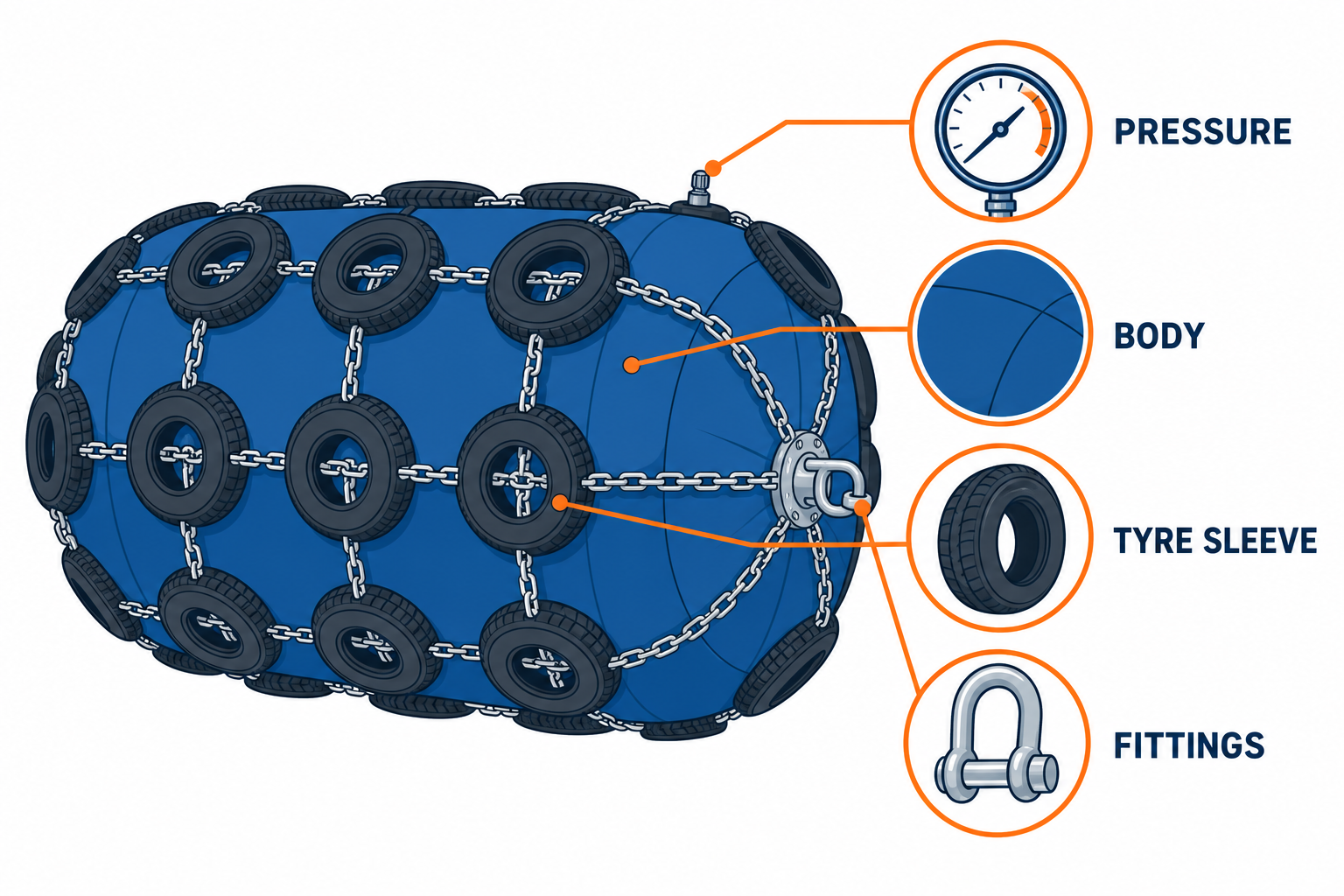
Before service, confirm inflation pressure matches the fender type. During service, inspect the rubber body for cuts, abrasion, and leaks. Check tyre sleeves, chain, slings, and metal fittings for wear and damage. Replace worn tyres before they expose the rubber body. Record inspections by fender serial number. Escalate to skilled service if you find unexplained pressure loss, body damage beyond surface marks, or structural issues with fittings.
Pre-Service Inspection Checklist
Before deploying a fender, complete these checks:
- Confirm the fender type (Type I or Type II) and the specified inflation pressure (50 kPa or 80 kPa).
- For new-fender acceptance, confirm an air-leakage test at initial pressure has been completed for more than 30 minutes with no leakage, as specified by ISO 17357-1:2014.
- Inspect the rubber body for manufacturing defects, cuts, or surface damage.
- Check all metal fittings, flanges, chains, slings, and attachment points for integrity.
- Verify the tyre sleeves (CTN type) or slings (sling type) are intact and correctly installed.
- Test the inflation valve for proper seating and operation.
- Record the fender serial number, inflation pressure, and inspection date.
Routine In-Service Inspection
Check the fender at least quarterly, or more frequently if contact is frequent or harsh. The Yokohama handling manual recommends skilled personnel perform these checks and record findings against the fender’s serial number.
- Measure and record internal pressure. Top up if pressure has dropped below the specified range.
- Inspect the rubber body for cuts, punctures, abrasion, bulging, or surface cracks.
- Inspect tyre sleeves for wear, cracking, or displacement. Replace worn tyres immediately. Tyre damage is a service wear item, not a warranty claim, but it can lead to body puncture if ignored.
- Check chains (CTN type) for corrosion, broken links, or loose connections.
- Check slings (sling type) for cuts, fraying, UV damage, or attachment failure.
- Inspect metal fittings, flanges, and guy ropes for corrosion, deformation, or loosening.
- Clean the fender surface if contamination could accelerate wear.
Escalation and Repair Boundaries
Not all damage can be repaired in the field. I use these escalation rules:
- Surface scuffs and minor abrasion: acceptable unless they penetrate the outer rubber layer.
- Cuts that do not reach reinforcement layers: escalate for skilled assessment and follow the manufacturer’s repair guidance.
- Punctures, cuts exposing reinforcement, or leaks with visible external damage: repair may be possible if detected early; escalate immediately.
- Leaks without external damage: in hand-wound construction, this typically indicates inner-bladder failure and the fender must be replaced. In moulded construction, investigate for concealed puncture; repair may be possible.
- Any structural issue with metal fittings, flanges, or attachment points: remove the fender from service and escalate to competent service provider.
Maintenance must be performed by skilled staff and recorded. Do not attempt field repairs beyond the manufacturer’s guidance. A failed repair creates liability and safety risk.
What Information Is Needed for Size and Quotation?
Before I can recommend a fender size or provide a quotation, I need operational inputs. A request for “a 4.5 m × 9.0 m Yokohama fender” is not enough.
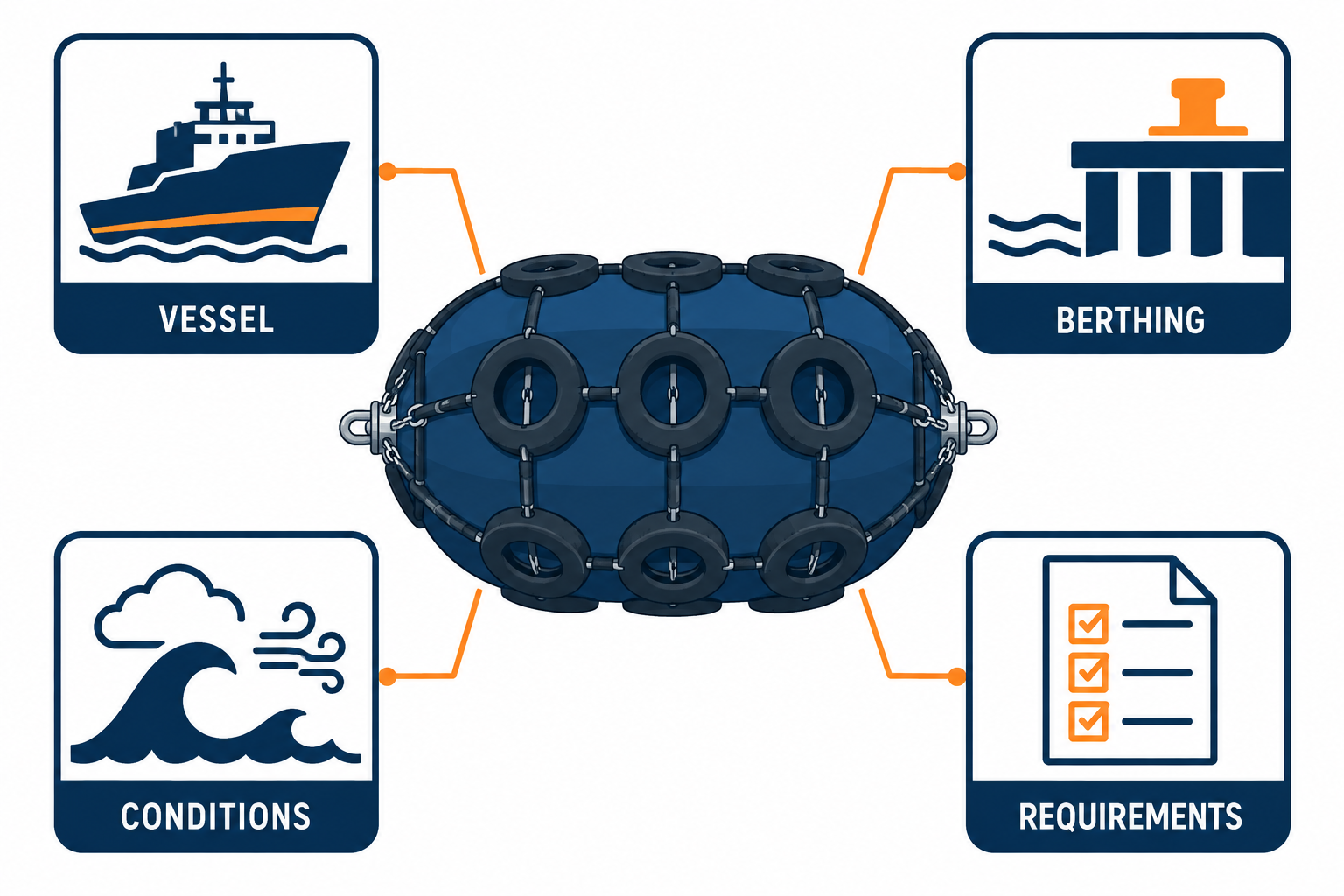
To configure a pneumatic fender package and provide a quotation, supply vessel types and dimensions, displacement or deadweight tonnage, freeboard, berthing scenario, expected sea state or tidal range, operating location, and any applicable standards or class requirements. For non-routine operations, also describe the transfer duration, mooring arrangement, and any special constraints.
Required Information Checklist
Provide the following inputs to start a configuration discussion:
- Vessel information: vessel type, length overall, beam, displacement or DWT, freeboard at operating draft.
- Berthing scenario: ship-to-ship transfer, lightering, temporary mooring, or floating berth protection.
- Operating conditions: expected sea state (Beaufort scale or significant wave height), tidal range, current.
- Location and environment: operating location, temperature range, exposure to UV, ozone, or chemical contaminants.
- Standards and class: applicable standards (ISO 17357-1, OCIMF, national regulations), class society requirements, flag state.
- Fender type preference: chain-tyre-net or sling-type, moulded or hand-wound construction (if you have a preference or budget constraint).
- Quantity and accessories: number of fenders, guy ropes, shackles, inflation equipment, spare parts.
- Delivery and documents: required delivery date, destination port, certificates (material, pressure test, class approval), inspection witness requirements.
When Standard Packages Apply
For routine transfer work with familiar vessel types and moderate conditions, I can use standard fender package patterns as a starting point. Four large fenders with two baby fenders, or five large fenders with two baby fenders, cover many common scenarios. But I still need vessel dimensions and operating conditions to confirm the package is appropriate and to specify the fender sizes.
When Operational Input Is Required
For non-routine operations, I cannot recommend a configuration without operational details. If the vessel is unusual, the sea state is harsh, the berthing geometry is constrained, or the transfer duration is long, the standard package assumptions do not apply. Clarify the intended use, constraints, and special requirements before I proceed to quote. For configuration support and RFQ assistance, see our Yokohama pneumatic fender product page.
Conclusion
A Yokohama fender is a market term for a pneumatic rubber fender, but the name does not define construction, configuration, or commercial value. Before comparing offers, clarify the product class, construction route, protection type, and operating context. Inspect pressure, body, and protective components routinely, and escalate damage beyond field-repair boundaries. When you’re ready for a configuration review, send your vessel details, berthing scenario, and operating conditions. We’ll help you select the right fender package and provide a quotation that matches your project requirements.