
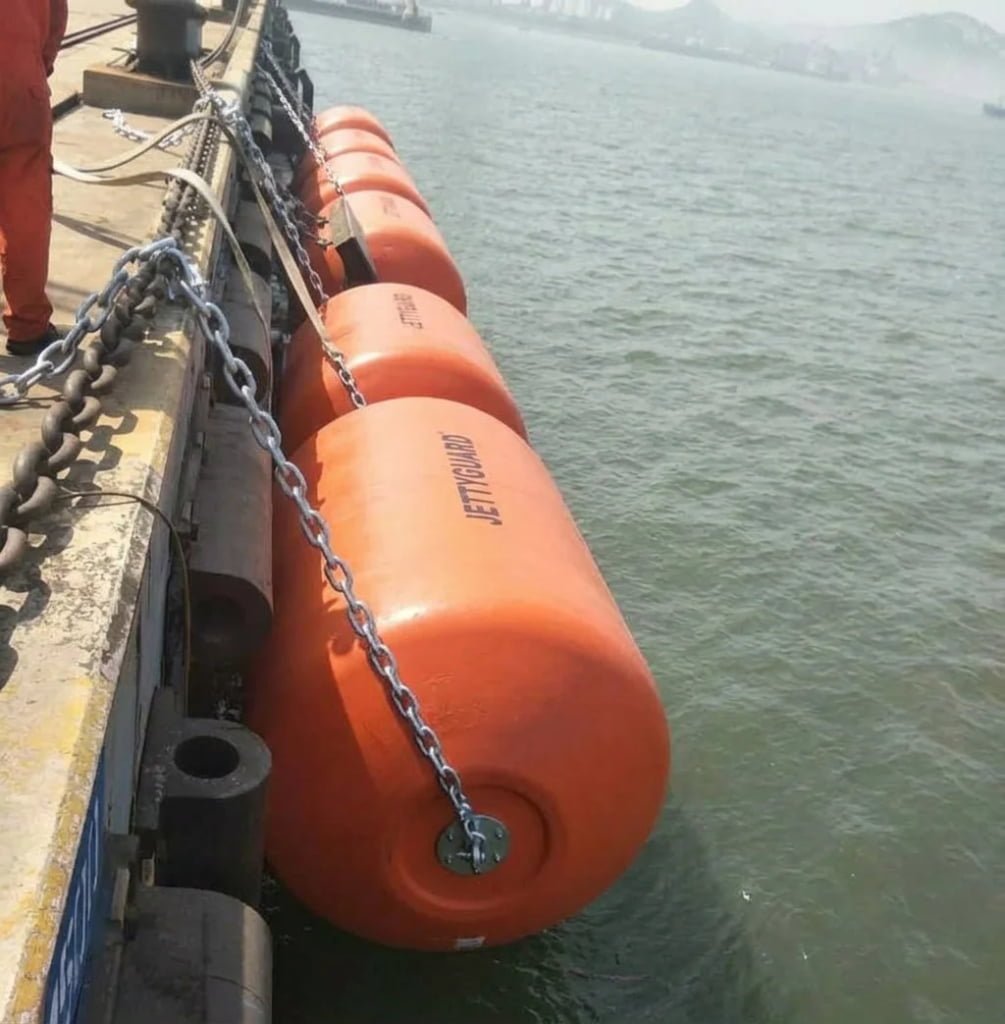
Two foam filled fenders can carry the same nominal rating, list the same material names, and still be in very different condition after two seasons. That difference can start in the construction, not only in the service history.
A foam filled marine fender absorbs berthing energy by compressing a closed-cell foam core inside a reinforced elastomer skin. The core deforms on vessel contact and recovers when the load is released. There is no internal air pressure to set or monitor. The PIANC Fender Guidelines 2024 (MarCom WG 211) §9.8 covers the construction.
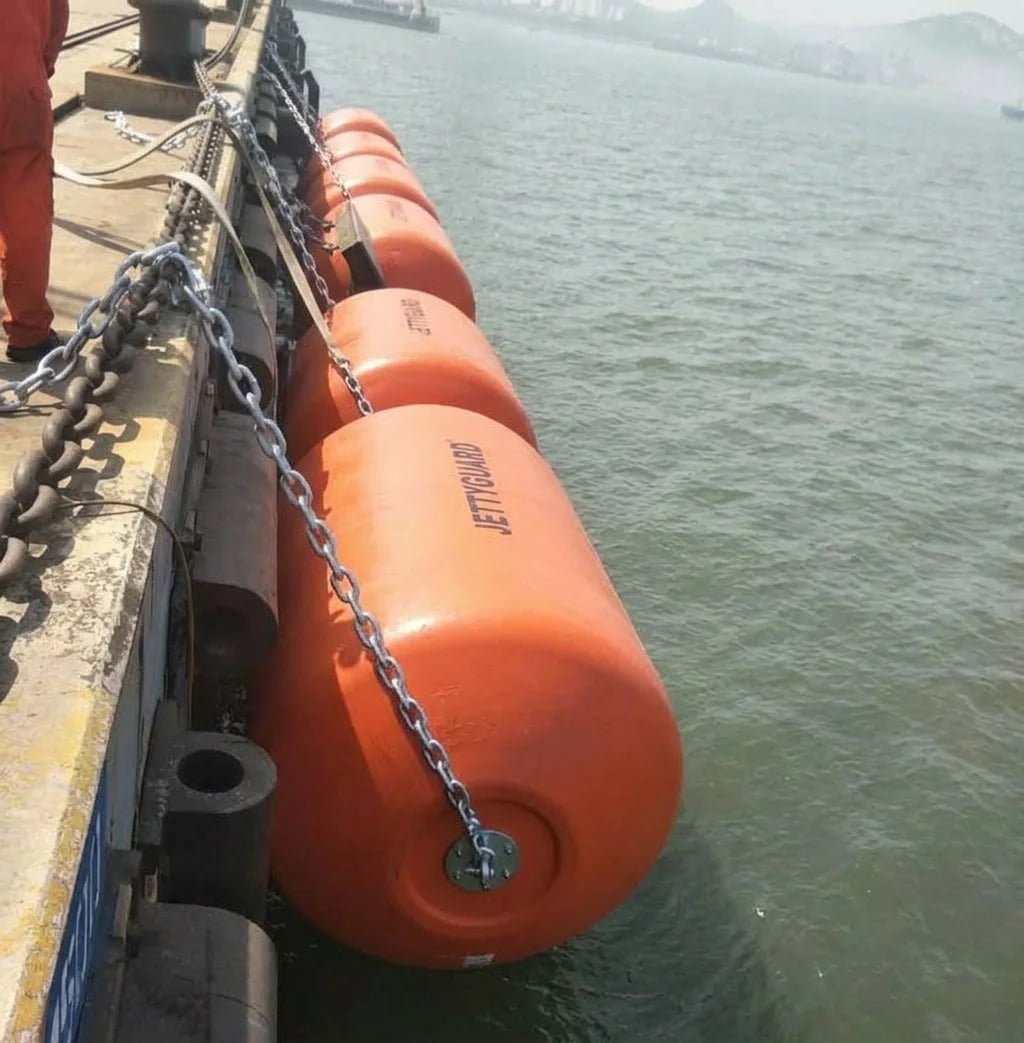
This page covers what they are, how they absorb energy, how they are built, and where the limits sit. For project specifications, size and performance selection, drawings and quotation, see foam filled fender specifications and performance grades.
What Is a Foam Filled Marine Fender?
Every foam filled marine fender shares two features: a closed-cell foam core that absorbs energy by compressing, and a reinforced skin that protects it. Everything else, including how the unit is connected and how it moves, follows the configuration chosen for the berth.
Each foam cell is sealed on its own. The skin is a reinforced elastomer layer that takes abrasion, UV exposure and seawater contact. With a solid cellular core instead of compressed air, there is no valve, no pressure gauge and no inflation schedule.
For cylindrical floating or suspended configurations, end fittings are provided for mooring chains or hanging hardware. A donut fender is a different foam fender configuration: an annular body that rides around a monopile or a jetty leg, so it need not carry the same two-end connection structure.
Sizes run from under a metre in diameter up to several metres for tanker and LNG-class berthing.
Skin damage also behaves differently: a cut does not vent a pressurised chamber. It is still damage. Cut depth, the reinforcement underneath and whether the foam core has been reached all have to be checked before concluding anything about the unit.
How Do Foam Filled Fenders Absorb Berthing Energy?
When a vessel contacts the fender, the foam cells compress. That compression absorbs the energy, and reaction force builds as the fender deflects.
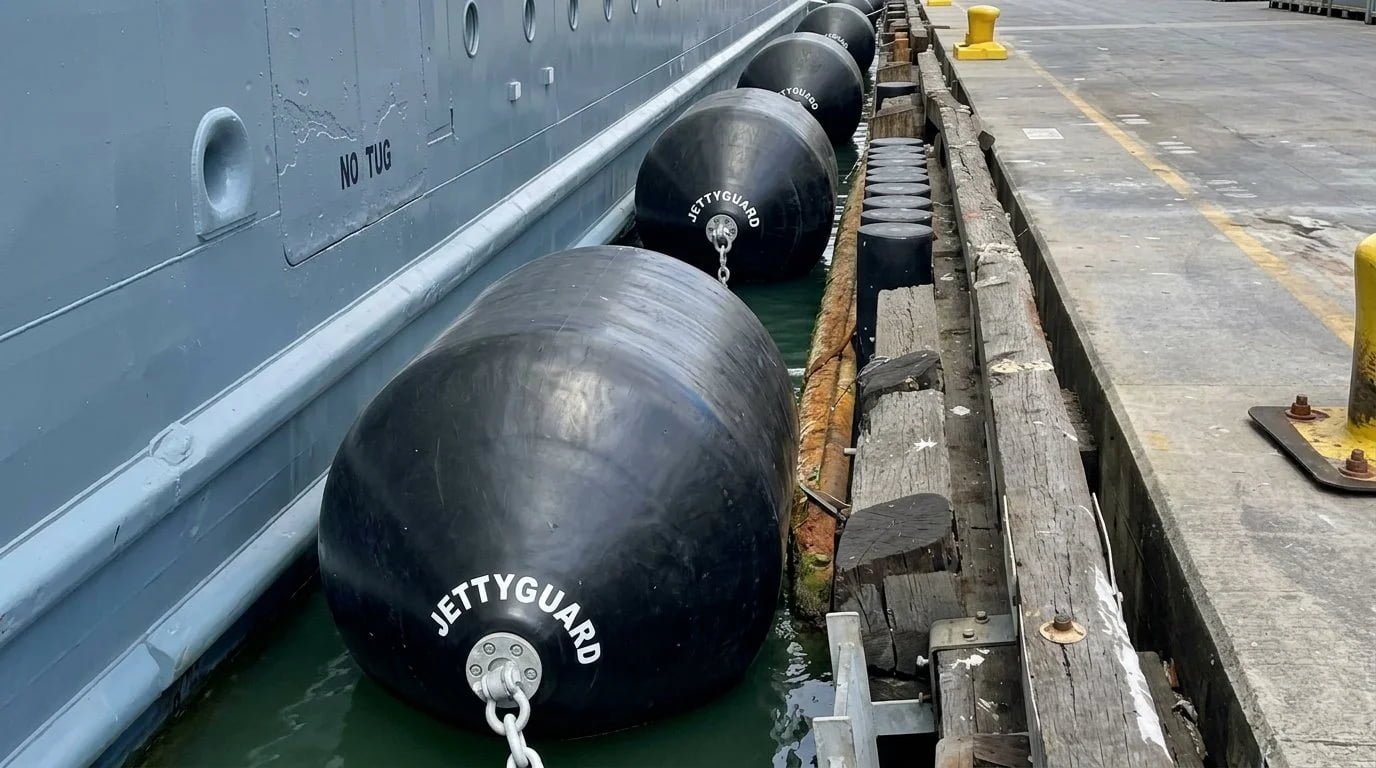
Two consequences follow.
First, nominal performance is set by the foam grade, geometry and construction, and is not field-adjustable. Skin thickness, reinforcement layer and foam density all feed the published figures.
Service behaviour can still differ from that figure. Reaction force and absorbed energy vary with temperature, compression rate, contact angle, manufacturing tolerance and unit condition. PIANC WG211:2024 §10.12.2 notes that velocity and temperature effects are often neglected for foam fenders but can be significant in some cases.
Second, the closed cells are sealed individually, so a local skin injury does not flood the body the way a pressure loss empties an air chamber. That is the main behavioural difference from a pneumatic fender in LNG and STS service, where the body can lose pressure, buoyancy and rated performance if it is damaged.
How Is a Foam Filled Marine Fender Constructed?
Foam filled marine fender construction is a sequence, and each step decides part of the finished performance.
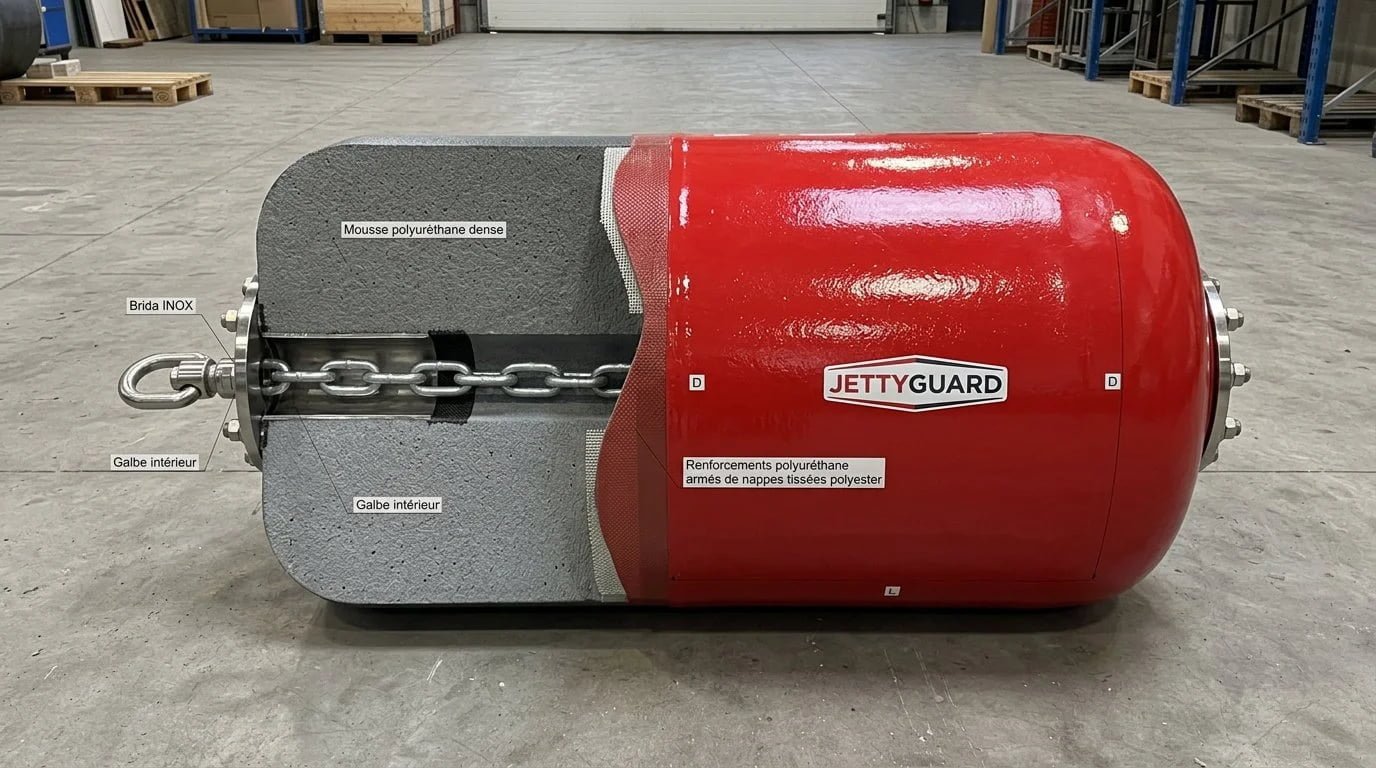
One cutaway example; internal load paths and material specifications vary by design.
Core forming. Closed-cell foam is cut, shaped and thermally laminated into a single core body of the required diameter and length. Lamination turns separate stock into a virtually solid core that compresses as one piece. Closed-cell EVA foam is one common core choice.
Reinforcement. The core is wrapped with continuous nylon filament reinforcement, which takes tensile load and holds the body together as the core deflects and recovers.
Skin. A sprayed elastomer is applied over the reinforcement. PIANC Fender Guidelines 2024 (MarCom WG 211) §10.11.2 addresses polyurethane outer skins or similar materials. JettyGuard uses SPUA, which is not named separately in the guideline; applicable SPUA properties and test methods should be defined in the project specification.
The skin is the wear surface, and its thickness and integrity drive abrasion resistance and durability. Sprayed polyurea coating on foam fenders covers it in detail.
End fittings. Fittings are embedded at the ends for chains, swivels and hanging or mooring hardware.
Of those four steps, the two that carry the most weight are the core forming process and the quality of the SPUA skin. That is where I would look first on any unit.
No single internal load path is shared by every foam filled fender. Some designs carry mooring load through an internal axial member, others transfer it through embedded end fittings and the reinforced body. Which one applies is a project design decision. PIANC WG211:2024 §9.8 describes several distinct configurations rather than one standard internal structure.
Which Construction Details Actually Change Quality?
This is the part buyers most often skip. From the outside you cannot see much difference between one supplier’s foam filled fender and another’s, and the material names on the datasheets read almost the same.
The real spread sits underneath: the core forming process, the foam type, the SPUA thickness and the quality of the SPUA material itself. Those four drive both price and durability, and the gap between a careful build and a thin one is wider than the paperwork suggests.
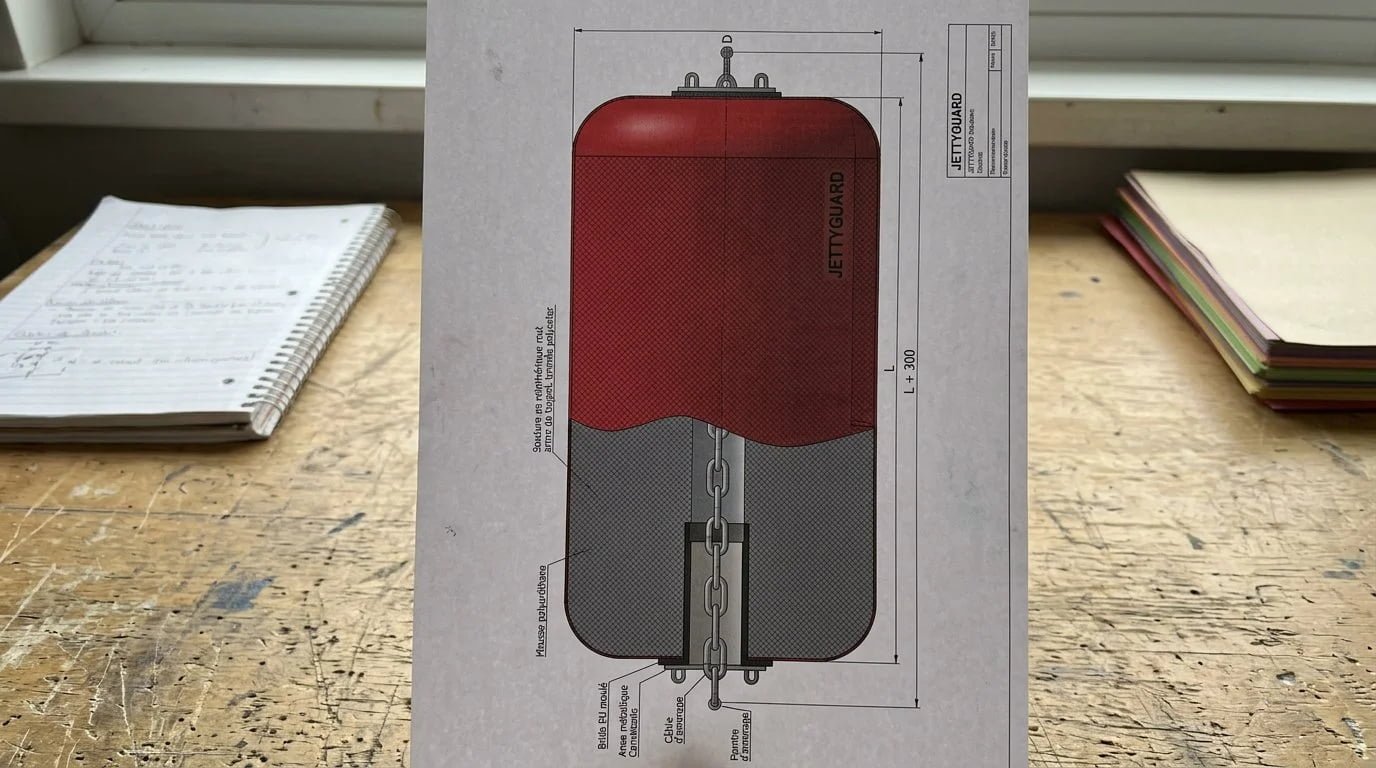
The unit shown uses a through-body chain and steel end assemblies. That is one possible internal load-path configuration, not a universal feature of foam filled fenders.
| Element | Function | What it affects in service |
|---|---|---|
| Closed-cell foam core | Absorbs energy by compressing | Energy absorbed and reaction force at a given deflection |
| Core forming and lamination | Makes foam stock act as one body | How evenly the core compresses and recovers |
| Filament reinforcement | Carries tensile load | Body integrity through repeated cycles |
| Skin thickness and material | Resists abrasion, UV and seawater | Wear rate and repair frequency |
| Embedded end fittings | Connect chains, swivels and mooring hardware | How load transfers into berth or hull |
| Internal axial member, where used | Carries mooring load through the body | Only present in configurations designed around it |
| Chain and tyre net, where specified | Protects the skin on abrasive faces | Wear rate on rough quay walls |
The skin and the reinforcement are the hardest parts to judge on a finished unit. External condition can be checked visually, but skin thickness and reinforcement placement cannot.
PIANC WG211:2024 §10.12.4 describes core sampling for those checks, and §10.11 sets out material tests for the foam core, the outer elastomer and the reinforcement layer, so documented test records matter alongside visual inspection.
Where Are Foam Filled Marine Fenders Used?
Common applications share one trait: the fender keeps working without routine pressure checks.
- Ship-to-ship transfer and floating terminals. The fender hangs between hulls or against a floating structure, often for long deployments.
- LNG and tanker berths. Large-diameter units suit high displacement vessels approaching at low velocity.
- Commercial quays and multi-purpose berths. Mixed traffic, variable tidal range.
- Naval, coast guard, cruise and passenger berths. Painted hulls and visible surface condition.
- Offshore moorings and monobuoy approaches. Remote locations, infrequent inspection visits.
- Floating docks, pontoons and workboat berths. Buoyancy and self-adjusting waterline.

Cold-climate and high-abrasion berths load the skin harder, so the build details show up sooner there.
What Are Their Benefits and Practical Limitations?
Both sides are worth stating plainly.
What works well
- No inflation monitoring and low routine maintenance: no valve, no pressure log, no re-inflation cycle.
- Buoyancy is not lost suddenly through a local cut. The closed-cell core does not empty the way a pressurised chamber does, so performance does not depend on pressure holding steady over a long deployment.
- Light-coloured skins reduce the risk of marking light or painted hulls. That depends on skin colour and surface condition, so it is not absolute.
Where the limits are
- Damaged skin is an inspection item, not a cosmetic one. A cut has to be assessed for depth, reinforcement involvement and core exposure, and rated performance should not be assumed unchanged until then. Leaving the skin open increases abrasion damage underneath.
- Puncture is a recognised failure mode, not an edge case. PIANC WG211:2024 Table 11-1 lists it among the common ones, and §10.12.1 requires test specimens to be free of surface damage, cuts and cracks.
- Nominal performance cannot be tuned on site the way inflation pressure can be adjusted.
- Large units are heavy and bulky, and need lifting, transport and installation planning. A pneumatic fender can be de-inflated to save space; a foam filled fender cannot be collapsed.
- There is no dedicated ISO product standard for foam filled fenders. ISO 17357-1:2014 applies to high-pressure floating pneumatic rubber fenders, so it does not cover foam construction.
- PIANC WG211:2024 §9.8 and §§10.10–10.12 cover foam fender configurations, construction and testing. Selection rests on engineering criteria and berthing energy calculation.
When Does General Guidance End and Project Selection Begin?
Everything above is product behaviour. It does not tell you which size or grade a berth needs, or how a specific unit was built.
A project I worked on in Russia is why I keep making that distinction. We held the construction and quality standard we had set for the units, our quotation had no price advantage against the competing offers, and we lost the tender.
What that confirmed for me is narrower than a verdict on anyone else’s product: appearance and material names are not evidence that the construction and the quality behind them are the same.
A price difference on comparable-looking fenders can come from the core forming process, the foam type, the SPUA thickness or the quality of the SPUA material itself. If the datasheets look identical, the evaluation has not started yet.
Sizing turns on vessel displacement and approach velocity, berthing angle, tidal range, berth structure, hull pressure limits and how the fender is hung or moored. Those inputs give a required energy absorption and an acceptable reaction force. How to choose a foam filled fender walks through that reasoning.
Frequently Asked Questions
Do foam filled marine fenders need maintenance?
They need inspection, not pressure management: no valve, no pressure log, no re-inflation cycle. The skin is a wear surface, and PIANC WG211:2024 Table 11-1 lists puncture and skin wear among the common failure modes.
What happens if the skin is cut?
A cut does not cause the sudden pressure loss seen in a pneumatic chamber, but its effect on the load path and rated performance depends on its depth, reinforcement involvement and core exposure. It is still damage, and it has to be assessed.
Can two fenders with the same rating behave differently?
Yes. Nominal figures come from foam grade, geometry and construction, and real behaviour shifts with temperature, compression rate, contact angle, tolerance and unit condition.
Which standard covers foam filled fenders?
There is no dedicated ISO product standard. ISO 17357-1:2014 covers high-pressure floating pneumatic rubber fenders, not foam construction; PIANC WG211:2024 §9.8 and §§10.10–10.12 cover foam fender configurations, construction and testing.
JettyGuard manufactures foam filled fenders. For dimensions, performance data and project support, see foam filled fender specifications and performance grades.