
STS fender selection comes down to service life, certification route, and maintenance reality. Consultants often default to ISO 17357 pneumatic fenders for oil and gas STS because the route is familiar. For owner-operated infrastructure deployed for 15 years or more, foam-filled fenders can give lower total cost and steadier service because they do not depend on air pressure.
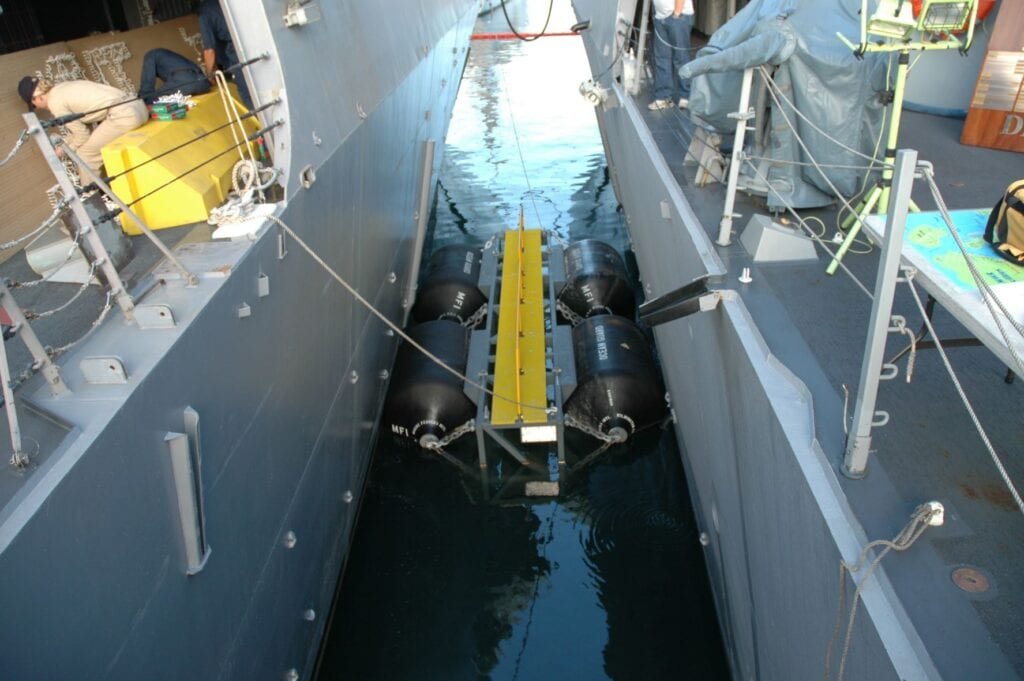
This guide does not repeat the standards-and-spec comparison. For OCIMF, ISO 17357, PIANC framework details, hull pressure curves, and dual-configuration sizing, read our comprehensive standards comparison.
What this guide covers: a five-step decision tree, an STS operation matrix, a five-year cost comparison, and the honest boundary cases most manufacturer sites avoid.
The STS Fender Selection Decision Tree
The choice between foam and pneumatic fenders for STS is not a product preference. It is an operational risk calculation. Five questions resolve most cases.
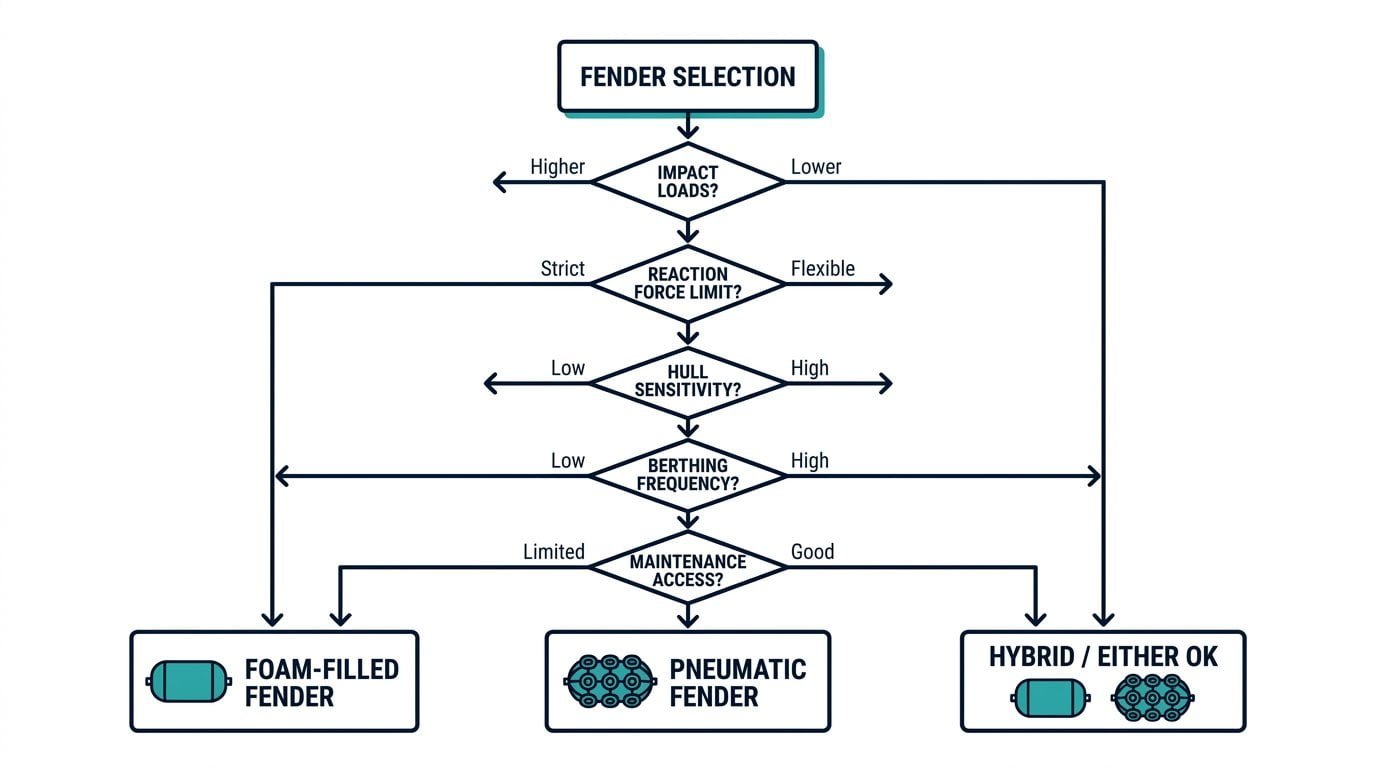
Step 1: Continuous service or one-off?
If the STS site runs more than 30 transfers per year, the maintenance and depreciation math points to pneumatic. One-off lightering, casualty response, and seasonal operations point to foam. The foam unit can sit idle for months without losing readiness.
Step 2: Pressure-monitoring crew on hand?
Pneumatic fenders need monthly pressure checks, a working air compressor on site, and a crew trained on inflate and deflate procedure. If any of those three are missing, failure risk rises sharply. Foam becomes the lower-risk pick.
Step 3: Smaller vessel hull pressure capacity (kPa)?
If the smaller vessel cannot accept the reaction force of a standard pneumatic unit at the planned approach velocity, you size up the fender contact area. Foam fenders distribute load over the full body length and often spread hull pressure better at low IIP equivalent.
Step 4: Deep water or near-shore?
For deepwater terminals with long deployment chains, pneumatic’s lower in-water weight helps. For near-shore lightering and anchorage transfers, that weight advantage disappears. Foam’s puncture-survivability matters more in those cases.
Step 5: CAPEX or OPEX sensitivity?
Pneumatic units cost less up front per kNm of energy absorption. Foam units cost more on day one but cut annual OPEX by 60-80% (est.). High-utilisation operators amortise pneumatic faster. Low-utilisation operators recover foam’s premium in three to four years.
The decision tree ends in three buckets: full pneumatic, full foam, or hybrid. For hybrid sizing and arrangement guidance, see the pneumatic vs foam standards comparison.
STS Operation Matrix: Vessel Type, Tonnage, and Frequency
The decision tree gives you a direction. The matrix below gives a starting recommendation by operation profile. It draws on our delivery records for STS service providers and one-off charterers over 2024-2025.
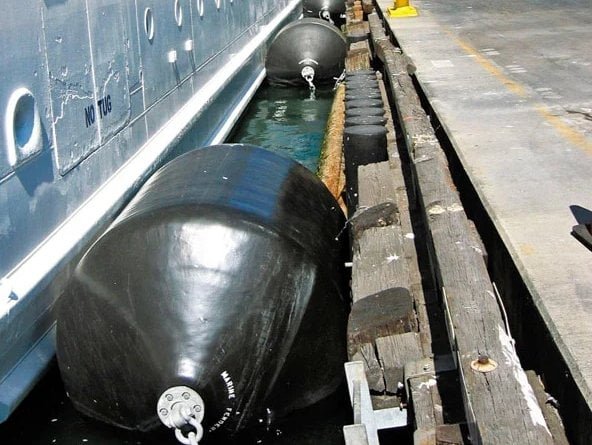
Table 1: STS Recommendation Matrix
| Operation profile | Vessel size | Frequency | Recommended fender | Why |
|---|---|---|---|---|
| Consultant-led oil and gas STS | Aframax / Suezmax | Weekly+ | Pneumatic (Yokohama-type) | Familiar ISO 17357 route and easier specification acceptance |
| Owner-operated oil and gas infrastructure | Mixed tanker range | 15+ year deployment | Foam-filled | Lower long-term maintenance and no pressure-loss failure mode |
| Anchorage lightering | Handymax / Panamax | Monthly | Pneumatic primary, foam back-up | Mid-utilisation, hybrid is common |
| Emergency / casualty lightering | Any tanker | One-off | Foam-filled | Cannot deflate, ready 24/7, no air compressor needed |
| Seasonal / port congestion | Bulk / chemical | Quarterly | Foam-filled | Low utilisation, OPEX-light |
| Workboat to FSO / FPSO | Supply boat scale | Weekly | Foam-filled | Smaller energy demand, no air infrastructure offshore |
| Pier-side STS station | Mixed | Continuous | Foam-filled | Fixed position, abrasion exposure |
Reading the matrix as an oil and gas owner
Many owners first ask whether there is a better option than pneumatic for long-term STS infrastructure. My answer is yes, if the owner can approve the specification route. Foam is often the stronger engineering choice for a 15-year deployment.
The difficulty is not only technical. Consultants usually follow industry habit and select ISO 17357 pneumatic fenders. That route is easier to explain to charterers, insurers, and internal reviewers.
A back-up foam package on the support tug is common practice. For fixed long-term infrastructure, foam can also move from back-up to primary if the owner accepts the document trail.
Reading the matrix as a one-off charterer
For a one-off lightering during a casualty, port congestion event, or routing diversion, the matrix tilts to foam. You do not have a maintenance crew. You do not have an air compressor on site.
You cannot wait for pneumatic units to be shipped from the nearest service base. Foam units delivered direct to the support vessel are ready on arrival.
Maintenance and Total Cost: What Operators Actually Pay
The headline price of the fender is rarely the deciding number. STS operators are choosing between two cost profiles: lower CAPEX with recurring maintenance (pneumatic), or higher CAPEX and freight with much lower service work (foam).
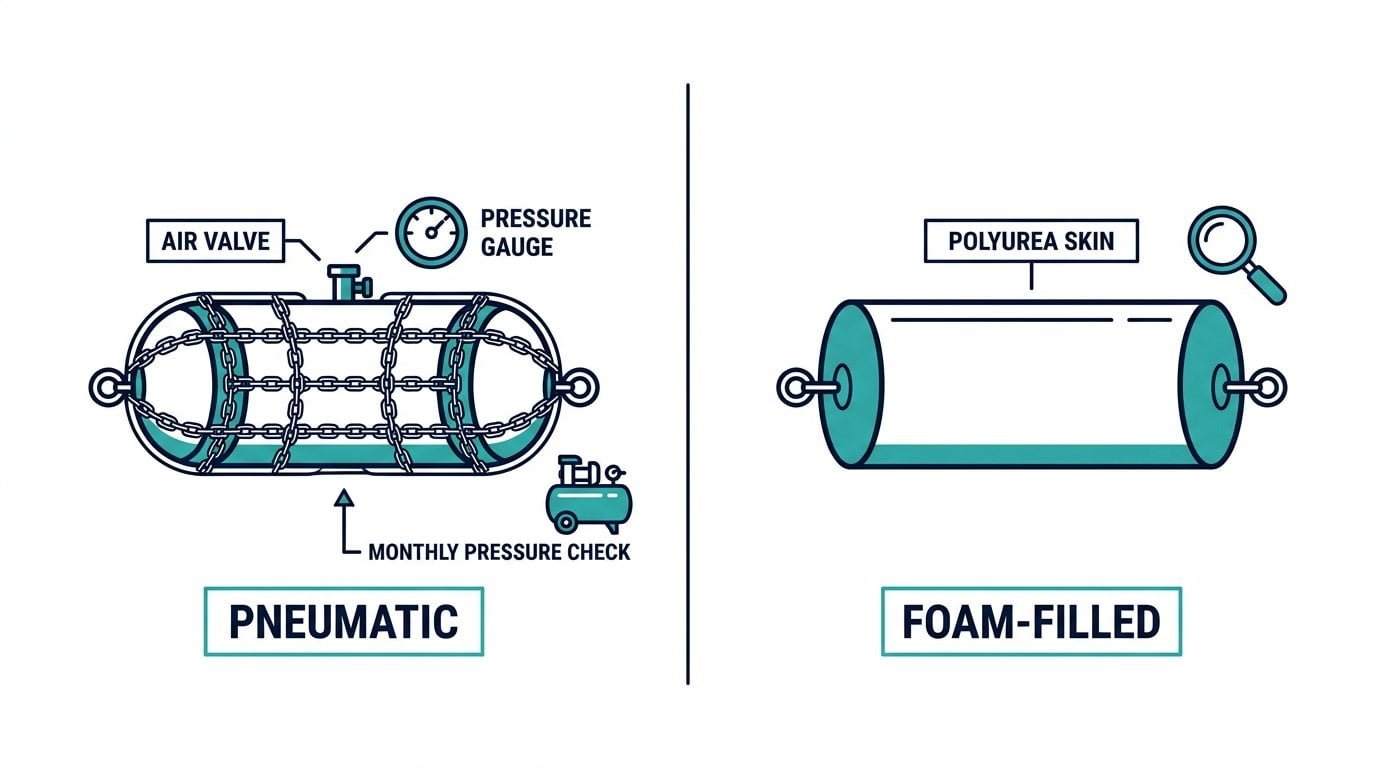
Pneumatic fender maintenance reality
A pneumatic fender in active STS service needs monthly pressure checks against the rated 50 or 80 kPa setpoint. Annual inspection labor and consumables run $800-1,500 per unit (est.).
Air top-up equipment amortises at $300-600 per unit per year (est.). Valve service at 12-24 month intervals adds $400-1,000 (est.) per cycle. The outer net, tyres, and chains often need repair or partial replacement every two to three years in oil and gas service.
Total annual OPEX often lands in the $1,500-3,100 range per unit before major net work. None of this work is exotic. All of it requires a maintenance crew and a budget line.
Foam-filled fender maintenance reality
A foam fender has no pressure system, no valve, and no air supply requirement. Annual skin inspection runs $200-400 per unit (est.).
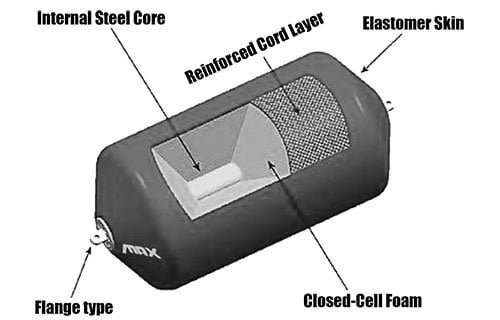
High-strength polyurea skin also changes the protection logic. In many long-term oil and gas deployments, foam fenders can work without a tyre sleeve. That removes one large maintenance item from the service cycle.
A foam unit still needs lifting eyes, shackles, and surface checks. Total annual OPEX usually lands at $300-800 per unit. Service life is 15-25 years versus 8-15 years for pneumatic.
Table 2: 5-Year TCO Comparison
| Cost item | Pneumatic 3.3×6.5m | Foam-filled 3.3×6.5m |
|---|---|---|
| Initial unit cost (est.) | $$ baseline | $$ baseline +20-40% |
| Freight cost (est.) | Lower, can deflate | Higher, often needs flat rack or platform container |
| Annual pressure / inspection (est.) | $800-1,500 | $200-400 |
| Air top-up equipment amortised (est.) | $300-600 | $0 |
| Net / tyre / valve service (est.) | $600-1,500 | $0-200 |
| Recoat / skin maintenance (est., averaged) | n/a | $0-400 |
| Typical service life | 8-15 yr | 15-25 yr |
| 5-year cumulative OPEX (est.) | $8,500-18,000 | $1,500-4,000 |
Numbers are illustrative ranges for a 3.3 × 6.5 m unit. Actual quotes depend on size, IIP grade, foam density, skin spec, chain-net config, and container freight market.
Table 3: Maintenance Action Comparison
| Maintenance action | Pneumatic | Foam-filled |
|---|---|---|
| Monthly pressure check | Required | Not applicable |
| Air compressor on-site | Required | Not required |
| Valve service interval | 12-24 months | None |
| Skin / cover inspection | Annual | Annual |
| Polyurea recoat | n/a | 8-12 years |
| Chain-net inspection | Quarterly | Quarterly |
| Hydrostatic test (third-party) | Per OCIMF cycle | Not standard |
When the cost math flips
High utilisation plus a consultant-led specification often keeps pneumatic in place. Long service life, owner control, limited maintenance access, and a 15-year budget horizon flip the equation to foam. The break-even point depends heavily on freight because large foam units cannot be deflated for transport.
Emergency and Temporary STS: Where Foam Has a Clear Edge
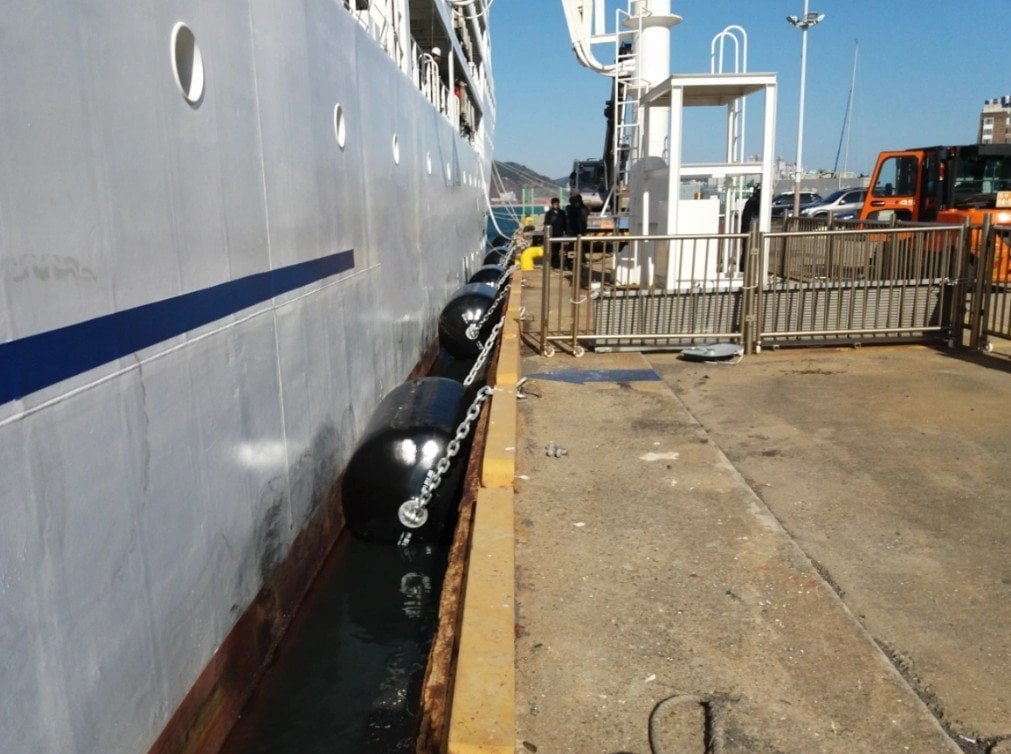
Emergency lightering is the use case where foam fenders eliminate failure modes pneumatic units cannot dismiss. A casualty response, a salvage operation, or a port congestion event does not let you stage pressure checks, position an air compressor, or fly in a certified inflate crew.
Salvage and casualty operations
In a casualty lightering scenario, the support vessel arrives on scene with whatever equipment was already aboard. A deflated pneumatic fender is a hazard, not an asset.
A foam-filled fender deploys from its sea-fastening, lowers over the side, and absorbs the first contact within minutes. We have shipped foam units to salvage operators staging response packages along West Africa and the Gulf coast for exactly this readiness profile.
Port congestion lightering and seasonal STS
Port congestion lightering and typhoon-season standby fall in a similar category. The fender package may sit on a wharf or aboard a tug for nine months before a single transfer happens.
Pressure-loss risk on a stored pneumatic unit is real. A foam fender stored for the same period needs only a visual skin check on deployment.
In our 2024-2025 delivery records, foam-filled fender shipments for seasonal standby roughly doubled compared with two years earlier. Most of those units went to operators with no permanent maintenance team on site.
Long-Term Oil and Gas STS: Where Foam Can Be the Better Asset
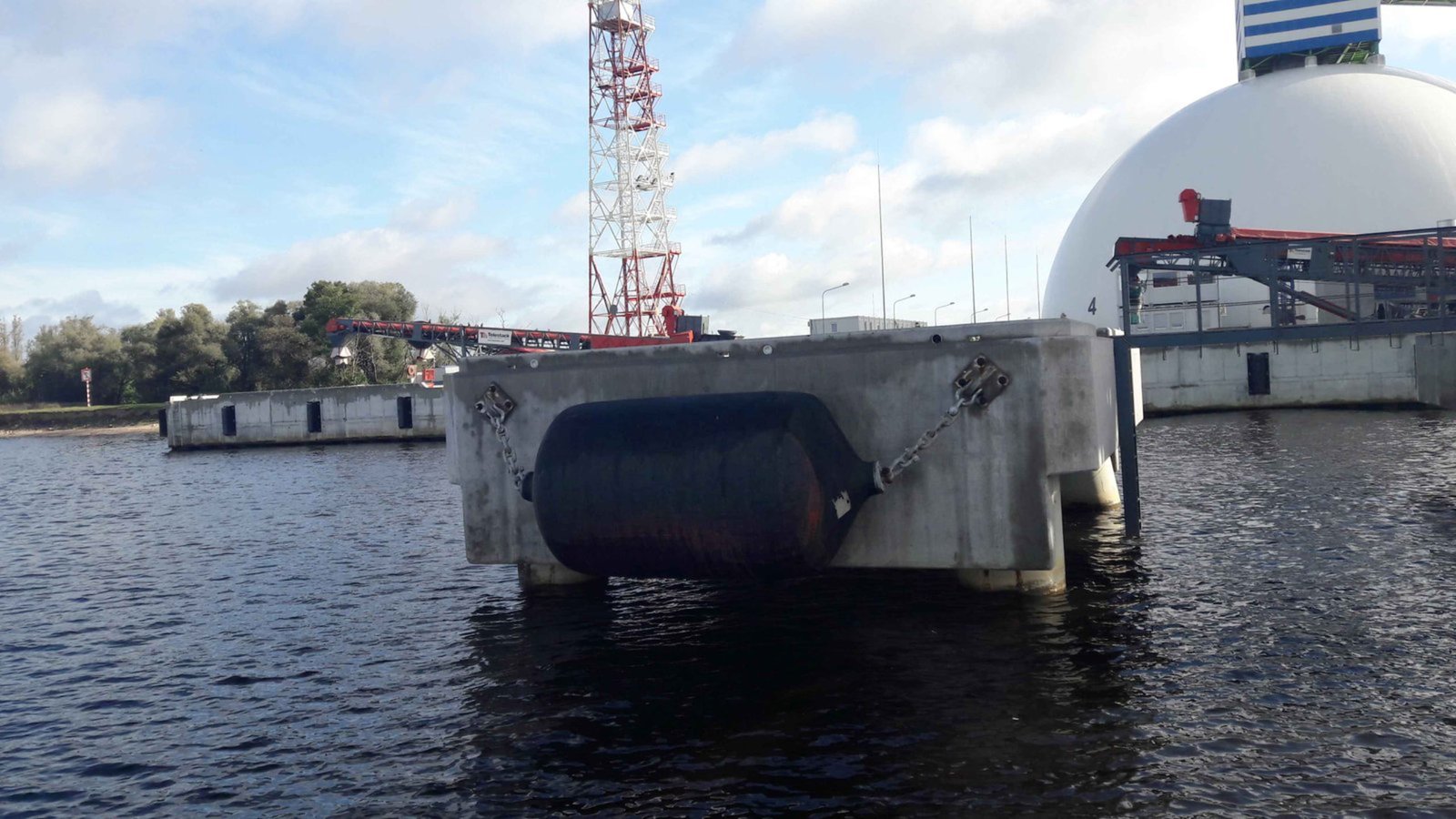
For oil and gas infrastructure planned for 15 years or more, foam-filled fenders deserve a serious review. The industry still defaults to pneumatic, but that default is often driven by convention and consultant templates, not by full lifecycle cost.
Why consultants still default to pneumatic
The OCIMF Ship-to-Ship Transfer Guide names pneumatic fenders as the default for tanker and LNG operations. Charterers and marine assurance teams know that format. Consultants also prefer a document route already defined by ISO 17357.
This is why many owner teams never see foam as a serious option. They receive the standard pneumatic recommendation before the 15-year maintenance profile is discussed.
Why foam improves the long-term cost profile
Foam units do not need pressure checks, valves, air compressors, or tyre-net replacement cycles. The polyurea surface is strong enough that many long-term deployments can avoid a full tyre sleeve.
Initial cost is higher. Freight is also higher because the fender cannot be deflated and large sizes may need flat rack or platform container transport. For a 15-25 year service window, the lower maintenance load can still make the foam-filled fender the lower total-cost asset.
Honest Boundaries: When Foam Is the Wrong Choice for STS
Most online content avoids this list. We publish it because procurement teams ask the question privately anyway. Our buyers tell us they prefer suppliers who flag the limits up front.
Foam-filled fenders are not the right answer for:
- LNG STS operations where the consultant fixes ISO 17357 pneumatic in the tender. Foam may still be a better lifecycle asset, but the proposal will face document objections from the charterer and marine assurance team.
- VLCC lightering above the tonnage where Net Energy Absorption demand exceeds the highest standard foam unit ratings. Pneumatic delivers higher kNm per cubic meter of fender volume at the top end.
- Operations where independent third-party verification of pressure or deflection at each transfer is contractually required. There is no equivalent test cycle for foam.
- Surveyor-required hydrostatic testing regimes that match the pneumatic certification path. BV, DNV, and other class surveyors have a defined cycle for pneumatic. Foam acceptance follows a different document trail.
- Deepwater offshore terminals with very long deployment chains, where pneumatic’s lower in-water weight reduces line tension and rigging fatigue.
I have seen oil and gas owners ask whether there is a better long-term option than pneumatic. Usually there is. Foam gives a more stable maintenance profile. The blocker is that the consultant, tender document, or charterer checklist often stays with the familiar ISO and OCIMF pneumatic route.
Buyers also worry that pneumatic fenders need regular pressure checks, inflation readiness, and valve condition checks. That worry is valid. Even a well-made pneumatic fender still has outer net, tyre, chain, and valve items that may need work every two to three years.
For full standards detail, see the OCIMF STS fender requirements page.
How to Specify Either Choice on a Purchase Order
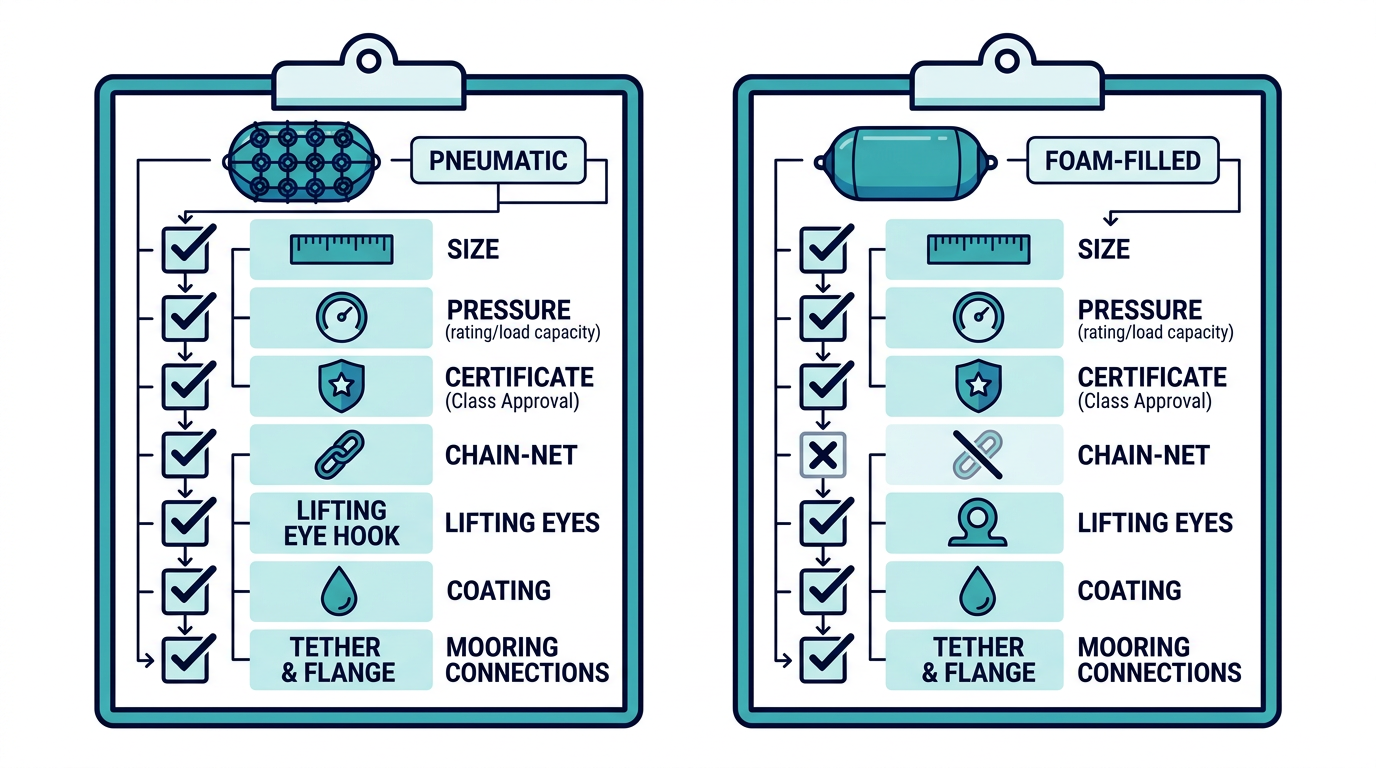
A clean PO removes 80% of post-order disputes. The two checklists below cover the line items we ask buyers to confirm before contract signature.
Specifying a pneumatic STS fender
- Size: nominal diameter × length in mm (for example 3300 × 6500)
- IIP grade: 50 kPa or 80 kPa
- Net Energy Absorption: kNm at 60% deflection, signed off against operation sizing
- Chain-tyre-net spec: chain grade, tyre type, net coverage area
- OCIMF certificate of conformance
- Hydrostatic test report from BV, DNV, or equivalent
- Air valve type and inflation pressure setpoint
See our pneumatic fender overview for size and IIP options.
Specifying a foam-filled STS fender
- Size: diameter × length in mm
- Foam density and Net Energy Absorption: kNm at 60% deflection
- Skin spec: polyurea preferred for STS service; reinforced polyurethane acceptable for lower-utilisation duty
- Chain-net spec: chain grade, net coverage, attachment hardware
- Lifting eye configuration and SWL
- ISO 17357 reference where applicable to the buyer’s documentation route
- Optional: third-party witness inspection at FAT
FAQ
Can foam fenders be used for ship-to-ship transfer?
Yes. Foam-filled fenders are used in STS, particularly for emergency lightering, casualty response, smaller-tonnage anchorage transfers, and operations where pressure-monitoring crews are not available. For permanent STS service zones with high utilisation, pneumatic fenders remain the industry default.
Are foam fenders OCIMF approved for STS?
The OCIMF Ship-to-Ship Transfer Guide recognises both types. Pneumatic fenders dominate the published guidance for tanker and LNG STS. Foam-filled units are accepted for specific cases. See our comprehensive standards comparison for the full framework.
Which fender type costs less over 5 years?
Foam-filled fenders usually have lower OPEX because there are no pressure checks, valves, air compressors, or tyre-net replacement cycles. Initial cost and freight are higher. For owner-operated oil and gas infrastructure over 15 years, foam can be the lower total-cost option.
What happens if a pneumatic fender deflates during STS?
Loss of pressure causes loss of energy-absorption capacity and a real risk of hull contact. This is why monthly pressure checks and on-site air supply are non-negotiable for pneumatic STS operations. Foam-filled fenders eliminate this failure mode by design.
How long does a foam-filled fender last in STS service?
Typical service life is 15-25 years. The range depends on skin spec, chain-net protection, and operation severity. Polyurea coatings outperform standard polyurethane in abrasive STS service. A recoat at 8-12 years is common for high-utilisation units.
Can I mix foam and pneumatic in one STS operation?
Yes. Hybrid arrangements are common, with pneumatic units in the primary contact zone and foam units as back-up or at the bow and stern positions. See the pneumatic vs foam standards comparison for sizing and arrangement guidance.
What size fender do I need for an Aframax STS?
Sizing depends on approach velocity, displacement, and freeboard differential. A 3.3 × 6.5 m unit is a common Aframax-class reference. Final sizing requires the full operation profile. Send vessel specs and operation parameters for a calculated recommendation.
Closing
The decision tree, the matrix, and the cost tables together resolve most STS fender selection questions in one pass. If your case sits on the boundary between profiles, send the operation profile (vessel type, tonnage, frequency, location, crew structure) and we will size an STS fender package against it.
For fixed berth selection, also see our foam filled fender vs rubber fender comparison.